
“Tsunami” is an electoral metaphor with Japanese origins ultimately written on the ancient bones of oxen and turtles.
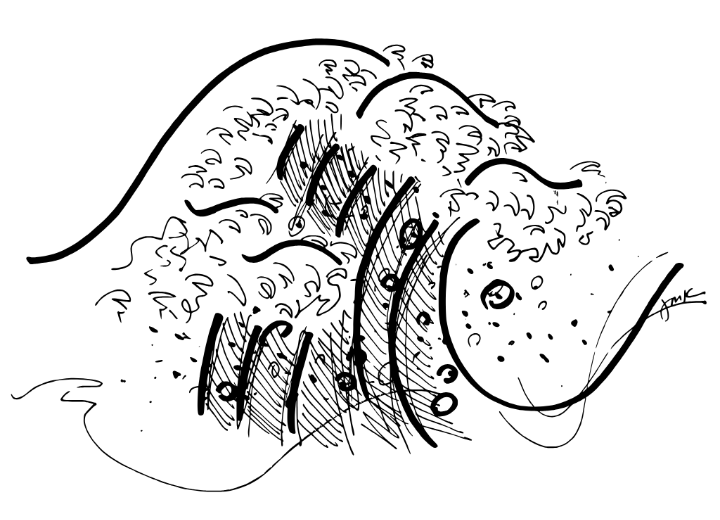
In US politics, a wave election happens when one political party makes sweeping gains over the other. The 2026 midterms this past Tuesday witnessed a swell for Democrats so immense and historic that the metaphorical wave was just not big enough.
It was a blue tsunami, as many in the media so measured the outcomes.
We the people felt a need for change in our very bones. And this public school teacher—whose paycheck gets maxed out by the cost of rent, groceries, energy bills, and gas—felt that need all the way back in his ancient Chinese oracle bones, where we can trace some of the deeper etymology of tsunami.
Never miss a mash! Feed your inner word nerd and subscribe to get Mashed Radish fresh in your inbox.
Tsunami etymology
The word tsunami crashes into English as early as 1896. The Oxford English Dictionary cites it in July that year in the Marion Pilot, an erstwhile newspaper out of Iowa: “The dreaded tsunami (sea wave) was not altogether new to some of those who were so soon to become its victims.”
A month earlier, in June 1896, a massive earthquake struck off the northeast coast of Japan, triggering two tsunamis that indeed claimed many victims—an estimated 22,000, in fact. The waves are said to have climbed to 125 feet, as tall as a 12-story building.

Japan knows tsunamis all too well. Even the word is Japanese.
In Japanese kanji, tsunami is written as 津波. The first character, 津, tsu, means “inlet, harbor.” The second character, 波, nami, means “wave.”
Both of the Japanese words, tsu and nami, derive from Old Japanese terms for the same. The Chinese 波, meanwhile, represents one of its native words for wave, bō.
As we saw, the Marion Pilot glossed tsunami as “sea wave”—of which the tsunami is a long, high, and most catastrophic specimen. Etymologically, we can gloss tsunami as “harbor wave,” as the phenomenon proves especially destructive to sea ports.
In Japanese, the initial ts in tsunami is pronounced like the final sound of, say, cats. If dictionary pronunciation guides are any measure, English also originally pronounced it this way when it borrowed the word. However, I’d say those guides need updating, as I only ever hear tsunami realized in English as sunami, that tiny ignition of a t extinguished.
Figurative extensions of tsunami—from “tidal wave” to “overwhelming occurrence”— stretch back in English to at least the 1970s. Electoral “waves,” meanwhile, have precedent in 1960, with the metaphor rising in 1994 and properly spreading after 2004, as word scholar Ben Zimmer has written.
One of the greatest depictions of a wave is The Great Wave off Kanagawa, the famed 1831 woodblock print by the Japanese artist Katsushika Hokusai. Its Japanese title is 神奈川沖浪裏.

The first three characters of that title, 神奈川, mean “Kanagawa.” The last character, 裏, means “back, behind, other side.” The middle characters, 沖浪, have a sense of “deep, offshore wave,” with 浪 an older variant of nami, drawn from another Chinese character for “wave,” 浪, làng.
Hosukai’s wave isn’t necessarily meant to be a tsunami, it’s worth noting.
Hokusai’s wave towers in our imagination, a stature all the more impressive since the artwork only sizes up to about 10 x 14 inches. It was still the center of attention at the excellent Hokusai exhibition I was able to visit in Boston in 2023.

The bones of 水 (shuǐ)
Kanji is a Japanese writing system that uses characters adapted from Chinese, which seismically shaped Japanese writing and vocabulary.
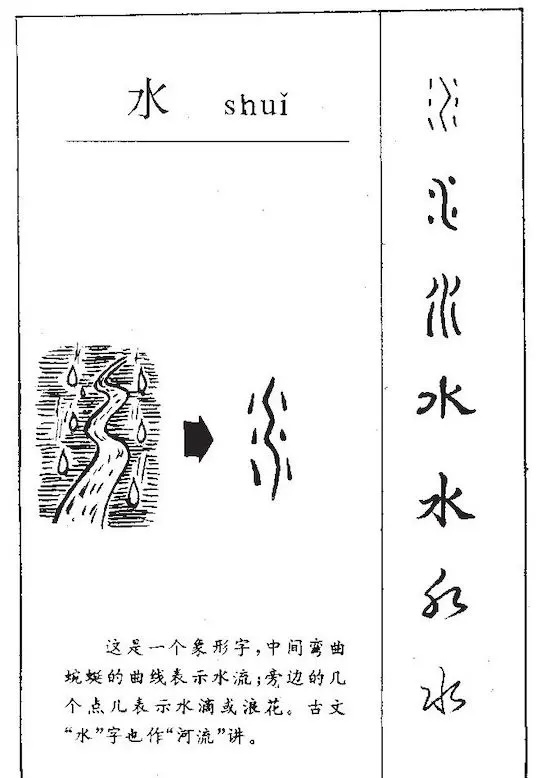
In the kanji for tsunami, 津波, note the splashy strokes forming the left side of each character: 氵. That element is a form of 水, shuǐ, the Chinese word for water. (Japanese pronounces its 水, however, like mizu, its native word for water.)
水 is also a radical, or basic component used to compose many other characters. We encountered it earlier this year in my post on hantavirus, whose hanta– is based on the name of a river in Korea, Hantangang (한탄강). Chinese also greatly influenced Korean, which has a kanji equivalent known as Hanja. The Hanja for Hantangang is 漢灘江, each character of which features 氵.
I mentioned in my hantavirus post that the origins of Chinese characters are found in carvings in bones used for divination. These bones are known as oracle bones. Into the shoulder bones of oxen and the under-shells of turtles, which were frequently used, were carved pictograms. Diviners would then heat the bones, interpreting how the ensuing cracks interacted with the original message. Pictures evolved into symbols, which evolved into words and characters. Chinese bronze seals were an important, standardizing part of this process.
The ancient pictograph for 水 depicted a flowing river, droplets of water splashing from its banks.

Over time, the depiction was stylized into 水. These oracle bones inscriptions are jawbone-dropping artifacts of visual etymology.
Haven’t had enough etymological election coverage?
In wave elections, the losing party is commonly said to have gotten a drubbing and shellacking, the former of which comes from Arabic and the latter Sanskrit, as you can find out in my archives.
For matters close to home, US politics can certainly rely on from terms that come from afar.


Leave a Reply