
Into the term “jack-o’-lantern” is carved will-o’-the-wisps, every man Jack, and American pumpkin pranksters.
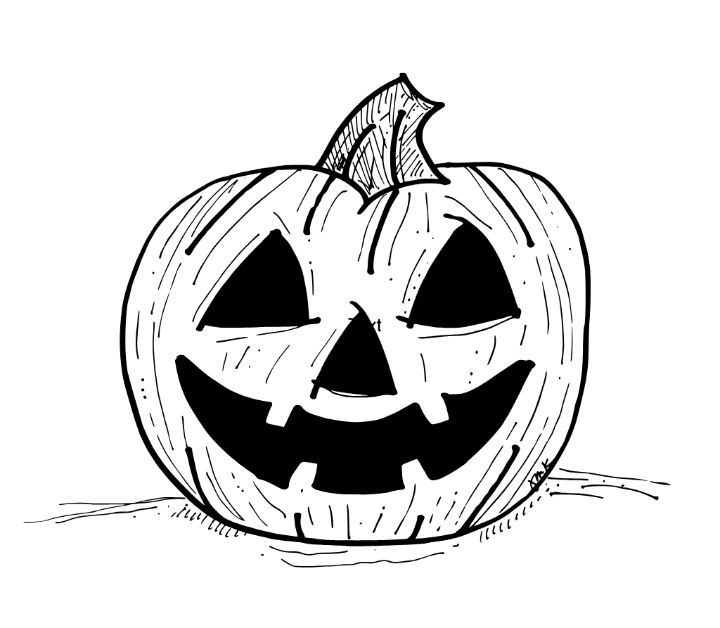
Jack-o’-lantern etymology
It has earned many names, the spectral sight. Those soft lights floating over marshland at night.
Will-o’-the-wisp. Ignis fatuus. Jack-o’-lantern.
No, the earliest sense of jack-o’-lantern was not the harrowingly hollowed, creepily carved pumpkin we set alight on porch stoops for Halloween. It was the phantasmic phenomenon of phosphorescence in benighted bogs and swamps—enkindled by methane bubbles, not spirits, as it happens.
Jack-o’-lantern named another spooky, sparky display as well: St. Elmo’s fire, that electrical discharge haunting ships in sea and, later, sky. And it’s as a translation of St. Elmo’s fire, which has also been called St. Herme’s fire, that the Oxford English Dictionary (OED) first records jack-o’-lantern.
The form is Jack in a lanthorn. The date is 1658. The translation is of a 17th-century French libertine, Cyrano de Bergerac.
Another early variant was Jack with a lanthorn. Lanthorn? Animal horns were once flattened into transparent windows for lanterns, which apparently influenced the spelling of lanthorn. Lantern itself comes from the Greek lamptḗr, “torch, lantern,” related to lamp.
Never miss a mash! Feed your inner word nerd and subscribe to get Mashed Radish fresh in your inbox.
Jack of all trades
But who is this Jack, and why is he in or with or of—as the o’ is so contracted—a lantern?
Jack has long been a nickname for John. For it, we ultimately owe the Dutch Janke, equivalent to John-kin—and also the source of Yankee! (Your John here, though, is a Johnny, not a Jack, to his familiars. I did have a friend in grad school who called me Jackie, though.)
The diminutive suffix –kin, a variant of the Dutch –ke, likely influenced the sound and shape of the word pumpkin, which ultimately derives from the Greek for “melon.” Fun facts: pumpkins are technically fruits and botanically a kind of berry. Same goes for melons!
John, and thereby Jack, was an enormously popular given name back in the day, so popular that it came to stand in for any ol’ regular workin’ guy. As a common worker, a jack-of-all-trades if you will, jack was applied to various tools and devices, from jackhammers to headphone jacks.
Generalization wasn’t exclusive to Jack, however. Ever heard of Tom, Dick, and Harry? And the very will in will-o’-the-wisp comes from Will, a pet name of William. The wisp he carries originally meant “bundle of hay or straw,” which could be lit for a torch.
We now know the long-mysterious will-o’-the-wisp is caused by microlightning, but folklore the world over has attributed it to sundry ghosts, sprites, and creatures of the night.

English tradition personified paludal luminescence as some fellow—some witching-hour Jack—who was swinging a lantern in the fens. Just like will-o’-the-wisp is some bloke, some Will, with a torch.
Speaking of swinging lanterns, jack-o’-lantern was also briefly a term for just that: a man with a lantern or a night watchman. The OED logs this use in 1663, effectively contemporaneous with the term’s 1658 record, though its light seems to be extinguished in the early 1700s.
From marshes to porches
It’s not until 1837 that the OED finds jack-o’-lantern for a pumpkin lantern—and finds it in American letters. Credit goes, fittingly enough, to Nathaniel Hawthorne, he of Scarlet Letter and other dark Romantic novels exploring themes of evil, moral corruption, and psychic turmoil.
The 1837 citation comes from Hawthorne’s “The Great Carbuncle,” a story in his collection, Twice-Told Tales. The titular Great Carbuncle is not a boil but a brilliant gem that has eluded its obsessive seekers:
Hide it [the Great Carbuncle] under thy cloak, say’st thou? Why, it will gleam through the holes, and make thee look like a jack-o’lantern!
The reasons why jack-o’-lantern jumping-jacked from ignis fatuus (that’s Latin for “foolish fire,” by the way) to illuminated squash with faces is a bit dim.
The custom of pumpkin-carving started with turnips in ancient Celtic rituals, later picked up by Christians on the feast of All Hallow’s Eve—Halloween.
An Irish folktale tells of Stingy Jack, a trickster who beguiled the devil but, after his death, had to wander the earth with only a turnip lantern to guide his path.
History notes that other tricksters, young boys playing pranks in 1800s North America, lit pumpkin lanterns to spook wayfarers, apparently to create similar effects as the will-o’-the-wisp jack-o’-lanterns—and thus the name may have been extended.
Afraid of the dark?
I think it’s hard for us to imagine just how dark it used to be—and therefore just how scary a jack-o’-lantern, in swamp or stoop form, would have been in a blackness unpolluted by the foolish fire of our constant electricity.
The loss of this fear of the dark has, perhaps, led to a loss of imagination. One that no longer encounters a wispy jack-o’-lantern outside of literature like Hawthorne’s. One that squints at the primitive explanation of some lantern-lugging man lurking in a lonely marsh. One that only registers the seasonal semiotics of a glowing gourd—not the macabre magic of the thing itself.
And perhaps one that struggles to accept the jump a word like jack-o’-lantern can easily take.
Happy Halloween! Enjoy some dark—including of the chocolate, candy-sized variety, I hope.

Leave a Reply