
Greek butts, Welsh heads, Spanish nicknames, Scandinavian screeches, Latin plumpness, French explorers, and Portuguese epithets

Tilcayo? Meet the southeastern gentoo.
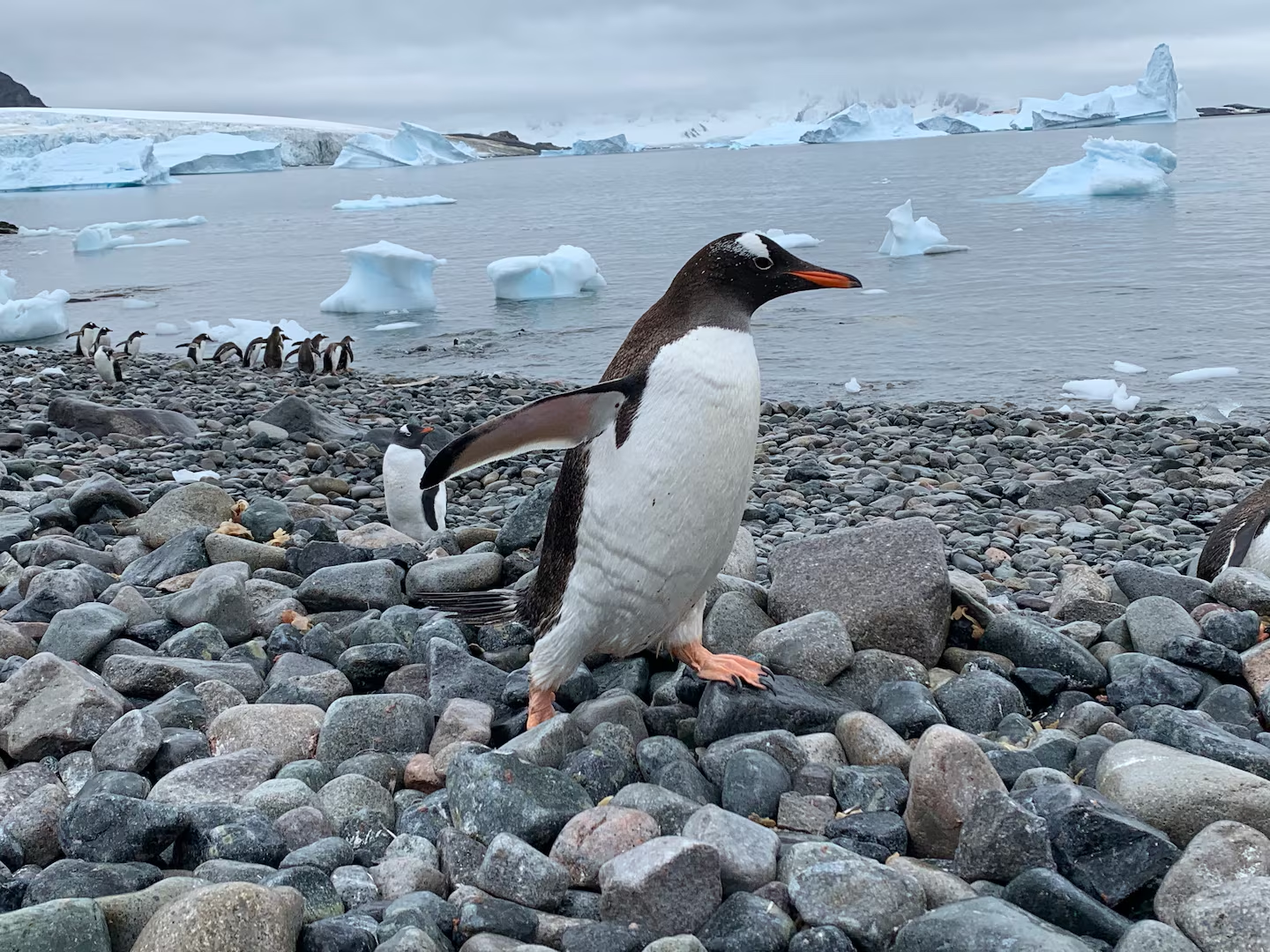
On the heels of the tilcayo, the first new species of cat identified in over 100 years, we also have the southeastern gentoo, the first new species of penguin named in over a century.
Its home is a remote one: the Kerguelen Islands, which are so far out in the Indian Ocean they are also known as the Desolation Islands.
Credit for the discovery of the archipelago goes to the French naval officer Yves-Joseph de Kerguélen-Trémarec in 1772.
His name lives on not only in the Kerguelen Islands, but by extension in the scientific moniker of the southeastern gentoo as well: Pygoscelis kerguelensis.
Pygoscelis meaning
Pygoscelis, the gentoo genus, literally means “rump-legged.” Penguin feet are sort of just stuck onto their butts, aren’t they?
Pygo– is based on the Greek pugḗ (πυγή), “tail, rump.” In zoology, pygo– can be used as a combining form so referring to the behind.
More playfully, pygalgia means “pain in the butt” and pygophilia, posterior attraction.
Scelis is based on the Greek skélos (σκέλος), meaning “leg.” You might recognize skélos in isosceles, Greek for “equal legs.”
Never miss a mash! Feed your inner word nerd and subscribe to get Mashed Radish fresh in your inbox.
Gentoo etymology
The name gentoo has a more complicated history.
Now thought to comprise four distinct species, including the new southeastern sibling, gentoo penguins have been so dubbed since at least 1820, according to the Oxford English Dictionary (OED).
Why gentoo?
For obscure reasons, it may be an application of Gentoo, a historical and now outdated term for a Hindu person in India in contrast to Muslims.
Gentoo is a corruption of the Portuguese gentio, “gentile” or “heathen.” The deeper root is the Latin gēns, “race, tribe, clan.”
Why Portuguese?
In 1498, the Portuguese navigator Vasco de Gama reached southwestern India, and Portugal held territories there all the way until 1961.
The OED first finds Gentoo in 1638. Hobson-Jobson—the influential, idiosyncratic, and problematic Anglo-Indian dictionary compiled in the late 1800s—finds it in 1548.
As recorded since 1832, the gentoo penguin has also answered to Johnny. The Spanish counterpart to Johnny is Juanito, which may have influenced gentoo.
This explanation seems a bit flightless, if you ask me.
Penguin etymology
As for penguin itself, the word waddles all the way back to the 1570s, when it first named the great auk of Newfoundland.
Notoriously hunted to extinction, the great auk did resemble penguins, but they aren’t related. Auk is probably a Scandinavian imitation of a bird cry.

A decade later, in the 1580s, penguin was applied to proper spheniscids in the Southern Hemisphere.
(Taxonomically, penguins are called spheniscids, based on the Greek for “small wedge” and alluding to the shape of their wings.)
While the ultimate origin is up for debate, penguin may well come from the Welsh for “white head,” with pen meaning “head” and gwyn meaning “white, fair, blessed.”
Indeed, some penguins do have prominent white plumage on their noggins.
The Welsh Pen and gwyn
You might recognize the Welsh pen, “head,” in pendragon, a title for ancient British or Welsh rulers. Here, pen means “chief” and dragon, “warrior.”
Pendragon famously titled Uther Pendragon, legendary father of King Arthur.
Speaking of Arthurian legend, gwyn, “white, blessed” may have given name to Guinevere, the wife of King Arthur, via Welsh Gwenhwyfar, taken literally to mean “fair spirit.”
A form of the Welsh Gwenhwyfar in a related Celtic language, Cornish, yields Jennifer.
Gwyn does form the name Gwendolen and its other spellings. Ultimately related to the English dale, the Welsh dolen means “ring, hair,” rendering Gwendolen “white-haired.”
Gwyneth, as of the Paltrow variety, is based on Gwynedd, a historical kingdom of Wales—and which may or may not have anything to do with the same gwyn, “white, fair, blessed, holy.”
And, of course, there’s the name Gwen on her own, “fair” terms.
***
Now, another explanation for penguin roots it in the Latin pinguis, “fat, dense, oily,” a distant cousin of English’s own fat and source of the plump, little adjective pinguid.
We may never know the ultimate origins behind gentoo and penguin, but at least we now know we can talk about—and with etymological relevance—the pinguid pygo of the gentile gentoo penguin, Johnny.
A flock of other bird-related word origins circles the archival skies of Mashed Radish in blue jay, chicken, eagle, falcon, hawk, and turkey.


Leave a Reply