
There is a lot of interesting etymology afoot thanks to sports in summer 2026. Plus, the word “kick” is younger than you think.
Am I so round with you as you with me,
That like a football you do spurn me thus?
So cries the servant Dromio of Ephesus to his mistress, Adriana, as she whacks him for bearing bad news in Shakespeare’s Comedy of Errors. In beating him, Adriana is using her hands, of course. But Dromio’s spurning? That involves the feet.
To build his pun, Shakespeare employs an older sense of spurn, meaning “to kick”—which is, as we’ll see, related to spur.
And it’s a sporting pun that makes for a perfect peg, with sports in high season:
The World Cup kicked off yesterday in Mexico City with the home team beating South Africa 2–0. Meanwhile in Game 4 of the NBA Finals, the San Antonio Spurs ceded a first-half knockout to a historic comeback by the New York Knicks. (Some might even cast both games as their own comedies of errors, with three red cards marring the MEX-RSA match and the Spurs collapsing after a 29-point lead.)
I hope you don’t feel left out, Vegas Golden Knights and Carolina Hurricanes. I’ll see if I can’t just find a way to tie in hockey’s Stanley Cup with this post. Etymology almost always has a few tricks up its sleeves—or shall I say, a few pricks on its spurs?
If you’re cheering “Go Knicks!” you’re ultimately cheering “Go satirical Dutch guy!” The name of the Knicks has a long and fascinating history. And brush up on your football in this explainer on the very British origins of the name soccer.
Spur etymology
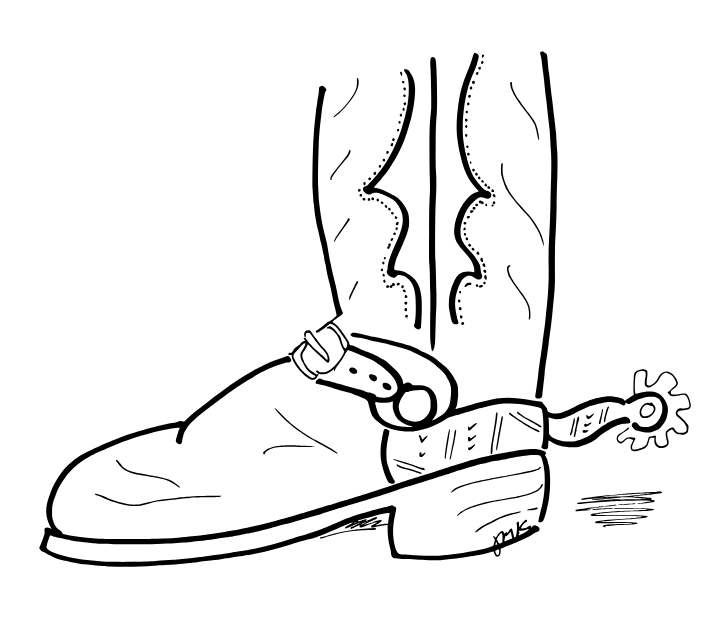
A spur, of course, is a device with a small, often wheeled spike worn on a rider’s heel to urge a horse on. That little wheel, by the way, is known as a rowel, from a diminutive of the Latin rota, “wheel.”

It’s that very device, thanks to Texas’s culture of cowboys and the tradition of Mexican vaqueros before them, that gives name to the San Antonio Spurs. It even stands in as the U of the team’s logo.

The Spurs were formed as such in 1973 from the former Dallas Chaparrals, referring to thickets of dense, tangled, and thorny shrubs and bushes that carpet the Southwest. (Chaparral, originally the “dwarf evergreen oak,” is from Spanish, in turn from the Basque txaparro.) Apparently the Spurs were briefly dubbed the Gunslingers, but management never pulled the trigger on that moniker.
The word spur is formed from the Old English spora or spura. The Oxford English Dictionary first records it glossing the Latin calcar (“spur, stimulus”) in the Corpus Glossary, a Latin-English dictionary dated to the 700s.
The metaphorical spur, “an incitement,” is evidenced by at least the mid-1500s, although it was already being used in that sense verbally in the early 1200s. It’s also in the 1500s we see record of the other applications of spur for various “sharp projections,” whether of bones, rocks, or cocks. In the chicken sense, I mean. (Can’t resist a rhyme.)
Spurn etymology
Closely related to spur is spurn. We might call them kicking cousins. Spurn comes from the Old English spurnan or spornan, which early on already meant both “to kick” and “to disdain.” (In treating something with contempt, it’s like you are kicking it. The “kick” sense of spurn has since hung up its spurs.)
Spur and spurn have their cousins across the Germanic languages, thought to be pricked on by the Proto-Indo-European *sperǝ-, “ankle,” itself possibly from a more essential root for “kick.”
On the spoor of spoor
One such cousin is spoor, “a track, trail, or scent of an animal or person being pursued,” borrowed in the 1800s from Afrikaans, the Dutch-derived language of South Africa. The Afrikaans spoor is from the Middle Dutch spoor or spor. Related to it is the English speer, “to inquire or ask,” a chiefly Scottish—and now dated—term.
Never miss a mash! Feed your inner word nerd and subscribe to get Mashed Radish fresh in your inbox.
Winning one’s spurs
I promised you a Stanley Cup tie-in, so a Stanley Cup tie-in you get:
The Vegas Golden Knights surely hope to win their spurns. Dating back to at least Middle English, the expression originally meant “to earn knighthood by an act of valor,” later figuratively extended to the attainment of other forms of distinction. Gilt/gilded spurs were indeed once the distinction of medieval knights—and thus a symbol of chivalry. How fitting for Golden Knights.

Kick etymology
So, spurn once meant “to kick.” What about the word kick, which we will see so much of in the expansive 2026 World Cup?
Kick is one of those words—one of those simple, seemingly eternal and unalterable syllables—whose origin I don’t think I ever really looked up until now. Because I assumed it just always is and was in English.
Not so!
As far as we know now, kick isn’t recorded in English until the late 1300s in the (now rather unfortunately spelled) Middle English forms of kyke and kike. The word is spelled with a -ck by the 1500s.
The exact origin of kick is unknown. (This is less of a surprise to me.) It was once supposed kick came from a Celtic source, like the Welsh cicio, but the origin is the other way around. Now it’s supposed that kick may be connected to the Old Norse kikna, “to sink at the knees, bend backwards.”
Like me, you must be wondering if kink adds a twist to the origin story. Perhaps. Kink, originally for a “twist or curl” in something like rope, isn’t recorded until the 1620s, either from Dutch or German. I suspect kink and kick are at some level related—and ultimately imitative in origin.
Kicking against the spur
Now, the earliest attested instance of kick comes in 1380 in a work by the prominent English theologian John Wycliffe—and in the context of a figure of speech concerning, of all things, spurs.
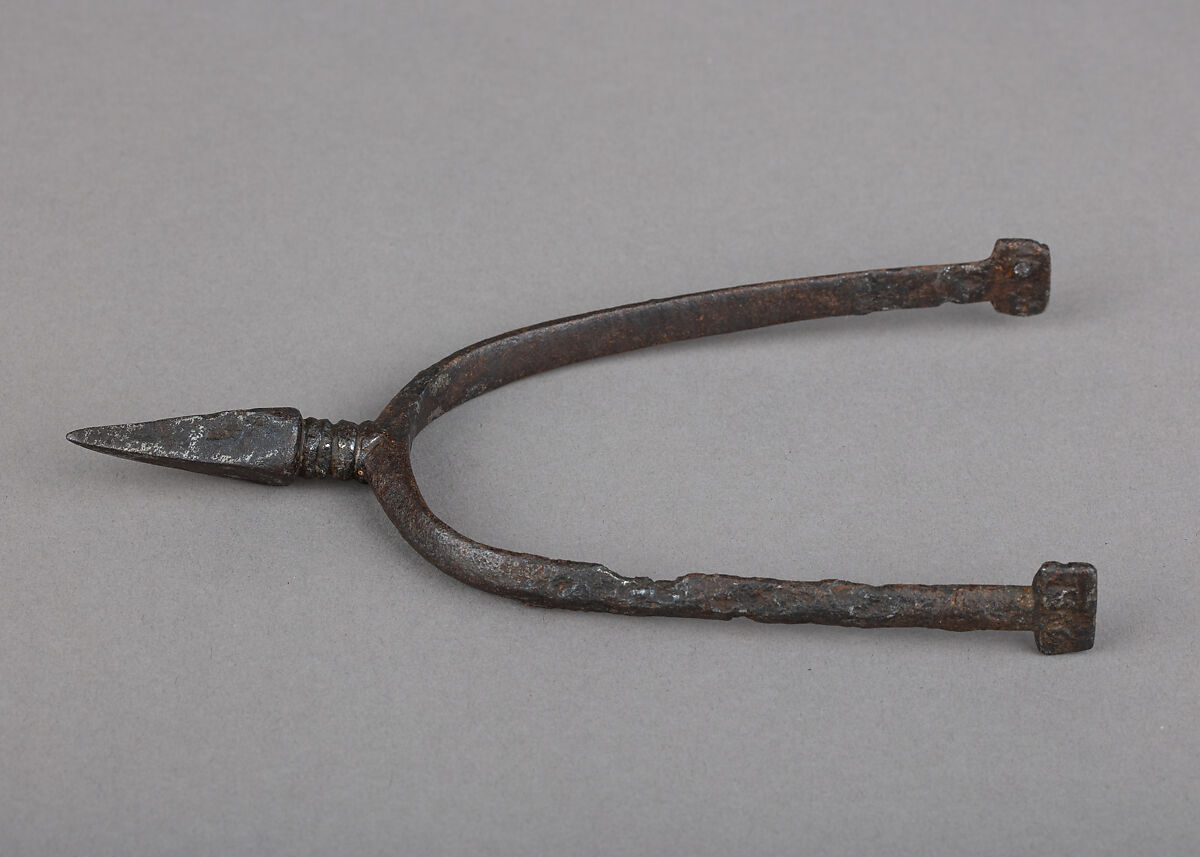
Wycliffe wrote: “It is hard to kyke aȝen þe spore.” Or, “It is hard to kick against the spore.” Another, more familiar form of the phrase is to kick against the pricks. The expressions literally refer to an animal kicking back against being goaded—that is, to defy one’s own hurt. Today, the phrase denotes contesting authority or fate.
And the Knicks, to be sure, kicked against the pricks … I mean Spurs!

Leave a Reply