
When it comes to the etymology of the name “Knicks,” Washington Irving is the MVP. But the real MVP? The Dutch.
For the first time since 1999, the New York Knicks have made it to the NBA Finals. That feat compels me—and not for the first time—to wonder: Why are they called the New York Knicks?
Now, I’ve never been an avid follower of professional basketball, but the big names of the 1990s—Jordan, Barkley, Malone, Shaq, the Knicks’ own Patrick Ewing—were certainly on my youthful radar. And sports were certainly on my radio. Or rather my dad’s.
Growing up, I spent a lot of time in the car with my dad, who often turned the dial to sports. When I wasn’t sleeping or studying in the passenger seat, I’d often just be wondering, especially about words—about why things are called what they are. My dad, a Classics major turned lawyer, often had good answers.
It was in one of those car rides with my dad—in one of those moments of precious, pre-phone boredom—I asked him about the Knicks. I don’t remember when exactly, though I think it was a handful of years before 1999. I do remember my dad informed me that Knicks was short for Knickerbockers, which he cited as a kind of old-fashioned pants. I’m sure that struck me as odd, and I think it did him, too, as our father-and-son etymological talk ended there.
But there’s so much more to the story of the Knicks. I’ll take the ball from here, Dad.
Never miss a mash! Feed your inner word nerd and subscribe to get Mashed Radish fresh in your inbox.
New York Knicks name origin
In 1946, New York was awarded a professional basketball franchise. Ned Irish, then a manager of Madison Square Garden, founded a team. For its name, Irish solicited suggestions. Intimately—and alliteratively—associated with New York identity, Knickerbockers prevailed. It was clipped to Knicks soon after.
The Knicks still call the Garden home today.
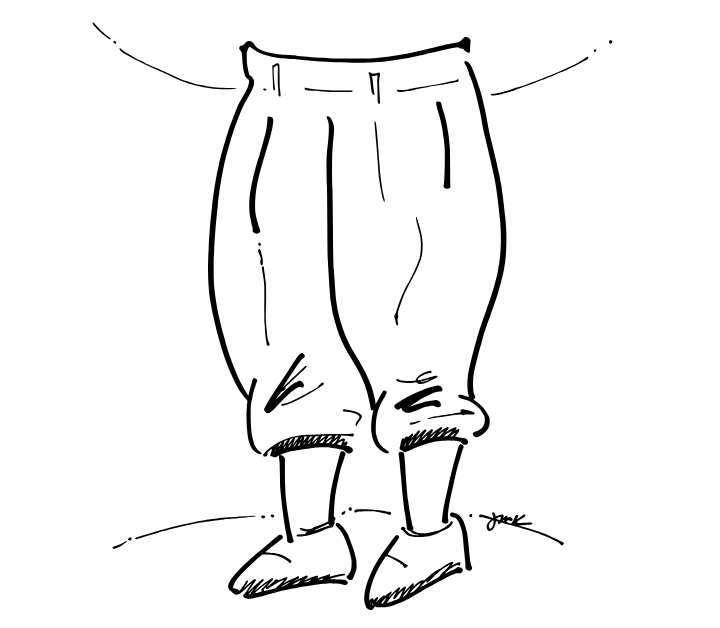
Now, Knickerbockers has long been a nickname for “New Yorkers.” It also doubles, often as hemmed to knickers, as a term for baggy, knee-length trousers or underwear.
But why should a word like Knickerbockers ❤️ NY? And what does it have to do with pants?
Knickerbockers etymology
Thank Irving. No, not Kyrie. Washington.
Washington Irving, the Manhattan-made man of letters behind such iconic—and iconically American—tales as “Rip Van Winkle” and “The Legend of Sleepy Hollow.”
For his 1809 burlesque, A History of New York, Irving created a full-on persona for its author: Diedrich Knickerbocker. Irving, who lived 1783–1859, fashioned his imaginary mijnheer as an old-timey Dutch historian; the book’s accompanying illustrations fashioned him in the bygone garbs of a tricorn hat and breeches.


Irving subtitled his satire, which mocked history writing in his day, From the Beginning of the World to the End of the Dutch Dynasty.
And Dutch is indeed the key to our Knickerbocker.
In the early 1600s, the Dutch established New Netherland, a colony that spanned the East Coast of the later United States. Its capital, New Amsterdam, occupied the southern tip of today’s Manhattan. While the Dutch ultimately ceded their territory to the English, they made their mark in New York, including through notable Dutch-descended families in the city and state.
The Knickerbocker family name
One such family was the Knickerbockers. Its patriarch was Harmen Janse. We know he settled in Albany, NY, but it’s not certain when, exactly, he lived (1640s–1710s) or what his actual surname was (records show Van Turkeyen, Van Bommel, Van Wye, Boertie, and variations on Knickerbocker).
History did settle on Knickerbocker, which his modern-day descendants have traced to a 1682 land deed referring to the man as Harmen Janse kenne ker backer, interpreting kenne ker backer as “known as the baker.” The Dutch for “baker” is bakker.
Another theory also takes up bakker, explaining Knickerbocker as combining the Dutch knikker, “toy marble,” and bakker, “baker.” That would make a Knickerbocker literally a “marble baker.”
(In Dutch, the initial K in knikker would be pronounced. As for the given name Diedrich, it’s one of many variants, including Derek and Theodoric, of an old Germanic name meaning “people ruler.”)
Harmen’s grandson, Herman Knickerbocker, was a member of Congress—and a friend of Washington Irving. For Irving, the Knickerbocker name apparently evoked a Dutchness fitting for his parodic project. So, he nicked Knickerbocker.
With the success of A History of New York, the Knickerbocker borrowing went from gentle jibing to beloved sobriquet. By the mid-1800s, Knickerbocker became a name for “a descendant of the original Dutch settlers of New York.” Mere decades later, it expanded as a general byname for “a New Yorker”—and, in the affectionate epithet of Father Knickerbocker, a symbol of New Yorkness.
As a 1933 New York Times article on Washington Irving describes him and his creation:
… the inventor of that Father Knickerbocker, who with his small-clothes, deep-pocketed, long-skirted coat and three-cornered hat, has become the pictorial embodiment of the city that was once Dutch New Amsterdam and is now metropolitan and cosmopolitan New York.
Knickers etymology
Now, once more to the breeches: Knickerbocker’s knickerbockers.
Breeches go to the knee. When a style of truncated trousers, looser and longer on the limbs, vaulted into vogue in the latter leg of the 1800s, they were thought to resemble the bottoms of Diedrich and his fellow Dutchmen depicted in A History of New York. Hence knickerbockers.
The Oxford English Dictionary records knickerbockers for loose-fitting, knee-length pants by 1859. By 1881, knickerbockers were snipped to knickers, a similarly styled underwear.
Try ’em on! Both pants and trousers are cut from some fascinating etymological cloths all their own.
As outerwear, freer-flowing knickerbockers favored the active and athletic, including baseball players. Well before the New York Knicks took the court, the Knickerbocker Base Ball Club of New York took the field in the mid-1800s. The sporting legacy of the name Knickerbockers no doubt added to the appeal to Ned Irish.
The Knicks’ launching logo featured old Father Knickerbocker himself, bedecked in knickerbockers and colored in blue, white, and a tell-tale Dutch orange—from the tricolor of New York City, whose hues hail from the flags of New Amsterdam and New Netherland.


Leave a Reply