
Can’t stand jargon? Blame it on the birds!

If you’re reading this at work, take five—to read five more Workplace Word Origins.
This batch finds our taproot-noggined salaryman morphed into a bird, hitchhiking, squashed under a giant foot, weary for a seat, and hitched to a covered wagon—all in the name of the workplace-related etymologies of jargon, milestone, sesquipedalian, benchmark, and team.
Yes, sesquipedalian!
Only have five? Go for jargon and benchmark.
Don’t want to wait for the roundups? Follow along on LinkedIn.
Don’t care? Here’s some newsy etymology on demolition as well as jewel, heist, and Louvre I posted last week on Bluesky.
Never miss a mash! Feed your inner word nerd and subscribe to get Mashed Radish fresh in your inbox.
Jargon

“Let’s circle back on the learnings about the synergies we parking-lotted in the standup because we have to jump off to double click on the value-adds in our deep dive.”
Sound like someone you know? Does the corporate jargon make you want to reach for the earplugs?
🔑 ‘Jargon’ comes from the French ‘jargon,’ which referred to the “twitter or chattering birds”—which, to our ears, is nonsense.
And so that French root also meant “gibberish,” which is the earliest recorded sense of ‘jargon’ in English dating back to the mid-1300s.
The further origin of ‘jargon’ is uncertain, but it is probably imitative—that is, the sound of the word imitates what it means. Think onomatopoeia. Tweet tweet. Chirp chirp.
The French ‘jargon’ could be connected to the Latin ‘garrīre,’ “to chatter, prattle, jabber”—all of which words are themselves imitative, as it happens. There’s something about words for balderdash…
⚡ By the mid-1600s, ‘jargon’ had evolved to its familiar sense today: a pejorative term for words and expressions used in a particular field that are hard for outsiders to understand.
Now, someone given to chattering is ‘garrulous,’ derived from that same Latin ‘garrīre.’
Someone given to jargon is, well, irritating to so many of us—especially corporate jargon. Why is that?
Corporate jargon can be efficient. It can be helpful. And we all use it. In context, jargon facilitates quick and specific communication and understanding.
For example, I think ‘synergy’—which dates all the way back to the early 1600s, by the way—is useful!
So why do we despise jargon so much?
For one thing, I think we humans have a short fuse for overuse—and given how much time we spend at work and talking about the process of work at that—we are exposed to a lot of repetitive buzzwords.
For another, jargon can variously come across as lazy, self-important, unoriginal, inauthentic—and worse, as BS.
And sometimes it is BS, when top-down corporate jargon is needlessly obfuscatory or deceptive. Like ‘smartsizing.’ Just tell us we’re getting canned already, OK?
You can keep the swag earplugs, by the way. We’ve got some birdsong to enjoy.
Of course, we all have jargon we hate. So, I challenge you to share some jargon you actually—or maybe reluctantly—like!
Milestone

If you’ve ever worked on a project—or tried to tell your colleagues you celebrated a major birthday without revealing your age—you’ve probably used the word ‘milestone.’
But have you ever stopped along your linguistic way and wondered, “Wait, why do we say ‘milestone’? Were there literal stones placed on roads to mark distances?”
OK, maybe that’s just nerdy me, but the answer is a resounding ‘yes’!
🔑 The word ‘milestone’ is a simple compound of ‘mile’ and ‘stone,’ originally signifying a stone or small pillar set beside a road indicating the distance in miles to a certain place.
It’s recorded in English in the 1660s, though there is evidence of the term in Old English in ostensible reference to a Roman milestone on a road in England. The Romans indeed widely used milestones in their famed road network. Milestones survive today, not just as relics of the past but also in their modern form of mile markers, particularly on highways.
‘Milestone’ was metaphorically extended to other significant markers, such as in one’s life or career. Evidence for this figurative use dates back to at least 1820.
⚡ The application of ‘milestone’ to work—specifically in the context of project management—dates back to at least 1958. Here, it’s first attested in a US Navy document in reference to PERT, or the program evaluation and review technique.
PERT was, well, a milestone in the rise of project management as a professionalized discipline. It is a statistical tool first developed to help manage a complex weapons engineering project led by the US Navy.
So far in this Workplace Words Origins series, we have seen several modern work terms rooted in military history. This is true of a lot of corporate jargon, by the way.
But the military—and military engineering at that—didn’t just impact how we talk at work. It also greatly impacted how we do the work itself, especially coming out of World War II.
Also around that same time in the late 1950s, a few other logical, “I-like-things-to-be-neat-and-have-a-plan” minds developed CPM, or the critical path method, another milestone in project management.
Of course, Henry Gantt was ahead of his time(line), developing his eponymous Gantt chart, a popular and effective way of visualizing structuring a project, in the early 1910s.
✨ Bonus: ‘Mile’ comes from the Latin ‘milia,’ meaning “thousands” and the plural of ‘mīlle.’ Advertisers and markers know ‘mīlle’ well from CPM, or cost per mille, the amount paid for one thousand impressions of an ad. Not one million impressions, though Latin’s ‘mīlle’ is also the source of ‘million.’
The mile began as a Roman unit measuring a distance of 1,000 paces, or ‘mīlle passūs.’ This was estimated to be about 1618 yards. Variant distances abounded as the former subjects of the Roman empire, and its roads, adapted its culture and technology. England standardized the mile into 1760 yards in 1592, source of the same legal mile in the US.
Sesquipedalian
My ONE SECRET TRICK to networking:
Use big words!
I recently attended a very informative forum on the topic of mergers and acquisitions. As one does. Afterwards, I continued networking, as one does.
“Where do you work? What do you there? What did you think of the talk?” That good stuff.
Me: Boldsquare. Communications. Business development. The talk was very insightful! You know, when I come to these events, I can’t help but listen out for terms of art, for specialized vocabulary, that I didn’t know before. Like here, the metaphorical use of ‘dry powder’ in the finance and private equity space. New to me. I feel private equity is becoming more prominent in the wider culture, so I can’t help but look out for how this term may spread, too. Just how my brain is wired, especially from my time heading up content at Dictionary.com.
“Ooh! I get their Word of the Day. You must have a favorite word then?”
Me: Many. Depends on the day. But I have always loved ‘sesquipedalian’.
“Sesqui–what now?”
Me: You asked!
🔑 ‘Sesquipedalian’ refers to a “long” or “many-syllabled” word. It ultimately comes from the Latin ‘sesqui-,’ meaning “one and a half times” and ‘pēs,’ meaning “foot.”
A ‘sesquipedalian’ word is literally a “foot and a half long”—and is itself sesquipedalian!
That irony is the point. In his missive poem ‘Ars Poetica,’ the odes-known Roman poet Horace urges rising versifiers to toss out ‘sesquipedalia verba,’ or “words that are a foot and half long.”
‘Ars Poetica,’ or “Poetic Arts,” is dated to around 19 BCE. ‘Sesquipedalian’ is first recorded in English in 1656 in direct reference to Horace.
The stem of the Latin word for foot, ‘pēs,’ is ‘ped-,’ and derivatives abound in English, from ‘impede’ to ‘pedal’ to ‘pedestrian.’
‘Sesqui-’ is known as a combining form and was more common historically in English in technical words, though it does occur in the somewhat more familiar ‘sesquicentennial,’ or “150th” anniversary.
I only went to explain *some* of this detail on ‘sesquipedalian’ to my patient, generous audience. It’s a fifty-cent word whose real value ended up being making far more meaningful and memorable connections than just sounding like your resume. Or leaning on buzzwords. Or talking like ChatGPT.
The digital landscape—and overreliance on AI—flattens us. Bring yourself to what you do. Your humanity, your personality, your unique set of lived experiences, down to your specific quirks, differentiate you in an increasingly same-y environment.
Be curious and you will invite curiosity. (And let’s leave room for cool words in the workplace!)
Now, ‘sesquipedalian’ definitely doesn’t make sense in most emails …
… but you never know, Horace!
Benchmark

A ‘milestone’ began as a stone placed on roads to measure miles. Keeping with project management lingo, what about the ‘bench’ in ‘benchmark’?
Our relationships with words color our understanding of them—and that’s definitely true for me with ‘benchmark.’
I’ve always associated ‘benchmark’ with a store of the same name in Cincinnati, a local shop specializing in outdoor apparel and gear and where my family would go to get hiking boots and the like.

Their logo, in a sunny yellow, features a stylized backpacker.
At some point in my youth, I came across the actual word ‘benchmark’ the business based its name on—and had it in my mind that the word’s constituent ‘bench’ must refer to a wooden seat giving rest to hikers at key stops along their trail.
Well, that doesn’t explain the ‘bench’ in ‘benchmark,’ but it was a nice idea (and one my mind won’t ever fully be able to abandon).
🔑 ‘Benchmark’ originally referred to a mark cut into a wall, post, or building and used by a surveyor as a fixed point for measuring elevations.
Surveyors once commonly made benchmarks by cutting a horizontal groove into the surface. Then they’d insert a bracket known as an angle iron into it.
The upper surface of the angle iron was used as a bench—a ledge, a rest—that supported a tool known as a leveling staff to take subsequent measurements consistently.
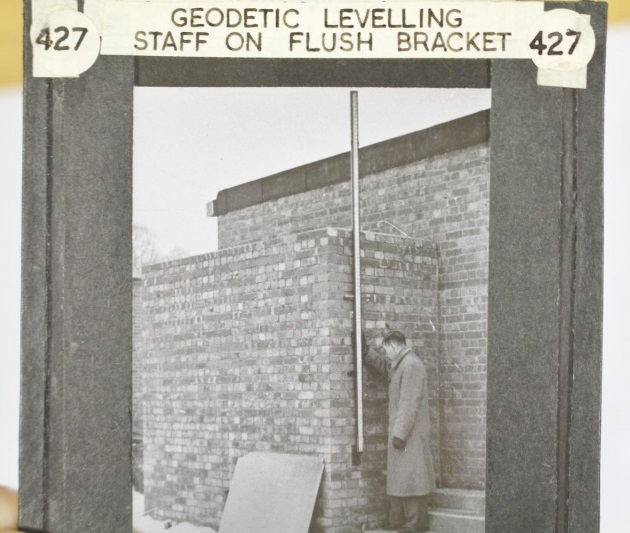
The Oxford English Dictionary first cites ‘benchmark’ in 1826 in a US government document concerning a proposal for the Chesapeake and Ohio Canal.
⚡ By the 1880s, ‘benchmark’ had metaphorically extended to its primary sense today: a standard or reference by which other things can be measured.
The computing sense of ‘benchmark,’ a test to evaluate or compare hardware and software performance, is evidenced by the late 1950s
So, etymologically, benchmarks didn’t help yellow backpackers take a load off—but they did originate in efforts to map the lay of the land they trek, if you will.
✨ Bonus: In the UK, thousands of historic benchmarks survive from the extensive, long-running work by the Ordnance Survey to map the country. They take the distinctive form of a horizontal mark with a three-lined arrow pointing to it from below. The horizontal line is known as a datum line and the arrow, a broad arrow, a symbol with roots in heraldry long used by England to identify government property.

Team
Your workplace is not your family.
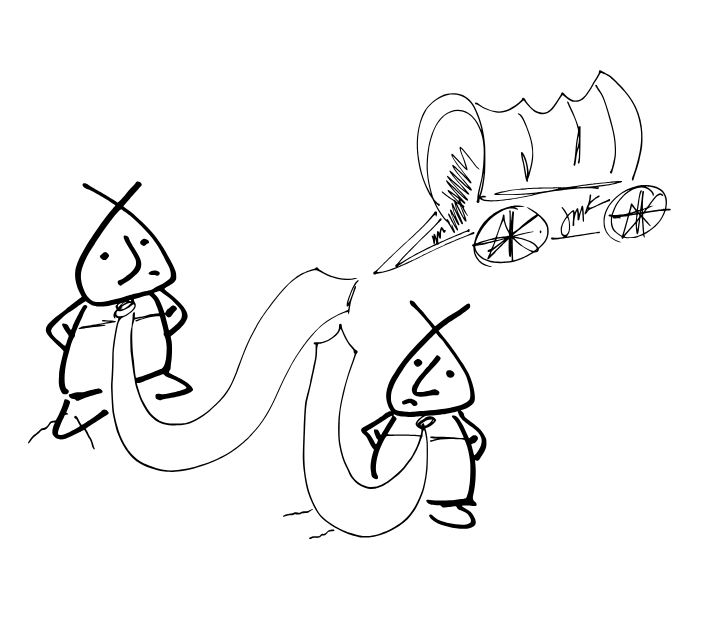
But your ‘team’ is—or was, etymologically speaking.
The word ‘team’ hasn’t changed in English much. It’s recorded in Old English as, well, ‘team.’
The meaning of ‘team,’ however, has evolved quite a bit.
(We haven’t seen a lot of Old English in my Workplace Word Origins series so far. See comments for why!)
🔑 In Old English, ‘team’ meant “child-bearing, offspring, family.” It also referred to groups of work animals, a sense which survives today in ‘team of horses’ or ‘team of oxen.’
Can you get a sense of where the word ‘team’ is headed already?
⚡ By the mid-1400s, ‘team’ had come to signify a group of people associated together in some common cause.
Over time, this sense has narrowed to people who work together professionally—or form one side of competition.
Evidence for ‘team’ in sports goes back to 1834, with the Oxford English Dictionary first citing it in the context of cricket. 🏏
The deeper roots of ‘team’ are Germanic. Many of its older cousins in that language family mean “bridle, rein, rope.” Scholars think the yet more ancient origins of ‘team’ denote “to draw, pull, lead.”
✨ Fun fact: the verb ‘teem’ comes from the noun ‘team’ or otherwise from its same Germanic roots. The original meaning of ‘teem’ in English was “to produce, bear, give birth,” out of which developed its sense today of being full or overflowing.
Words evolve. ‘Team’ in no way means ‘family’ anymore, as we’ve seen.
Work—and work culture—evolves, too. The growing pushback to sentiments like ‘we’re like family here’ at work is a powerful and fascinating example of how we are negotiating these changes directly at a language level.
***
For more Workplace Word Origins, see the first three roundups:
- Workplace Word Origins 3: engineer, salary, office, freelance, deadline
- Workplace Word Origins 2: resilience, company, focus, thrilled, code
- Workplace Word Origins 1: negotiate, strategy and tactics, incentive, recruit, network
 Mashed Radish

Leave a comment