
Business words don’t have to be boring—at least not etymologically.

In the last year or so, I’ve been spending more time on LinkedIn. For better or worse.
This was true in the long, arduous period when I was looking for work when my Dictionary.com era came suddenly to an end.
This is true now in my new work, doing strategic communications with a practice called Boldsquare—and building out our business here in Cincinnati.
Plus, X is a hellscape. Bluesky is rightly fixated on our national hellscape, but my blood pressure can’t withstand it nonstop. I never got into Instagram. I can’t keep up with TikTok. I don’t want to keep up with Facebook. I don’t think I have the bandwidth for Mastodon, though I hear great things about it. And I like my blog here, thank you very much, as much as I am supposed to use Substack now.
But regardless of what I am doing, regardless of where, I can never turn off my etymological curiosity. It’s just how I’m wired. I encounter a word and, like my brain has been struck by a reflex hammer, I want to know where it comes from.
So, every Wednesday on LinkedIn, I have been posting short posts on the origins of words a bit more relevant to a platform dedicated—at least originally—to all things professional.
I’ve done five posts so far: negotiate, strategy and tactics, incentive, recruit, and network.
And oh, there are doodles! I developed something of a character, a cartoon office worker whose head, if you must know, is inspired by the shape of an inverted radish.
I am sharing them below, and aim to round them up here regularly because I don’t expect my readers here to keep up with me on LinkedIn. If you don’t need to be active on LinkedIn, good for you! If you are, let’s connect!
Without further ado, workplace word origins. (Because LinkedIn posts don’t support italics, I refer to words as words in single quotation marks.)
Never miss a mash! Feed your inner word nerd and subscribe to get Mashed Radish fresh in your inbox.
Negotiate

We negotiate salaries. We negotiate terms of a contract. We negotiate challenging market conditions—or finding 10 minutes to inhale some calories between back-to-back Zooms.
Negotiating. It’s work—and literally, too!
🔑 The word ‘negotiate’ comes from a Latin root that literally means “not leisure.” It’s recorded in English by the end of the 1590s, with ‘negotiation’ found earlier, around 1500.
That root, the Latin ‘negōtium,’ means “business, work, difficulty, trouble.” It’s composed of ‘neg-,’ meaning “not” (like ‘negative’), and ‘ōtium,’ meaning “leisure, freedom from business, ease.”
⚡If you’re not busy, you could even describe yourself as ‘otiose,’ ”at rest,” though this adjective specifically implies “lazy” and has evolved to mean “fruitless” or “futile.”
Which is an odious feeling for many of us nowadays—that anxiety of being unproductive, the mentality that rest is, in fact, for the wicked.
I suppose we could all stand to negotiate some otiation. Or at least give ourselves a (lunch) break.
Strategy & tactics

It’s an age-old battle in business: are you pursuing a real strategy or are you actually just chasing tactics? ‘Battle’ is no coincidental word here, for the origins of both words have war stories to tell.
🔑 ‘Strategy’ ultimately comes from the Greek ‘stratēgós,’ meaning “a commander of an army” and used as a title. Its further roots literally mean “to lead an army.” ‘Stratagem’ also derives from ‘stratēgós.’
‘Strategy’ is found in English in the early 1600s, first referring to an army or region under command of a general. By the late 1700s, it was referring to the art of planning long-term military objectives of a battle or campaign. This sense was extended by the early 1800s to its contemporary meaning: a plan for any larger overall aim.
🔑 ‘Tactics’ also goes back to Greek and has veteran status, if you will. It’s rooted in the Greek adjective ‘taktos,’ meaning “ordered, arranged” and related to ‘taxonomy.’ A form of ‘taktos’ was used in an Ancient Greek phrase meaning ‘the art of (military) tactics.’
‘Tactics’ is recorded in English by the 1620s, referring to the art of arranging and directing forces in immediate battle. ‘Tactical’ is found earlier, in the 1570s. By at least the 1770s, ‘tactics’ was extended to its more familiar sense today: an action planned to achieve a particular end.
Historically in English, ‘strategy’ and ‘tactics’ were already being distinguished in military contexts, anticipating the important—though sometimes fuzzy—difference we make of them at work today.
‘Strategy’ usually gets all the glory. It’s the vision. It’s the what and why. But we can abuse the word to the point where calling something ‘strategic’ can seem like a filler word. ‘Tactics’—the steps, the how, the work itself—can seem lowlier, humbler, something that just any ole worker can do. But ideas are cheap—and execution is everything.
⚡ No reason for us to be war-torn about the two, though: a good strategy comes equipped with its tactics battle-ready. And great leaders always make sure to keep their eyes on how the day-to-day connects to the bigger picture.
For more on the etymology of strategy, revisit this post from the Mashed Radish archives.
Incentive

Common sense may lead us to suppose that the origin of ‘incentive’—something that incites action, especially in the form of payment to motivate work—would concern dollars and cents.
Well, we will have to work a little harder than that. As it turns out, ‘incentive’ is less about making it rain than … making it sing! At least etymologically speaking.
🔑 ‘Incentive’ derives from the Latin ‘incentīvus,’ meaning “stimulating”—and originally referring to an instrument “playing or setting the tune,” as opposed to an accompaniment part.
It is based on the verb ‘incinere,’ meaning “to sing, to blow into or play an instrument, to strike up.” That verb is composed of ‘in’ and ‘canere,’ “to sing” and ultimate source of such words as ‘accent,’ ‘canticle,’ ‘chant,’ ‘incantation,’ and ‘recant.’
‘Incentive’ is first recorded in English in the late 1400s as a noun for “something that arouses feeling or incites action.” By the 1600s, we find it as an adjective meaning ‘arousing, inciting, exciting.’ It’s not until the 1940s we see the word used in its contemporary monetary sense, also first as an adjective in expressions like ‘incentive pay’ or ‘incentive bonus,’ soon thereafter shortened to a noun on its own.
⚡ ‘Incentivize’ arrives on the scene by 1968, first in British English as ‘incentivise.’ It features that much maligned but perfectly productive—and far older than you’d think, going back to the 1500s—verb-forming suffix ‘-ize.’
Etymology pays. Erm, it at least incentivizes us to dig a little deeper, whatever our work at hand.
Recruit
This one’s for the recruiters, who deserve some backup as many are bearing at least the emotional brunt of a historically tough job market—and epochally different one in the age of AI.
‘Backup’ is indeed an operative word when it comes to the origin of ‘recruit.’ And as we saw with ‘strategy’ and ‘tactics’ a few weeks back, ‘recruit’ also was first used in military contexts.
🔑 ‘Recruit’ is first recorded as a noun in English around the 1620s, originally used in plural form for fresh troops supplied to strengthen a military force. It comes from the French ‘recrue,’ meaning a “supplementary body of troops.”
The French ‘recrue’ is a form of the verb ‘recroistre,’ meaning “to increase or grow again” and derived from the same Latin root that ultimately gives us words like ‘increase’ and ‘crescent’—as well as ‘crew,’ also originally a term for “military reinforcements.”
By the mid-1700s, the noun ‘recruit’ was extended to newly enlisted soldiers as well new members of any group—including employees. The verb form of ‘recruit’ is found in the 1640s, as is ‘recruiter.’
Fun fact: according to the Oxford English Dictionary, the oldest (and now historical sense) of ‘recruiter’ referred to members of English Parliament appointed to fill vacant seats during the tumultuous English Civil War. ‘Fun’ if you’re into etymology or loved AP Euro, I guess.
⚡ ‘Recruit,’ then, is literally a “new growth.” Perhaps that can give us a new way of thinking about the work of recruitment—to find talent that truly helps to grow a business, whose special skills and experience supplement a team or operation.
Or perhaps the military origins of ‘recruit’ just reminds us that it can feel like a battle out there in the job search …
Network
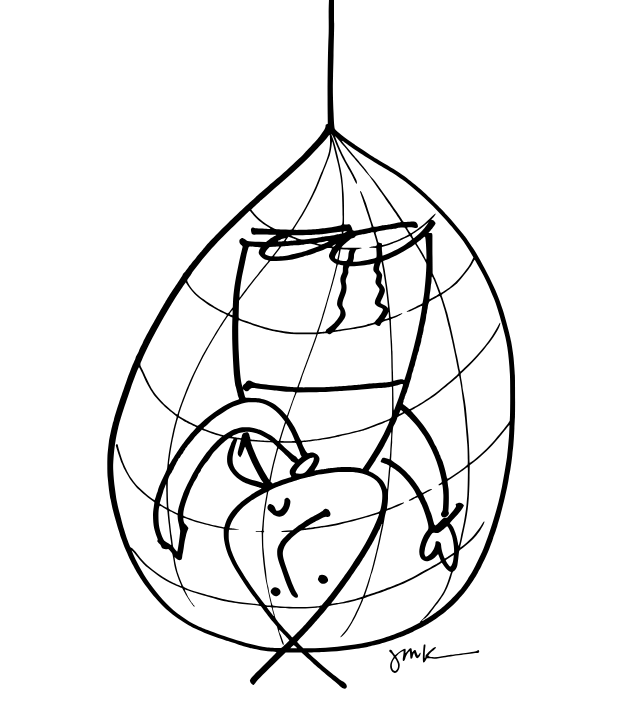
When I say ‘network,’ what’s the first thing that comes to mind?
Excluding “I’M MAD AS HELL, AND I’M NOT GOING TO TAKE THIS ANYMORE!”?
I’d venture to say it’s first and foremost your professional network. Then maybe your social network or support network? All are groups of people interconnected in some way for mutual benefit.
The word ‘network’ also probably conjures up things like trade or transportation networks as well as wireless networks. I suspect immediate associations of the word with radio and broadcast TV—network TV—are already beginning to fade.
But right there, in its very own humble compounding of ‘net’ and ‘work,’ lies the word’s original sense, now vanishingly distant, practically invisible, in our everyday usage.
🔑 ‘Network’: something made (a ‘work’) of interconnected threads, wire, or the like (a ‘net’). This was the meaning of ‘network’ when it was first recorded in the early 1500s. Compare ‘brickwork’ or ‘glasswork’ or even ‘classwork.’
I love that the literal stuff of ‘network’ is hiding in plain sight because of its extended uses. Hiding like a spider’s gossamer web you only discover once it brushes across your face. 🕸️
Metaphorical extensions of words absolutely abound in English. In the case of ‘network,’ the connection is interconnection: the extension of a literally wrought net to systems that resemble intricate net-like structures.
⚡Here’s a fun example of another metaphorical extension. The Rolodex, as those of who are apt to quote the 1976 movie ‘Network’ will recall, originated as a card file containing names, numbers, and addresses. Now this trademark name survives as just a way to refer to your contacts—your network. (You can still buy one, though! 📇)
The professional sense of ‘network’ now so increasingly common is actually the most recent one to evolve. As a noun, we find this ‘network’ by at least the 1940s. ‘Networking’ is found by the 1970s. The verb for all of this is recorded as late as 1980. (Dates for other kinds of networks track with their technological emergence.)
✨Bonus: Etymologically, ‘net’ and ‘work’ go back to Germanic roots pretty much meaning the same thing. But the ‘net’ in, say, ‘net worth’ is unrelated. That ‘net’ comes into English via French and is actually essentially the same word as ‘neat.’ Neat! Its ultimate Latin root means “to shine.” Capturing that etymology is a net to cast for another time.


Leave a Reply