
If you’re a freelancer, you’re a mercenary knight—at least etymologically speaking.

Round 3 of Workplace Word Origins, for those of you not following along on LinkedIn, sees our taproot-pated salaryman catapulted, salted, cubicled, knighted, then sighted.
Poor fella! He suffers for my doodles. We all suffer for my doodles.
This set of work-related etymologies features engineer, salary, office, freelance, and deadline—and their histories span Roman salt and soldiers, medieval mercenary knights, and Civil War prisons.
Only have a coffee break’s worth of time? Prioritize salary, freelance, and deadline.
Never miss a mash! Feed your inner word nerd and subscribe to get Mashed Radish fresh in your inbox.
Engineer
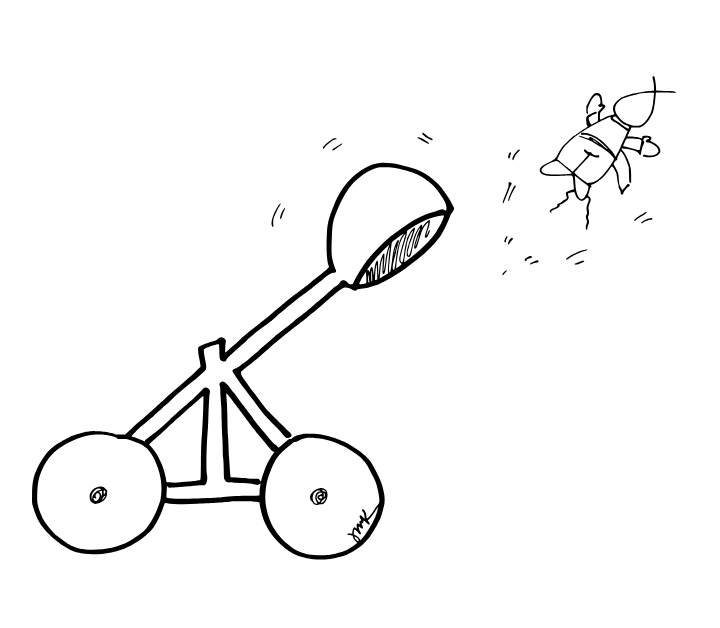
A writer of books is an author. A writer of code—which derives from the Latin for “book,” as we saw in last week’s Workplace Word Origin—is an engineer.
As we’ll see in this week’s origin, some learn to code—and some are born to code. At least in an etymological manner of speaking.
🔑 ‘Engineer’ ultimately derives from the Latin ‘ingenium,’ meaning “innate quality” and whose roots have a literal sense of “inborn, natural.”
Latin’s ‘ingenium’ had many other senses all clustered around various notions of a natural disposition, including “character, talent, intellect, skill” as well a clever person—and clever device.
Through this latter meaning, the Latin ‘ingenium’ came to be used for machines of war, such as battering rams or catapults, and these machines were called ‘engines,’ via the evolution of the word in French.
(This means ‘engineer’ joins ‘strategy,’ ‘tactics’ and ‘recruit’ as another occupational word we’ve seen with a military past so far.)
⚡ French tacked on its equivalent of the suffix ‘-or’ to denote “a constructor of military engines,” which was the original sense of ‘engineer’ when it was borrowed into English in the late 1300s.
As also in its proximate French root, the English ‘engineer’ underwent iterations. In the 1500s, it was naming people skilled in building types of other, non-military engines.
Not long later, types of engineers were being specified. ‘Civil engineer’ is recorded in the mid-1700s; ‘chemical engineer’ in the 1830s, ‘mechanical’ in the 1840s, ‘electrical’ in the 1850s. ‘Software engineer’ is first evidenced so far in the 1960s.
✨ Bonus: ‘ingenuity’ is actually based on ‘ingenuous,’ which historically meant ‘noble, upright, candid,’ but became confused with ‘ingenious,’ indeed from that same Latin ‘ingenium.’
That historical meaning of ‘ingenuous’ is perhaps better seen in its more common antonym, ‘disingenuous,’ meaning “not candid or sincere.”
Salary

Salary ranges: originally measured in milligrams of sodium and percentages of daily value as based on a 2,000-calorie diet?
The etymology of ‘salary’ has traditionally been explained that the word comes from the Latin for ‘salt’ because Roman soldiers were given money to buy salt, cited as a historically precious commodity.
Don’t hold the salt—just that stubborn ‘because,’ for all the flavor it adds.
🔑 ‘Salary’ does ultimately derive from the Latin ‘sāl,’ meaning “salt.” We just don’t know why.
We have no evidence that Roman soldiers were paid in salt or paid so they could buy it. And while salt was certainly important in antiquity, it’s a myth that it was rare and highly valuable.
This account is attractive, but it’s speculative—and obstinate, persisting now for some centuries.
The same goes for the expression ‘worth one’s salt’—to be competent or effective at one’s job—is also conventionally connected to the ‘salt money’–’salary’ misbelief.
Savory, but unsubstantiated.
Why this story is so sticky isn’t above my pay grade, if you will, but I don’t think the content will pay me any overtime here, to belabor the metaphor.
We do have evidence, however, there was ‘shoe money’ and ‘clothing money’ in ancient Rome.
Now, to get more granular on the origin of ‘salary’:
⚡ It’s recorded in English by the 1300s, coming from the French ‘salarie’ and, before it, the Latin ‘sālarium.’ The Latin ‘sālarium’ meant “stipend, allowance, pension”—and more specifically, “official pay to a holder of a civil or military post.”
‘Sālarium’ is in turn based on ‘sālarius,’ meaning “relating to salt,” an adjective formed from Latin’s ‘sāl.’ The English word ‘salt,’ going back to the Old English ‘sealt,’ is indeed related to the Latin ‘sāl’ through an ancient saline ancestor.
So, there is indeed some link between salt and compensation in ancient Rome, but the reason is now obscure.
Nature abhors a vacuum. The popular imagination abhors a word with an origin unknown—and scrumptiously spurious stories love to fill the void.
How would today’s version of ‘salt money’ go? Some custom of paying people in avocado toast or delivery burritos?
Office
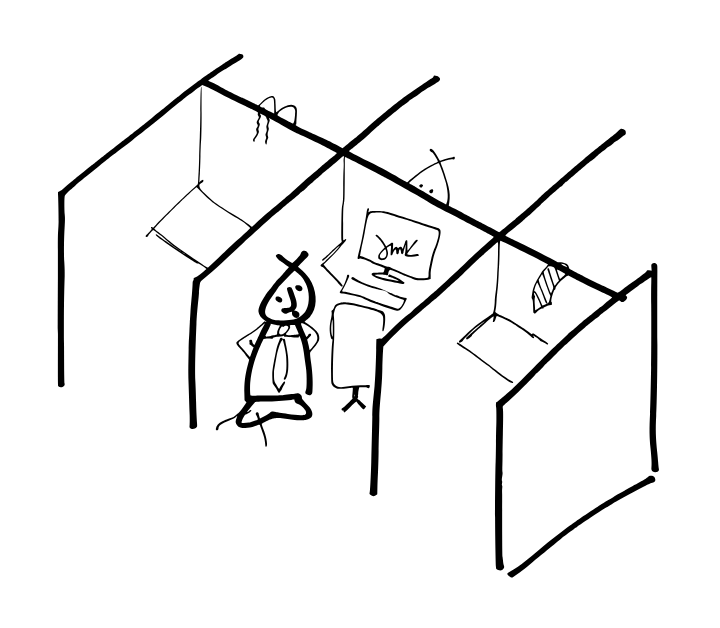
This post has been lightly edited for context.
🔑 ‘Office’ ultimately comes from a Latin root that means “work-doing.” It’s first recorded in English around 1300, borrowed from the French ‘office.’
That root, the Latin ‘opificium,’ meant “work.” It’s composed of two parts. First, ‘ops,’ meaning “power, might, help, influence,” related to such words as ‘opus,’ ‘opera,’ ‘operate,’ ‘optimism,’ and ‘opulence.’ Second, a form of ‘facere,’ meaning “to do, make,” source of ‘affect,’ ‘fact,’ ‘manufacture,’ ‘satisfy,’ and countless other words and word parts.
In Latin, ‘opificium’ became contracted into ‘officium,’ which variously meant “service, kindness, duty, ceremony, business, job.” In French, ‘officium’ evolved into ‘office.’ ‘Official,’ ‘officiate,’ and ‘officious’ all indeed trace back to ‘officium.’
⚡ Back in 1300, ‘office’ denoted an official divine service—a daily prayer—in the Christian Church. It also signified a “position,” a sense surviving today in expressions like ‘the office of the presidency.’ By 1400, we have evidence of ‘office’ referring to the familiar sense today: a room or building used for various work.
So there you have it. It’s official: an office is literally just a place for doing work.
Unless you are on the show ‘The Office,’ where there is anything but work-doing going on. Or me whenever I visit my company’s home office—because I get excited to be around colleagues I don’t see all the time and can’t resist chatting and goofing off and stirring up drama by making pronouncements like the US version of ‘The Office’ is overrated, for all its memorable characters and cultural impact, because it, like other American TV shows, had a habit of going on for too many seasons.
(I made some friends. I made even more enemies).
Now, the movie ‘Office Space’ on the other hand…
Freelance
If you’re a freelancer, yes, you are a mercenary knight—at least etymologically speaking.
🔑 ‘Freelance’ was originally used as a historical term to refer to knights who would fight for pay rather than as vassals. More broadly, it meant “a mercenary.”
The word is so far first recorded in Walter Scott’s 1819 chivalric romance ‘Ivanhoe’: ‘I offered Richard the service of my Free Lances.’ The term could be Scott’s invention.
‘Freelance’ combines ‘free,’ in the sense of “independent,” and ‘lance,’ that long spear used by cavalry—and associated with knightly jousting.
By the mid-1800s, that medieval meaning of ‘freelance’ extended to unaffiliated politicians and other such figures, originally with an implication that their independence was vexingly arbitrary.
⚡ By the late 1800s, ‘freelance’ had spread as a term to describe independent employment, especially in the context of journalism. The word still is closely associated with self-employed writing today.
The verb ‘freelance’ is evidenced by 1904, and the more familiar noun ‘freelancer’ by 1924.
Landing freelance gigs today—heck, landing any role these days—can certainly feel like jousting or a quixotic quest, with any professional code of chivalry as rusted as ancient armor.
Deadline
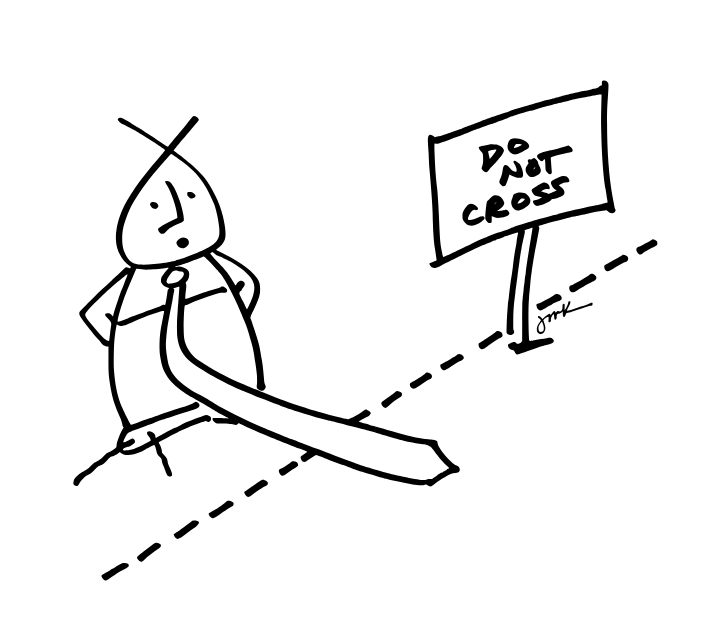
There was a time when missing—or, rather, crossing—a deadline meant you were toast, kaput, unalive.
🔑 In the 1860s during the American Civil War, a ‘deadline’ referred to a boundary around a prison that a prisoner crossed at the risk of being shot and killed.
Hence, a ‘dead line,’ now written as a single word and without a hyphen. (Bonus: such a word is known as a ‘closed compound.’)
One of the prisons most notorious for deadlines was in Andersonville, Georgia. It was a Confederate prison for Union soldiers run by a ruthless commander, Henry Wirz.
References to his nefarious ‘deadlines’ proliferated in 1864, according to Merriam-Webster.
⚡ By the 1890s in the US, ‘deadline’ extended, apparently as influenced by these deadly military demarcations, to its familiar sense today: a time or date by which something has to be completed. Or else.
The Oxford English Dictionary first cites this figurative ‘deadline’ in 1893 in the proceedings of a typographers’ union. The union stipulated members could not work for newspapers or printing offices that imposed deadlines. (Sounds nice.)
Deadlines, of course, remain especially prominent in the fields of journalism and publishing today.
There have been other senses of ‘deadline’ which draw on the many metaphorical shades of the adjective ‘dead’:
- As evidenced as early as the 1810s, in angling a ‘dead line’ is a line meant to catch fish by remaining still.
- As recorded in the 1910s, in printing a ‘deadline’ once referred to a guideline on a printing press past which text wouldn’t be readable.
- Also in the early 1900s, ‘deadline’ saw use in other work settings, including in reference to minimum daily work output (does not sound nice)—and upper age limits placed on factory workers, as Douglas Harper notes on Etymonline (sounds nice).
Missing too many deadlines may result in you getting terminated—just not, very fortunately, in any terminal sense.
***
For more Workplace Word Origins, see the first two roundups:
- Workplace Word Origins 2: resilience, company, focus, thrilled, code
- Workplace Word Origins 1: negotiate, strategy and tactics, incentive, recruit, network


Leave a Reply