
What do professional announcements have to do with boogers?
It’s time for another round of Workplace Word Origins!
This set of occupational etymology finds our radish-headed desk denizen:
- Transformed into a fish
- Breaking a giant loaf of bread
- Orbited by a ringed planet
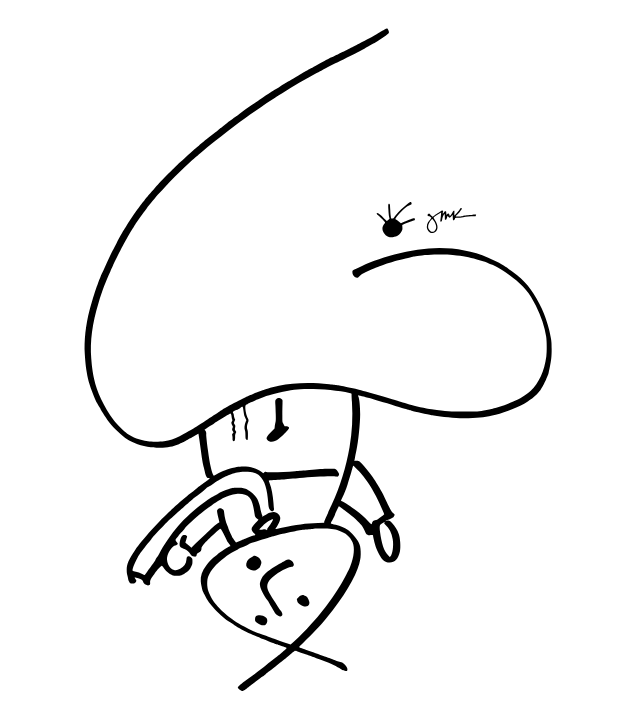
- Stuffed into an enormous nostril
- Smashed between the pages of a book
Why, those adventures could only spell resilience, company, focus, thrilled, and code.
You know, I thought each Workplace Word Origin would be a quick hit, like those 8 oz. bottles of water in an office fridge. Ha. I should have known better. I should have known myself better. I should have known words better.
So, don’t have time to read them all? I suggest you jump to thrilled or code. The former concerns noses; the latter, the history of books.
Never miss a mash! Feed your inner word nerd and subscribe to get Mashed Radish fresh in your inbox.
Resilience
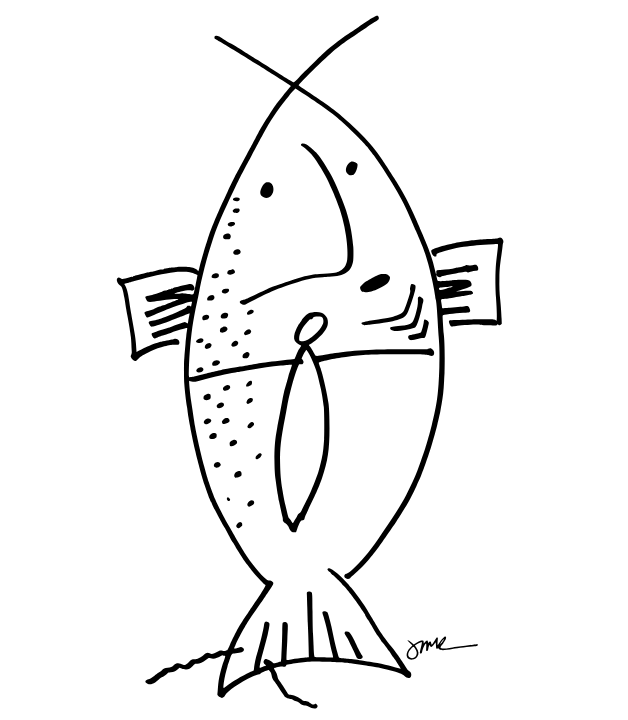
Resilience—the ability to bounce back from setbacks—has become one of the chief character strengths we champion in life and at work today.
And it’s no coincidence that we refer to resilience as “bouncing back.”
‘Resilience’ ultimately goes back to the Latin ‘resilīre,’ meaning “to spring back, jump back.” That verb is composed of ‘re-’ (“back”) and ‘salīre’ (“to jump, leap”). It’s first recorded in English around the 1620s.
According to the Oxford English Dictionary, the word was originally used for literal instances of rebounding and was extended to figurative senses of adaptability and hardiness by the mid-1800s.
That root Latin verb, ‘salīre,’ yields a great number of other words, all stemming from various notions of jumping and leaping, including:
- assail
- desultory
- exult
- insult
- result
- salient
- sally
- somersault
Something ‘salient,’ for example, is “prominent, important, conspicuous”—it leaps out. Fun fact: the oldest sense of ‘salient’ in English was used in heraldry to refer to animals depicted as leaping.
And speaking of animals … ‘salmon’ is also thought to ultimately derive from that Latin verb ‘to leap’!
Even more interesting to me, though, than the etymological history of ‘resilience’ is its social history. In form or another, going by one name or another, certainly resilience has long been valued and virtuous. Struggle, endure. Fall, get back up. Resilience—to cite its cousin—gets results. Right?
Starting in the 2000s, use of ‘resilience’ surged, using Google ngrams measure. I am brought to mind of grit, marshmallow tests, and nudges. Of the broader zeitgeist of behavioral economics during this time period in which ‘resilience’ really became more, well, salient. Of Freakonomics and Gladwell whose storytelling may have exceeded their science.
Others recoil (which, as it happens, is one of the older senses of ‘resilience’ in Latin and English) at a culture that over-valorizes resilience, connecting it to toxic positivity, trauma fetishization, and hyperindividualism—not to mention linking it to inequitable expectations that marginalized populations should be able to overcome structural challenges through strength of will alone.
Yeah, I’ve been jumping all over the place, so I turn to you. Has resilience become more trend than trait? Does it need to ‘bounce back’ from being a buzzword?
Company

🥖 Make that ‘bread.’ 🍞
Founded in 1670, the Hudson Bay Company, considered the oldest company in North America, recently closed its doors for good. The Bay began as a fur trader and ended as a department store—and iconic, centuries-spanning Canadian institution.
As for the word ‘company’ itself? It originally dealt in different goods: baked goods.
🔑 ‘Company’ ultimately derives from Latin roots for “together with bread.” Borrowed from the French ‘compagnie,’ the word ‘company’ is recorded in English at least by 1275 and first referred to the condition of being with others, especially friends.
That French ‘compagnie’ is based on the later Latin ‘companio,’ composed of ‘com-,’ meaning “with,” and ‘pānis,’ meaning “bread.”
✨ Panera Bread is a triple-loafer: it’s a company (derived from the Latin “bread”) that makes bread (among other things) with a name, Panera, that is in part based on the Latin ‘pānārium,’ meaning “breadbasket” and derived from that same Latin ‘pānis.’ Let’s even add a fourth loaf: as a company, its ultimate goal is to earn money—or more slangily, to ‘make bread.’ Er, get that bag-uette? I’ll see myself out.
‘Company’ keeps good company with ‘companion,’ which are effectively the same words. A ‘companion’ is, etymologically, a person who you regularly share meals with—someone you break bread with.
How poetic. How delicious.
Even tastier, at least to word nerds, is that the Latin ‘companio’ may be a loan translation of an old Germanic word represented as ‘gahlaibō,’ related to our word ‘loaf.’
(You want original content, LinkedIn? You got it. As far as I can tell, I can claim the first instance of the reconstructed Proto-Germanic root ‘gahlaibō’ on this platform. Um, there’s probably a reason for that…)
Past and present, ‘company’ has been used of various groups of peoples, including soldiers and skilled workers.
⚡ By the late 1300s, ‘company’ was specifically referring to medieval trade guilds and similar professional organizations, out of which arose the sense of ‘company’ for “commercial business” by the 1500s.
The abbreviation ‘co.’ for ‘company’ is evidenced as early as the 1670s—right around the name the Hudson Bay Company was, incredibly, just getting started.
As for the oldest company in the world? That distinction goes to Kongō Gumi, a Japanese construction company founded in 578, running for over 1400 years until it was acquired in 2006.
Focus
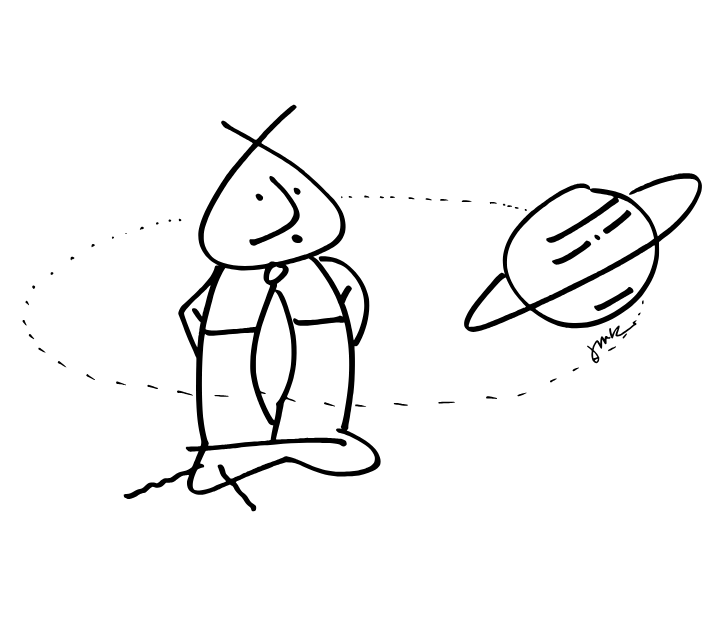
Check email. Check LinkedIn. To-do list. Scroll LinkedIn. Meeting. Slack. Meeting. Check email and LinkedIn and Slack at meeting. Twenty minutes of productive time—with only one check of email and LinkedIn while sending a (mere) four GIFs on Slack. Cross off item on to-do list. Add three more. Meeting. Email. LinkedIn. To-do list.
Crap, I actually got to get all of this stuff done.
Ever feel like your workday? Ever feel like your mind? It certainly feels like mine some days. (A lot of days.)
Focus is one of the most precious resources we have today, and it can feel in short supply—all the shorter with the onslaught of news, whipsaws of the market, and the siren calls of social media.
🔑 ‘Focus’ comes directly from the Latin ‘focus,’ meaning “hearth, fireplace.” This is what the word meant in the 1630s, when the borrowing is first evidenced in English.
Johannes Kepler—the German polymath who described the orbits of the planets around the sun as ellipses—adopted ‘focus’ in the early 1600s for his geometry to refer to fixed points that define various conic sections. The ‘focus’ of a circle, as a simple example, is its center.
But what does this have to do with fireplaces? According to the Oxford English Dictionary, Kepler may have likened geometric foci—as the plural goes—to sources of light, as if fire emanating from a hearth.
Another famous dude of yore, Thomas Hobbes—the English philosopher who described human life as “nasty, brutish, and short” in expounding his social contract theory—is credited with first using the geometric sense of ‘focus’ in English in the 1650s.
From geometry, ‘focus’ radiated outward to many other senses in English, including by the 1750s ‘center of interest or activity’ and by the 1830s, ‘concentration, ability to concentrate.’
Did Kepler and Hobbes have greater capacity for focus—and therefore for fulfilling their special genius? Perhaps.
But perhaps they also just had less to distract them.
Back then, we like to suppose there was little much else to do but focus, scrawling on their parchment by the light of a late fire instead of scrolling on their iPhones in its addictive, blue glow.
At least for those whose work wasn’t so nasty and brutish.
But we should indeed Hobbes. Life is short. We’d all be wise to hold our focus a little longer.
Now, if you’ll excuse me, I’ve got to go check every 17.2 seconds to see if this post got any likes.
Thrilled
I’m thrilled to announce…
…that the word ‘thrilled’ is related to ‘nostril’!
‘Thrilled’ has certainly become an announcement cliché (more on that below), but etymologically, it was once a much more ‘penetrating’ word choice.
🔑 ‘Thrilled’ is based on the Middle English verb ‘thirlen,’ meaning “to pierce,” ultimately from the Old English ‘thyrel,’ meaning “hole.”
If you’re ‘thrilled,’ it’s as if you’ve been penetrated with sudden and intense emotion.
We have evidence for this metaphorical use of ‘thrill’ by at least 1400; its derived verbal adjective, ‘thrilled,’ is established by the 1800s.
Also from Old English, ‘nostril’ combines ‘nosu,’ meaning “nose,” and that same ‘thyrel,’ “hole.” That means your nostril is, quite literally, your ‘nose hole.’ 🐽
These are the sort of facts we word nerds find thrilling, but why do we overuse “thrilled”?
Saying you’re ‘excited’ or ‘happy,’ for instance, about an item of news doesn’t feel strong enough, yet saying you’re ‘ecstatic’ or ‘elated’ comes across as excessive.
‘Thrilled’ bridges that emotive gap, at least originally. But its intensity has become diluted—and through a process called ‘semantic bleaching.’ (Think about how many things we call ‘amazing’ or ‘exciting’ or ‘interesting’ that are really just … meh.)
⚡ In an announcement, the job that ‘thrilled’ needs to perform is often less descriptive—how the announcer actually feels about the announcement—and more so functional: efficiently signaling to an audience that the message is about a positive announcement.
Plus, ‘thrilled’ fills an expected script about how we share promotions, product launches, etc. Take out phrases like ‘I’m thrilled’ and the result can feel too naked or matter-of-fact.
At the end of the day (see what I did there?), I’m not one to drill anyone for using clichés like ‘thrilled,’ particularly in speech or pragmatic writing. Calling out people’s everyday use of language is as banal as a cliché to me. Words work all three shifts for us—and only one of their many roles concerns originality.
But if you’re trying to break through? As in a high-impact keynote or piece of creative writing? In language, as in life, deviate from the cliché. That’ll help you pierce the noise.
✨ Bonus:
- The Old English ‘thyrel’ breaks down further into ‘thurh,’ meaning and source of “through,” and ‘-el,’ a suffix now usually written as ‘-le’ and historically conveying smallness or repeated action.
- The Old English ‘thyrel’ was written as ‘þyrel.’ That p-looking character, þ, is called ‘thorn’ and corresponds to our -th-, which is how we now write the sound.
- You may have noticed that the position of the ‘r’ in ‘thrill’ and in its earlier English roots switched. That change, known as ‘metathesis,’ has happened to many English words. ‘Bird’ began as ‘brid’ and ‘third,’ ‘thrid,’ as just two examples.
Code
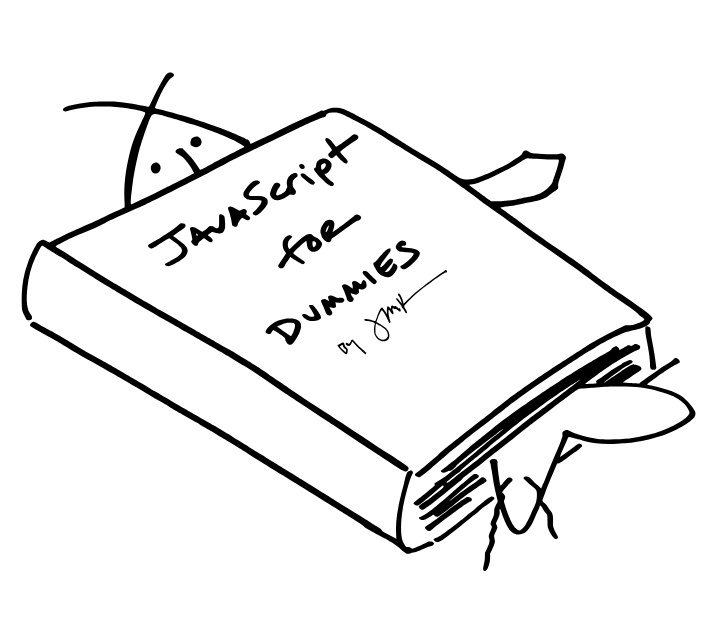
Whether you are writing it, vibing it, or relying on it behind the scenes, so much of our work depends on computer code, which, in its way, comes down to one of the most important technologies of all: the book. 📚 (Yes, books are tech!)
🔑 ‘Code’ derives from the Latin ‘codex,’ meaning “tree trunk,” from which ancient Romans made early books in the form of wooden tablets covered with wax. It enters English from the French ‘code,’ based on Latin’s ‘codex,’ a variant of ‘caudex.’
To put things far too simply, the scroll was a predominant medium for writing in antiquity. It proved more portable, editable, and durable than clay tablets. Then came along a light-bulb moment: why not stitch together those sheets of papyrus along a seam? This arrangement was a revolutionary invention—and it was the codex.
The codex is efficient—or ‘user-friendly’ as we might say today. The writer can use both sides of a page. The reader can jump quickly to desired sections. The binder can compile larger texts. Modern books, which evolved from the codex, still use the format. Talk about a flash of UX inspiration…
Codices (plural of ‘codex’) spread in the ancient Greco-Roman Mediterranean in the first century CE. Pre-Columbian Mesoamerican peoples separately invented the codex, with some specimens dating back to the 11th or 12th century CE.
‘Code’ is first recorded in English in the late 1300s, originally signifying a collection of laws. It extended to any collection of rules or regulations by the mid-1500s, then to any system of symbols that variously conveys information by the late 1700s. The sense of cryptographic code—which involves substituting one symbol for another—is found by the early 1800s.
⚡ In 1946, as the Oxford English Dictionary cites, we have some of our earliest evidence for computer ‘code’ in the still-influential scientific journal, ‘Nature’:
The brains of the machine lie in the control tape, which is code-punched in three sections. The first instructs the machine where to find its data; the second gives the destination of the data or answer, the third dictates the process.
Punched tape isn’t in anyone’s tech stack anymore, but your Python is, as this early example of ‘code’ makes clear, just a set of program instructions—now made of 1s and 0s, not wood.
✨ Bonus: the word ‘book’ is made of wood. It ultimately derives from a Germanic root related to ‘beech,’ as in a beech tree, on which, historically, writing was inscribed or from which tablets were made.


 Mashed Radish
Leave a comment