
Tell me, O Muse, of the origin of the name of the man of many devices. And why Latin calls him “Ulysses,” if you don’t mind.
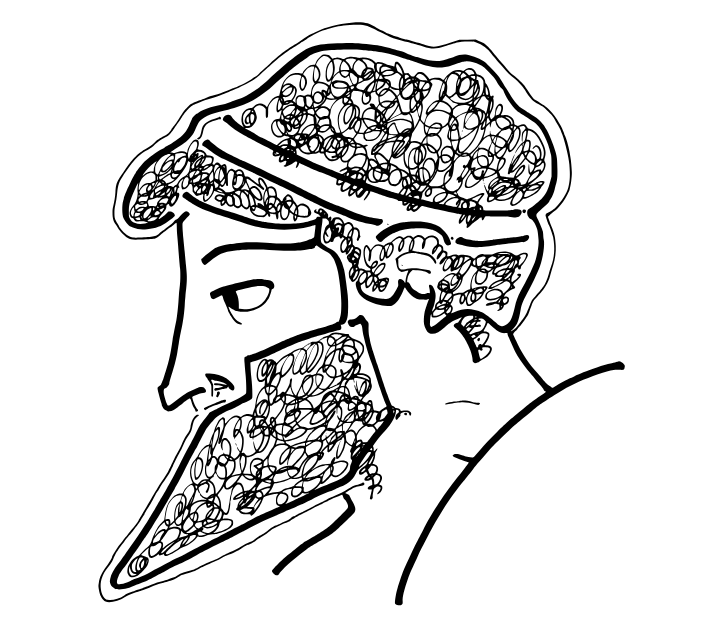
Homer’s Odyssey spans over 12,000 lines. Christopher Nolan’s new and acclaimed film adaptation of the ancient poem clocks its own epic length with a runtime of 172 minutes.
The journey of the word odyssey into English, however, is far briefer. May we pour out some libations! But the etymology of the name Odysseus proves to be something of a Trojan Horse, as we will see.
Odyssey etymology
Here is a summary of the tale of the word odyssey as passed down by the Oxford English Dictionary:
- Odyssey derives from the Greek name of the story, Ὀδύσσεια (Odusseia), a noun formed from the name of its central hero, Ὀδυσσεύς (Odusseus). Latin had a practice of rendering the Greek letter upsilon (υ) as a y, yielding Odyssea, the direct source of the English word.
- Referring to the Homeric poem, Odyssey is first attested in Old English as Odissia in the Enchiridion, a spiritual manual on numerology by Byrhtferth, a 10th-century English monk. It has a long gap in the record until 1590, when Edmund Spenser mentions the epic poem in his “Letter to Sir Walter Raleigh,” which contains the preface to his Faerie Queene. (In terms of length, Spenser far out-epics Homer in The Faerie Queen, which clocks in at just under 35,000 lines.)
- Evidence for the extended use of odyssey—for “a long series of wanderings” or “an adventurous journey”—sets its metaphorical foot ashore in Robert Louis Stevenson’s 1886 Kidnapped. A young adult novel, Kidnapped tells the odyssey of David Balfour, a teenager whose uncle violently thwarts him from claiming his inheritance. The figurative use of odyssey already had a decades-older antecedent in French.
But this is just the origin of odyssey. As for the name Odysseus itself? Gather round, readers.
Never miss a mash! Feed your inner word nerd and subscribe to get Mashed Radish fresh in your inbox.
Traditional etymology given for Odysseus
👉 The Odyssey itself offers its own, mythic origin for the name Odysseus: “hated by gods and men.” This is the sense traditionally given based on an instance of the verb ὀδύσσομαι (odussomai), “to hate, be angry with,” in a backstory in Book 19.
We pick up the story there.
After years of adventuresome setbacks at sea, Odysseus does return to his island kingdom of Ithaca. (Not to spoil the nearly 3,000-year-old epic for anyone…) But Odysseus doesn’t just show up and say, “Hey guys! Remember me?” Favoring him, the goddess Athena disguises our wily, worn hero as a beggar. That way, he can scope the scene, overrun as it has been by suitors vying for his unwavering wife, Penelope, and the wealth that would come with her weaving hand.

Penelope welcomes the masked mendicant into her oikos, where Odysseus permits his old nurse, Eurycleia, to wash his feet. Noticing a telltale scar just above his knee, she realizes who the stranger really is. (The only other character to recognize the incognito hero is Argos, his dog.) At this moment, Homer offers a flashback, recounting how Odysseus got his scar—and his name.
The scar Odysseus acquired when a boar gouged him during a hunt on Mount Parnassus with his grandfather, Autolycus, and uncles, who lived there. The name he acquired, we learn at the start of the digression, when Autolycus visited a newborn Odysseus, all a-suckle by Eurycleia, in Ithaca.
I quote A.T. Murray’s 1919 still-popular prose translation (lines 405 and preceding at the link):
Now Autolycus, on coming once to the rich land of Ithaca, had found his daughter’s son a babe new-born, and when he was finishing his supper, Eurycleia laid the child upon his knees and spoke, and addressed him: “Autolycus, find now thyself a name to give to thy child’s own child; be sure he has long been prayed for.”
Then Autolycus answered her, and said: “My daughter’s husband and my daughter, give him whatsoever name I say. Lo, inasmuch as I am come hither as one that has been angered with many, both men and women, over the fruitful earth, therefore let the name by which the child is named be Odysseus. And for my part, when he is a man grown and comes to the great house of his mother’s kin at Parnassus, where are my possessions, I will give him thereof and send him back rejoicing.”
Has been angered—that’s how Murray chose to handle the original Greek ὀδυσσάμενος (odussamenos). Yet the exact sense of the Greek word is wine-dark like the seas Odysseus wandered. Scholars take odussamenos as a participle of the verb ὀδύσσομαι (odussomai), “to hate, to be angry with,” but they have long debated whether the form is meant to have a passive or active force. Was Autolycus angered—or was he the one pissing everyone off? (Speaking of, the Latin odium, source of odious and even annoy, is related to odussomai.)
In the past 150 years or so, many have increasingly favored the active translation. After all, Greek mythology casts Autolycus as a thief and trickster who, with powers of shape-shifting and an invisibility helmet, caused trouble in his own adventures. In one tale, Autolycus stole cattle from a certain king, who blamed, of all people, Heracles for the theft. Enraged, Heracles killed the king and some of his family; he was punished with three years’ hard time for his crime.
Yeah, I’d say Autolycus ticked a few people off. And I think Robert Fagles would agree—and then some. In his celebrated verse translation (p. 328 at the link), Fagles goes further, poetically and prophetically so, with his rendering of odussamenos. Here again is Autolycus answering Eurycleia’s naming assignment:
Give the boy the name I tell you now. Just as I
have come from afar, creating pain for many—
men and women across the good green earth—
so let his name be Odysseus…
the Son of Pain, a name he’ll earn in full.
A literary digression of Homeric proportions
Translation affects interpretation. A passive translation—was angered—makes Autolycus, and his descendant Odysseus by extension, a victim, no more than an object of the whims of the gods and men. An active translation—angers—makes him an agent, a subject who makes choices with consequences in the world. But odussamenos is ambiguous, and Odysseus is named into that very ambiguity over much control we really have over our lives. And it’s a fundamental, metaphysical ambiguity—a tension between fate and free will—sitting at the core of the Ancient Greek worldview.
That ambiguity even bleeds into Odysseus’s signature trait: his cunning. He gets it from Autolycus, who in turn was given it by Hermes, messenger god and guardian of travelers and thieves. The skill is divine—and yet causes so much earthly woe.
Take one of the most famous episodes in the Odyssey. Odysseus employs his guile to escape the cave and clutches of the cyclops Polyphemus, but not without incensing Polyphemus’s father, the sea god Poseidon. (Odysseus probably would have gotten away with blinding Polyphemus if he hadn’t gloated over it, hubristically shouting credit for the deed as he escaped.) Poseidon retaliates by waylaying Odysseus at sea year after year after year after year.
It is Poseidon’s wrath, especially, that has compelled a sense of Odysseus as “one who is doomed to suffer”—or as Fagles lyrically characterizes his inherited fate, as “Son of Pain.” Indeed, “cunning” isn’t the only epithet the hero bore. He is also repeatedly referred to as “much enduring.” His trials inspired tricks to overcome them, and his tricks prompted patience-testing repercussions. The characteristics are intertwined.
Linguistic etymology proposed for Odysseus
Not that any of this matters for the actual etymology of the name Odysseus. Odussamenos, “hated by gods and men”: while this origin places Odysseus and his name in a matrix of myth, metaphysics, and meaning, it is a folk etymology, albeit a very literary one.
The true origin of Odysseus is obscure, but it’s not without a prominent theory. Robert Beekes, a distinguished 20th-century Dutch historical linguist, specialized in something known as Pre-Greek, the non-Indo-European language spoken in Bronze Age Greece before Greek around 2000 BC. There are no written records of Pre-Greek, but the likes of Beekes labored to reconstruct it (even if he has been criticized as a bit too eager to chalk up Greek etymologies to Pre-Greek).
👉 Beekes argued the name Odysseus originally took the form of *Odukyeu- or *Olukyeu- in Pre-Greek, which apparently could interchange d and l sounds. Any meaning behind *Od/lukyeu- has been lost to time.
Why should a distinctively Greek hero, Odysseus, take a Pre-Greek name? Jump down to the Aftermash for a historical digression equally worthy of Homer’s name.
Now, this d/l variation is not uncommon, as d and l (and n for that matter) have similar articulations. Latin had it, at least in a few notable instances:
- “Tongue”: Latin lingua vs. Proto-Indo-European *dnghu–
- “Tear”: Latin lacrima vs. Proto-Indo-European *dakru–
- “Brother-in-law”: Latin lēvir vs. Proto-Indo-European *dayhwer–
👉 The Latin name for Odysseus, Ulixēs and its alternative Ulyssēs, has also been thought to be a result of the language’s sometime d/l variation. But even Greek displayed the variation with such forms as Olutteús and Oulíxēs for Odysseus, all of which gives strength to Beekes’s Pre-Greek reconstruction. Beekes supposes Latin could have picked up its Ulixēs from a dialect of Greek used in Southern Italy, which Greek peoples had long settled.
Odysseus’s Ithaca is, after all, just across the Ionian Sea from Southern Italy—site of many of his adventures on his odyssey, including, the island of the Cyclopes, associated with Sicily.
Aftermash
So, why should a Greek hero like Odysseus have a Pre-Greek name? Someone please tell me why I am about to synthesize, um, many thousands of years of history and culture… Here goes!
The Odyssey is traditionally dated to around 750 BCE and attributed to the poet Homer, considered to be a composite of authors. The telling of the story is, of course, far older, coming down from a preliterate oral tradition during the so-called Greek Dark Ages, triggered by the Bronze Age collapse starting around 1,200 BCE.
In Greece, the multi-factor Bronze Age collapse spelled the end of the Mycenaean civilization, known especially for the impressive palaces around which their society was organized. Beholding the ruins the Mycenaean left behind, the Dark Age storytellers conjured up an epic past of gods and heroes. Indeed, the characters and events of the Odyssey—and much of ancient Greek myth and literature—are set within the Mycenaean epoch. For its part, the Odyssey kicks off at the end of the Trojan War in 1,200 BCE. (Odysseus and his fellow Greek warriors, whom we now identify as Mycenaeans, are called Achaeans within their world.)
But the people in Greece weren’t always ethnically Greek—and nor was their language. Speakers of the Indo-European language that became Greek island-hopped from Western Asia/the Eastern Mediterranean to mainland Greece by at least the start of the Bronze Age, which spanned about 3,000–1,000 BCE.
One such hopped island, Crete, produced the Minoans, who extensively influenced those seafarers who became the Mycenaeans. Of especial influence was writing: the Minoans developed a script, known as Linear A, which, apparently through trade and other contact, the Mycenaeans adapted into Linear B. While Linear A is still largely undeciphered, Linear B has been decoded; its records, dating back to around 1,400 BCE, preserve the earliest evidence of the Greek language, including mentions of such as Athena, Hermes, and Poseidon, whom we’ve already met here. (These scripts are different from the Phoenician-derived Greek alphabet, which emerged in the late 800s BCE, not long before the Homers took up their reed pens).
Contact—and, typically, conquest—is the name of the game. Back in 3,000 BCE, those Greek-speaking archipelago peregrines who settled the southern Balkans would have encountered late Stone Age farmers and fishers—and the Pre-Greek language that expressed their world.
This world would have been populated by olives and mint and cypresses and labyrinths and guitars and thalassan tyrants—all words we get from Greek, which Greek took from various Pre-Greek sources. This world, like the Mycenaeans and the later Greeks who located some sense of themselves in that past age, was also populated by gods and heroes.
👉 At some point in the far past, there was an indigenous man or men renowned for feats, fighting, and faring from far-flung places. He was called *Odukyeu- or *Olukyeu-. Over generations, his regional reputation soared to legend, his legend was exalted to myth, and his myth won worship as a hero. (Who else but a hero could have lived in the remains of one of those imposing palaces the ancients saw sprawling their lands?)
Through battering, bartering with, murdering, marrying, and carrying out other contact with the Pre-Greeks, the Greeks adopted this *Od/lukyeu- figure, absorbing and expanding him—and his ancient name and trickster archetype—into the folklore that still entertains and educates us in the Odyssey.


Leave a Reply