
Running up to the election, it’s all about the political polls. On election day, it’s about who shows up to the polls. Leaving the polls, we take exit polls. The following morning, we analyze the polls. All these polls are enough to make us lose our…polls?
Poll
In Old English, a poll referred to the head, especially the top of the head of persons or animals where hair grows. The Oxford English Dictionary (OED) cites this usage as early as 1300, although it does note, with a terrifying ambiguity, a reference to an obscure “kind of penal instrument of restraint.”
Over the ensuing decades, the sense of poll was transferred from the “top of the head” to the whole person, particularly as would be tallied in, say, a headcount–a count “by poll.” In 1625, the OED attests poll as the “counting of voters” for voice votes or by show of hands. We witness further transference to the “result of voting” with a citation in the New York Weekly Journal in October, 1736:
The Polls were so near, that a Scrutiny was demanded and had.
Later in the century, polls began to signify where votes were cast. It’s not until 1902 that polls named opinion surveys.
Surveying the “Poll”
So, poll-sick or poll-mad by election day? Blame the Dutch.
Our best guest as the origin of poll is evidenced by the Middle Dutch pol, meaning “top” or “summit,” with other Germanic cognates like Middle Low German’s polle for the “top” of plants. English may have borrowed the word or it may have developed in line, perhaps like the Swedish pull or Danish puld for “crown of the head,” as Skeat provides.
The Oxford Dictionary of English Etymology adds that poll in Old English lives on in place names, possibly meaning “hill,” and thus the original may have been “hill.”
Ernest Klein and Eric Partridge hold out for a connection to the Latin bulla, “bubble,” connected to the rather prolific (and likely imitative) Proto-Indo-European roots for “to swell,” like *bhel-, which we saw before in Super Bowl and fool.
Headcount
We count some “heads” in a few other surprising places. The poleax is a weapon with an ax on its poll, or head, though the unrelated pole is certainly an influence. Heads roll in a pollard, a tree whose tops have been pruned. Earlier, the word referred to deers that have cast their antlers, the OED notes.
Poll was also a verb, as pollard may have suggested, in case you recognize polled. Originally, it referred to cutting off hair; later, heads.
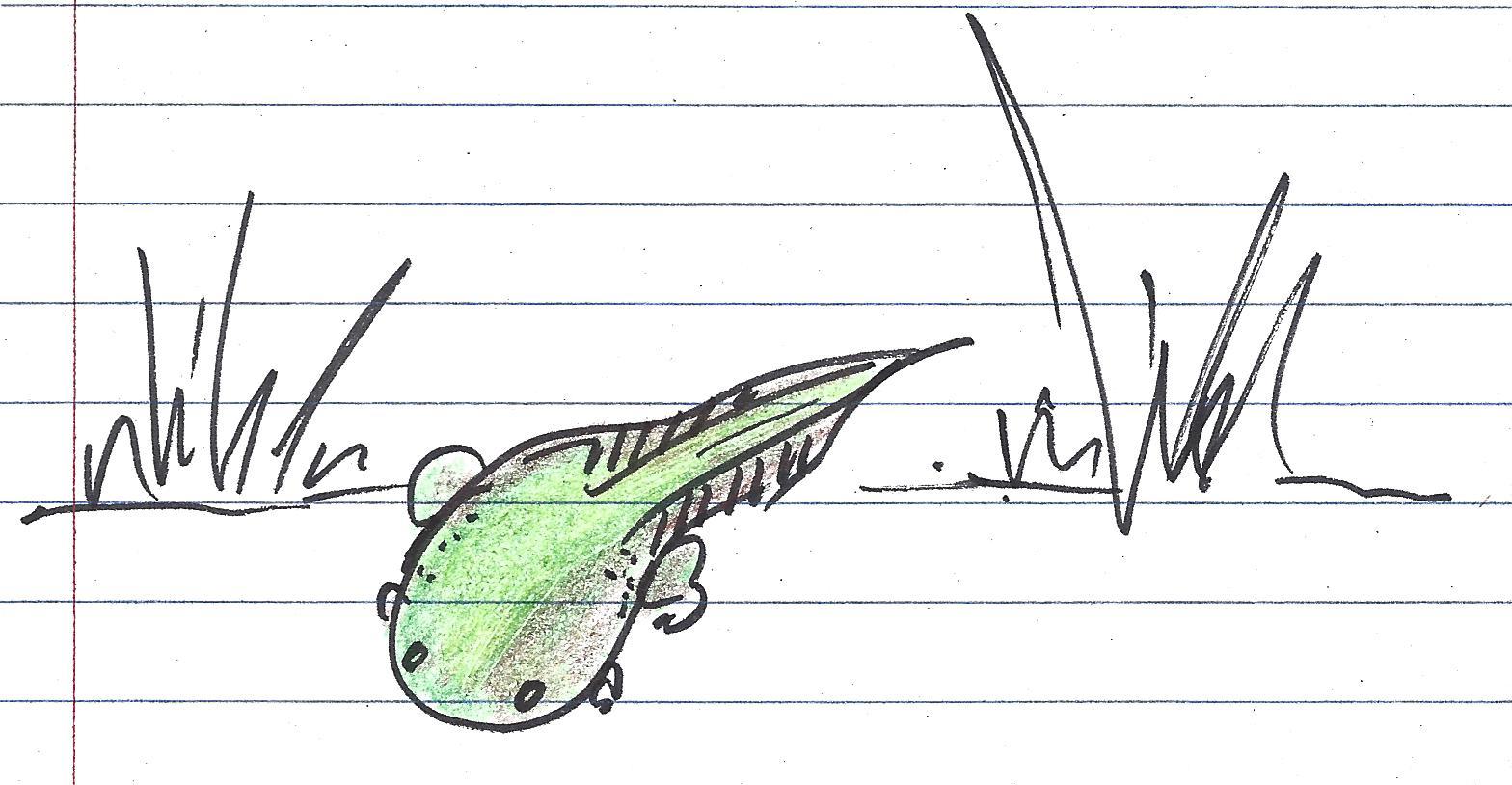
But what really turns my head is tadpole. This word is hatched from toad and poll, a “toad-head,” due to its top-heavy development. In some regions, it is known, delightfully enough, as a pollywog, joining that same poll with wiggle.
The connection couldn’t be better: The 2016 campaign for US President kicks off today, for all intents and purposes, and we will all soon squirm with polls like so many tadpoles in yet another political life cycle.
m ∫ r ∫


 Mashed Radish
Leave a comment