
Great God! Sometimes etymology offers us some sorely needed poetry.
“The world is too much with us,” William Wordsworth begins his eternal sonnet.
The world is too much with us; late and soon,
Getting and spending, we lay waste our powers;—
Little we see in Nature that is ours;
We have given away our hearts, a sordid boon!
Wordsworth, here, bemoans how alienated human life, preoccupied by our material affairs, has become from the awesomeness of nature.
Perhaps the world has been “too much” with my word origins, too. So, let me heed the Poet of Nature in my own etymological way.
With spring in season, I don’t have to go far to “have glimpses that would make me less forlorn,” as Wordsworth later longs.
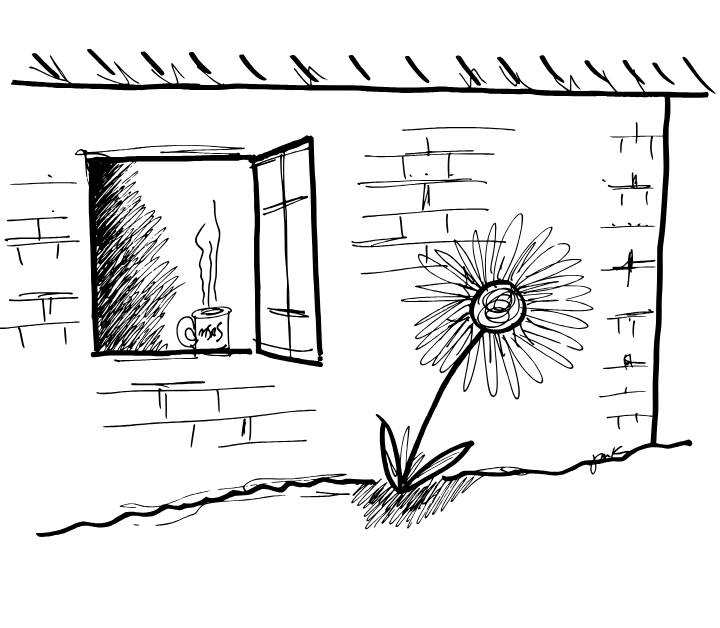
I can open a window to let in the warming breeze and, through it, behold a vernal bloom of a daffodil, crocus, or daisy.
I can even pluck a word like daisy or even window itself and discover in their origins tiny, perfect poems all their own.
I think I shall. And I think the world will still be there—will very much, too much going to be there—when I get back.
Never miss a mash! Feed your inner word nerd and subscribe to get Mashed Radish fresh in your inbox.
Daisy etymology
Means “day’s eye”
Daisy blossoms from the Old English dægesege, literally “day’s eye.” The flower is named for how its petals close at night and reopen at day.
If an Anglo-Saxon stripling picked a daisy in the mead for his maid, he would have pronounced that dægesege more like “daa-yuhs-eh-yuh.”
The first part of dægesege is dæges, the possessive form of dæg, which we now spell day. The second part, ege, is a form of ēage, now eye.
The Old English dæg is rooted in the Proto-Germanic *dagaz, possibly in turn from the Proto-Indo-European *agh-, referring to the unit of time, or *dhegh-, “to burn, warm.”
Despite any resemblance, the Old English dæg is not related to the Latin word for “day,” diēs, which is grounded in the Proto-Indo-European *dyeu-, “to shine.”
And despite no resemblance, the Latin word for “eye,” oculus, is, remarkably, related to the English eye. Both gaze out from the Proto-Indo-European *okw-, “to see,” as does the Greek ṓps.
Window etymology
Means “wind-eye”
Window opens up from the Old Norse vindauga, literally “wind-eye.” Borrowed into English by the 1200s, window replaced the native Old English word ēagduru, “eye-door.”
Picture the hoary scribe, peering up from his quill and parchment, to spy a sparrow through the “eye-door” of his stony chamber.
In the Old Norse vindauga, vind, a form of vindr, corresponds to the English wind; auga, to eye.
Vindr and wind share a root in the Proto-Germanic *windaz, from *wē-, the Proto-Indo-European for “to blow” and source of the Latin-based cognate vent.
Another word for window in Old English was ēagþȳrel, “eye-hole.” That second part, þȳrel, would now be spelled thirl, “to pierce” or “a perforation.”
While use of the word thirl has been effectively closed up, it lives on in the word thrill (as if penetrated by sudden emotion) and in nostril (literally, “nose-hole”).
Drill deeper into thrill, and its metathesis and thorn, in my previous Workplace Word Origin on the word.
As the Oxford English Dictionary (OED) instructs, vindauga, ēagduru, and ēagþȳrel “probably originally denoted the opening in the gable of an early medieval wooden hall … which allowed smoke to escape and also admitted some daylight.”
The OED goes on, noting fenester, from the Latin fenestra (“window”), coexisted with window in English into the 1500s. Originally denoting “an opening in the wall of a timber-framed or stone building of Mediterranean style,” the Latin fenestra may have Etruscan origins.
***
Wordsworth doesn’t end at “sordid boon,” of course. Let’s let the Poet of Nature speak his full piece.
The World Is Too Much with Us
By William Wordsworth
The world is too much with us; late and soon,
Getting and spending, we lay waste our powers;—
Little we see in Nature that is ours;
We have given our hearts away, a sordid boon!
This Sea that bares her bosom to the moon;
The winds that will be howling at all hours,
And are up-gathered now like sleeping flowers;
For this, for everything, we are out of tune;
It moves us not. Great God! I’d rather be
A Pagan suckled in a creed outworn;
So might I, standing on this pleasant lea,
Have glimpses that would make me less forlorn;
Have sight of Proteus rising from the sea;
Or hear old Triton blow his wreathèd horn.
 Mashed Radish
Leave a comment