Thanks to literal chess moves, the English word “check” ultimately derives from the Persian word for “king.” Plus, a surprising connection to your yoga practice.
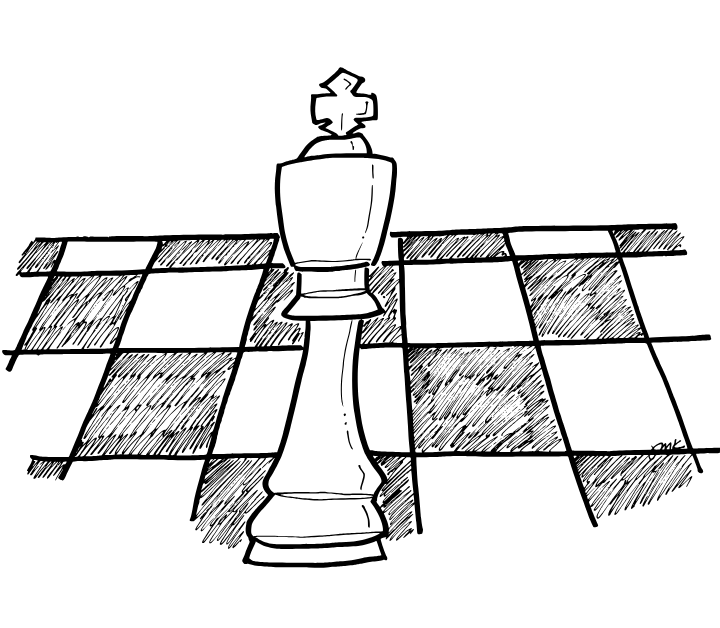
King of kings of the Iranians.
So Ardashir I, upon founding a dynasty that would rule Persia for over four hundred years, called himself.
Or as he put it in his tongue: Ardašīr šāhān šāh ērān.
Ruling 224–241 CE, Ardashir I inscribed his exalted epithet in resplendent rock reliefs and minted his majestic moniker on the coins of his vast realm.
Ardashir I spoke a language we now refer to as Middle Persian, written in a script known as Pahlavi. Rooted in an ancient Indo-Iranian self-designation, Ardashir I’s ērān evolved into the modern place name Iran, as I explored in my previous post.
And šāh? It becomes shah, the historic title for monarchs of Iran borne by Ardashir I and rulers centuries before and after him—a lineage emphasized in that expansive honorific of Shahanshah. The -ān of šāhān originates as a genitive plural marker.
Šāh also survives in the word check. Yes, check, as in:
- Checking your work
- Checking an item off a list
- Checking luggage
- Hotel checkout
- Annual checkup
- Checking out someone at the bar
- Feeling utterly checked out
- Keeping inflation in check
- Writing a check
Even as in, during a game of chess, exclaiming Check!
In fact, it’s that very chess move—of directly attacking an opponent’s king, which is checkmated if it cannot counter—that ultimately yields the multifarious meanings of check today.
Now that’s a legacy.
Never miss a mash! Feed your inner word nerd and subscribe to get Mashed Radish fresh in your inbox.
Fast Mash
Like the game of chess, this post is complicated. And long. Here’s a rundown for those looking for some etymological speed chess:
- Chess and check ultimately derive from šāh, Persian for “king”
- Persian šāh is shortened from xšāyaθiya, “he rules,” based in an Indo-European root meaning “to have power over”
- Chess begins as an ancient game called chaturanga, Sanskrit for “four members” and referring to major chess pieces
- Chess spread from India to Persia and on to Europe through Islam, the name evolving to emphasize the key move of check in the game
- In chess, check (noun, verb, interjection) refers to a direct attack on an opponent’s king, which, if not countered, results in checkmate
- Checkmate is from a Persian expression šāh māt, “the king has been conquered or confounded”
- The Islamic influence on chess survives in Arabic-based terms for the game, especially in Spanish (e.g., el ajedrez)
- Latin transformed Persian šāh into scaccus, which French turned into eschec and its plural eschès, which English turned into chess
- English also turned eschec into check, first evidenced in the early 1300s and referring to the chess move
- Early records of check and chess in English appear in some very colorful passages in some didactic texts
- Check underwent an extraordinary transformation in English, first evolving senses of “stopping or slowing progress,” then “restraining or regulating,” then “supervising, verifying, examining,” and on
- In finance, a check originally referred (early 1700s) to a counterfoil of bank documents functioning as checks against forgery or manipulation
- Banking check was influenced by exchequer, a historic English royal treasury named for its use of a chessboard-like grid for accounting
- Checkers (game) and checkered also allude to the chessboard pattern, via exchequer (French via Latin scaccārium, “chessboard”)
Shah etymology
The last shah of Iran was Mohammad Reza Pahlavi. He ruled Iran from 1941 until 1979, when the Iranian Revolution toppled the monarchy—and use of the title shah along with it. As we saw in my post on Iran, Shah Pahlavi prevailed upon the international community to refer to his country by the name Iran, not Persia.
The first shah of Iran, at least as far as the title is attested, was Cyrus II. He ruled Persia in 559–530 BCE after conquering the Menid Empire—but not, notably, oppressing his diverse subjects. Remembered as Cyrus the Great for his moderation and might, he was also christened messiah by Jews after he liberated them from Babylonia. Cyrus is the only non-Jewish person to bear the sacred designation of messiah, which is Hebrew for “anointed.”
The word shah comes from the Persian šāh, meaning “king” and written as شاه in Persian’s Arabic-based alphabet. It is shortened from the Old Persian xšāyaθiya, transliterated from the cuneiform 𐎧𐏁𐎠𐎹𐎰𐎡𐎹.
Parsed as an adjective meaning “ruling,” the Old Persian xšāyaθiya is reconstructed in the Indo-Iranian *kšáyati, “he rules, he has power over,” in turn rooted in the Proto-Indo-European *tke-, “to gain control or power over.”
Other offshoots of *tke- include the Sanskrit Kshatriya, a member of the military caste in Hinduism, and Xerxes, personal name of the famously Greek-defeated Persian king. Ancient Persian governors were satraps, an Old Persian word for “country-protector” in part derived from *tke-.
Chaturanga: a brief history of chess
Shah also helps form the word Shahnameh, Persian for “Book of Kings.” (Nāma is the Persian word for “book”; it’s related to the English name.)
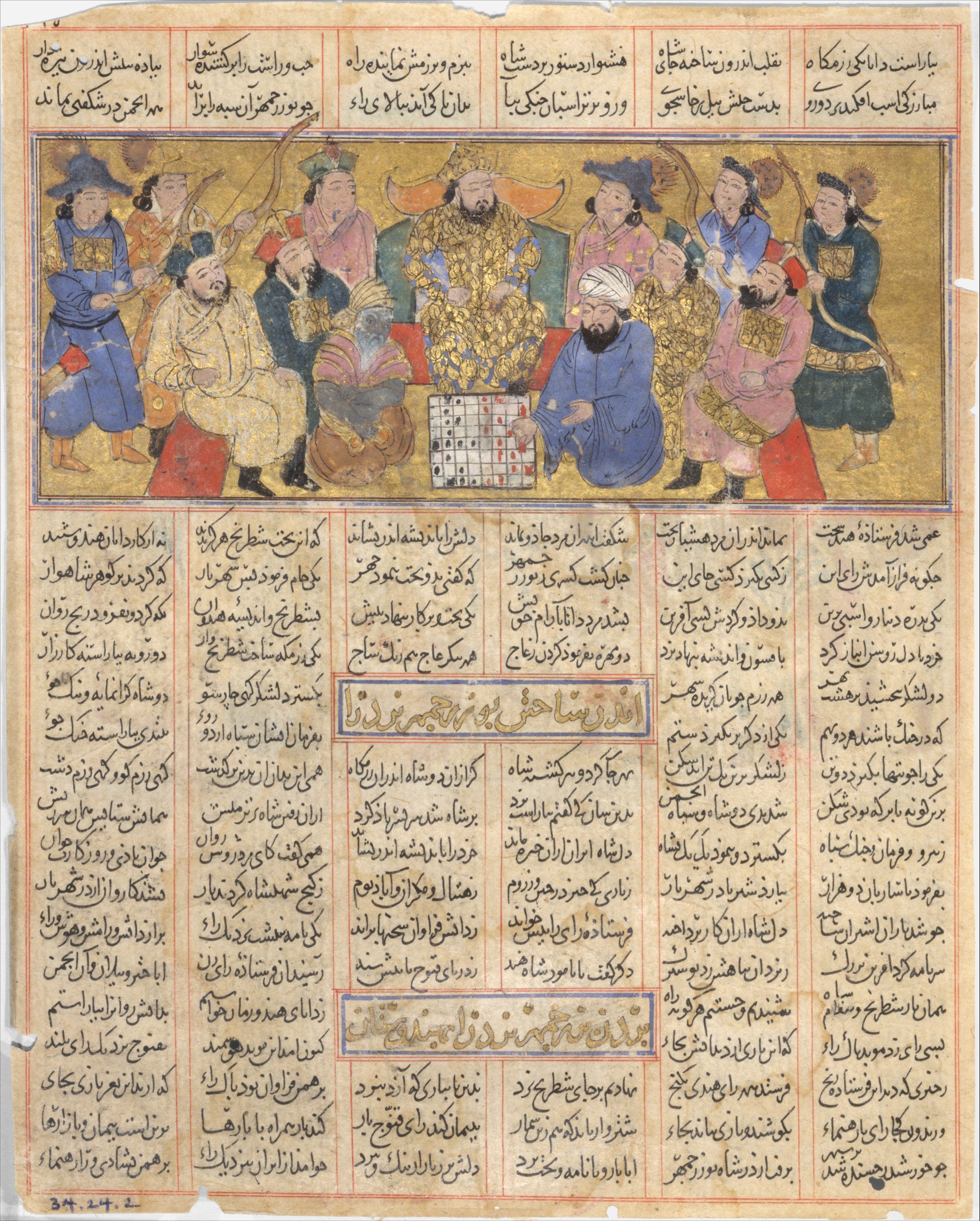
One of the world’s longest epic poems, the Shahnameh was composed by the poet Ferdowsi around 1000 CE. In this masterpiece of Persian literature and centerpiece of Iranian culture, Ferdowsi tells of myths, heroes, history—and even of chess.
In one tale, emissaries from the Indian king presented the Persians with the game of chess as a riddle to test their cunning. A wise vizier in the court of Khosrow I named Bozorgmehr puzzled out the game—which he would have called in Middle Persian čatrang when he lived in the mid-500s.
Čatrang comes from the Sanskrit cáturaṅga, or चतु॑रङ्ग in Devanagari script. Literally “having four members,” cáturaṅga refers to the four ancient military divisions of infantry, cavalry, elephantry, and chariotry. These correspond to pawns, knights, bishops, and rooks in chess.
If you have ever done yoga, you have surely posed your body in chaturanga, a low plank in which you hold yourself up—true to its name—on your four limbs.
The English word four is related to the Sanskrit catúr; angle to áṅga, “limb, member.”
A precursor to chess, the game chaturanga is indeed believed to originate in India at least by the 500–600s CE, thereafter spreading to Persia, where it occupied a distinguished place in its culture.
So, the broad facts here aren’t too far off Shahnameh’s fictions.
As the story in the Shahnameh continues, the sage Bozorgmehr invented the game of backgammon as a counter-challenge for those sagacious Sanskrit speakers.
And the Indians were stumped—checkmated, really.
Checkmate etymology
Checkmate ultimately comes from the Persian expression šāh māt, “the king has been conquered or confounded.”
Šāh means “king,” as we have seen. In addition to “conquered,” māt means “stunned, confounded, amazed.” The Persian māt itself became confounded with Arabic māta, “to die,” resulting in the interpretation of “the king is dead.”
The object of chess is checkmate: a player wins when she puts the opponent’s king in a direct attack, a check, from which it cannot escape.
So definitive is the move of check in chess that it became the prevailing European name of the game as it spread beyond the Middle East.
Evidence for chess in Europe is established by around 1000 CE. The vector? Islamic trade and conquest throughout the Mediterranean.
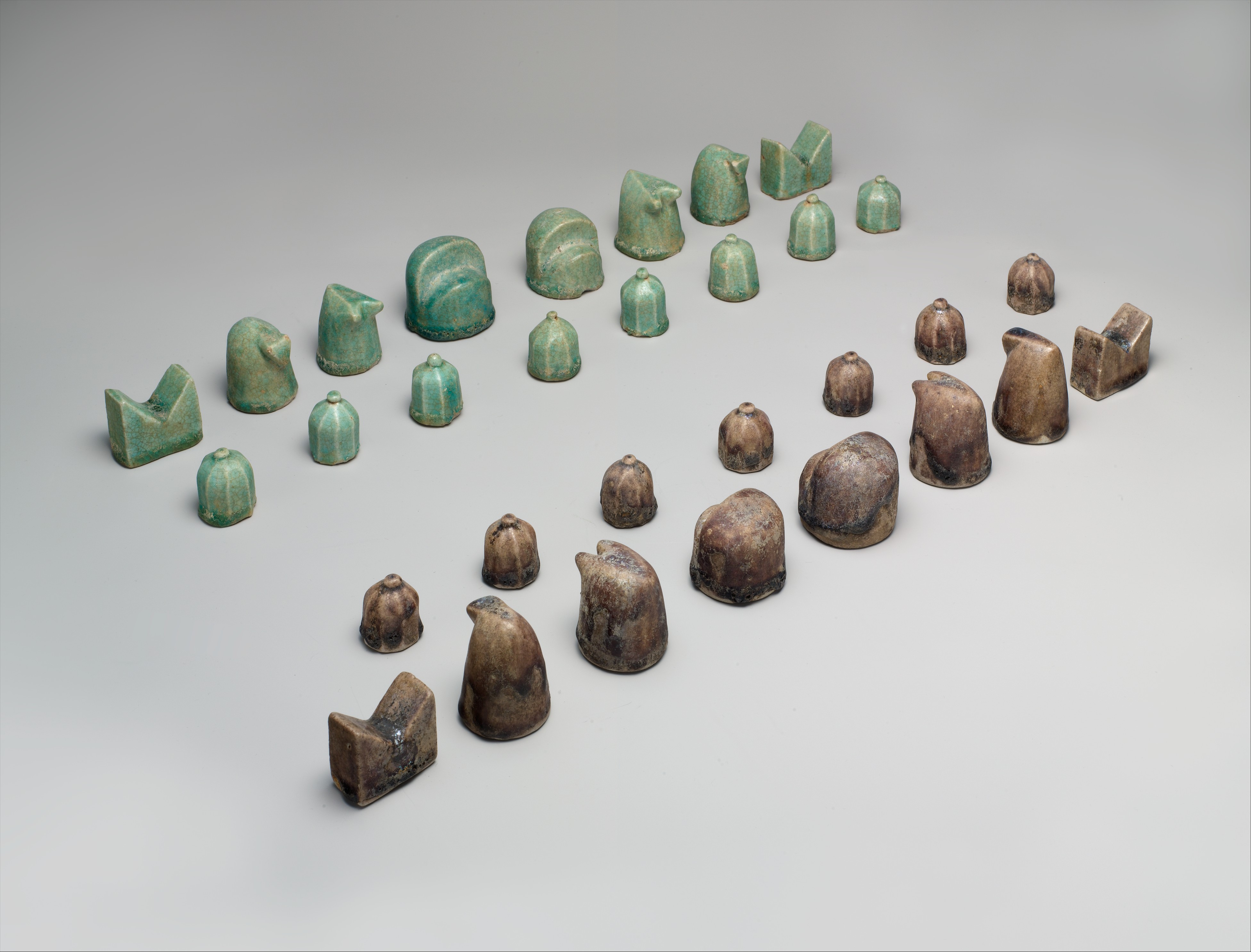
As Muslims picked up the game of chess by around 600 CE, they morphed the Persian čatrang into the Arabic šaṭranj (شطرنج), which English renders as shatranj.
The Arabic shatranj survives today in names for the game in the Iberian peninsula, much of which was ruled by Muslims from about 700–1500 CE.
That’s why the Spanish for chess is ajedrez; the Portuguese, xadrez.
Arabic chess terminology survives elsewhere in the Spanish alfil, from the Arabic al-fīl, “the elephant,” an ancient form of the chesspiece equivalent to the bishop. Similarly, Italian calls it alfiere. French, meanwhile, calls it fou, “fool”; German Läufer, “runner.”
Etymology of the word chess
So, where do we get the name chess?
The Persian name for the chief chessman, šāh, “king,” became the Arabic šāh. Medieval Latin positioned the Arabic šāh onto its lexical chessboard as scaccus, which French moved into eschec. The plural of eschec was eschès, which English then adopted as chess after sacrificing the pawn of the initial vowel in a process known as aphesis.
First referring to the pieces or board used to play the game, chess is first recorded in English in 1303. It appears in the form of chesse in Robert Mannyng’s penitential poem and metrical manual of Handlyng Synne:
Ȝyf hyt be nat þan redy, hys dyner,
Take furþe þe chesse or þe tabler;
So shal he pley tyl hyt be none,
And Goddys seruyse be al done.
Alas, wykkédly he dyspendyþ
Alle þe lyfe þat God hym sendyth!
The passage lambastes the rich man for missing church on Sundays—because he is slothfully preoccupied with his chessboard!
English captured the singular eschec in the form of chek by 1330. Here, it appears in the Auchinleck Manuscript, an invaluable illuminated manuscript comprising lives of saints, medieval romances, religious verse, and more.
One poem in the Auchinleck Manuscript relays the adventures of Guy of Warwick, a legendary English hero and knight. During a pilgrimage to the Holy Land, Guy is regaled with a story about a prince, Fabour, and Sadok, the son of sultan.
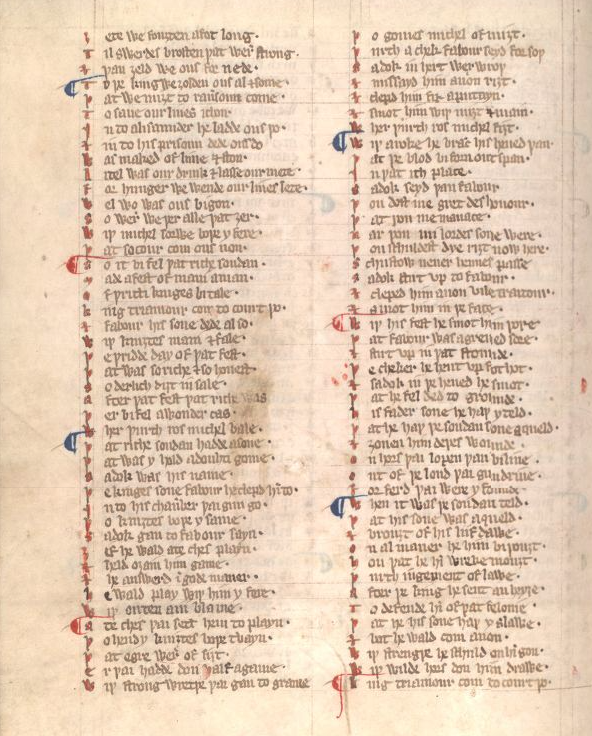
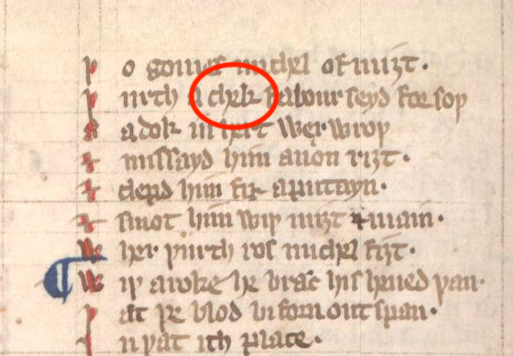
The two play a match of chess with a truly lethal endgame. After Fabour puts him in check, Sadok gets angry:
Þurth a chek Fabour seyd for soþ
Sadok in hert wex wroþ
& missayd him anonriȝt
Sadok beats Fabour over his head with rook (roke). Fabour counters by bludgeoning Sadok with the chessboard (cheker)—to death.
In this instance, the sin isn’t sloth, but wrath, if you will.
The origin and evolution of check
When your king is put in check, everything else stops. Your options include: moving the king, capturing the assailant, or blocking the attack with another piece. If you have none of these options, it’s game over. Checkmate.
So, checking arrests, hinders, thwarts, restrains. It’s from here that check was metaphorically extended as a noun and verb starting in the early 1400s to refer to various acts of stopping or slowing the progress of something, at first physically and then, over time, by a supervisory authority.
A key development comes around 1500, when the Oxford English Dictionary (OED) finds the verb check for “to dock or deduct someone’s wages as a penalty.” Another comes around 1600, when the OED finds the noun check for “a record of names and other details in a royal household, used in the calculation of wages, expenses, etc.”
It seems it’s from these early regulatory, supervisory, and record-keeping uses of check that the word makes its jump, like the L-shaped leap of a knight, to senses of verification, inspection, and examination.
By the end of the 1600s, check is recorded to mean “to examine or test something by comparison in order to regulate, evaluate accuracy, verify, etc.”
Enter the bank check—or as it’s spelled in British English, cheque.
The word originally signified a counterfoil—or, for those who claim American English, the stub of a ticket or, at one time, a check kept as a record or receipt. Think: the little tear-off you get for a coat check or baggage check.
The historic function of a counterfoil, as the OED helps us out, was as a check against forgery or alteration of various bank documents. It validated. It restrained fraud. And so by the late 1700s, check denoted a written order to a bank to pay the stated amount from the drawer’s account.
The “restaurant bill” sense of check is recorded by 1786. A check mark, now usually represented as ✓, is found slighter earlier in 1780.
On the chessboard: exchequer, checkers, checkered
Why do the British spell it cheque? That was probably influenced by the word exchequer and its related shortened form chequer. Recorded in English by 1300, an exchequer first referred to a chessboard. It comes from the French eschequier, in turn from the Medieval Latin scaccārium, “chessboard,” based on scaccus, the Latin word for “chess.”
Exchequer soon went on to name the King’s Exchequer, a governmental department established by the Norman kings of England that was responsible for collecting, administering, and arbitrating royal revenues. Its accountants used a table, dubbed an exchequer, covered in cloth divided into squares on which they reckoned sums using counters. This table was thought to resemble a chessboard, hence the name.
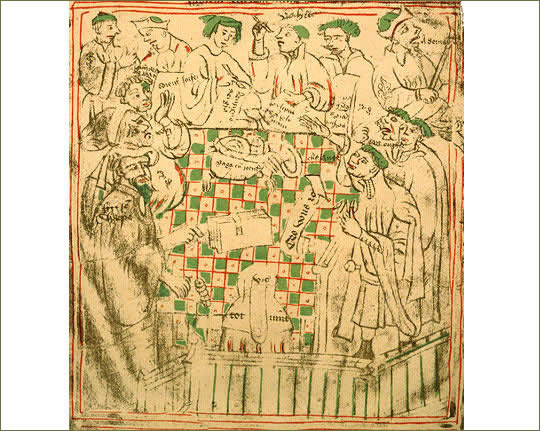
And the pattern of a chessboard, outfitted with squares of alternating color? We call that checkered precisely because of the chessboard, as we do the game of checkers, which is played on a similar board. Despite that similarity, checkers, known as draughts in British English, originates in an ancient game called alquerque, from Arabic for al (“the”) and qirq, the name of a precursor game.
 Mashed Radish
Leave a comment