
The name Iran, rooted in an ancient self-designation, has survived the rise and fall of empires past and present.
Without congressional authorization, evidence of imminent threat, or communication of any strategy, the US attacked Iran in a joint operation with Israel early Saturday morning.
The attacks killed the merciless and murderous Supreme Leader of Iran, Ayatollah Ali Khamanei. Iran, meanwhile, reported that over 80 schoolgirls were killed in a strike. What’s next, for an already volatile Iran, region, and world, remains uncertain.
One small, inconsequential thing that is certain is that my 2026 theme—the origins of the names of the places in our breakneck, Trump-broken news—continues apace on Mashed Radish with Iran.
Never miss a mash! Feed your inner word nerd and subscribe to get Mashed Radish fresh in your inbox.
Carved in rock: the etymology of Iran
The origin of the name Iran is, in one way, simple: it goes all the way back to an old word in an old language that means “of the Iranians.”
And yet in the name Iran we can flip over the hourglass and reverse the sands of time, glimpsing in these two mere syllables so much history—and complexity.
That old language? Middle Persian. That old word? Ērān.
Or, as it was written in Pahlavi, the script used to write Middle Persian, 𐭠𐭩𐭥𐭠𐭭. Reading right to left, 𐭠𐭩𐭥𐭠𐭭 transliterates to ‘y’rn and is pronounced as ērān.
Middle Persian refers to a historic period of the Persian language, today also known as Farsi and written in Arabic script. Persia is from the Persian Pārs, whose equivalent is Fārs in Arabic, hence Farsi. (Arabic has no native p sound.)
The Persian language is a member of the Iranian branch of the Indo-European family. That means, yes, Middle Persian is a (very) distant relative of English!
As David Neil MacKenzie, a British scholar of Iranian languages, explained in the remarkable resource, Encyclopædia Iranica, “The word ērān is first attested in the titles of Ardašīr I … founder of the Sasanian dynasty.” Evidence comes from “his investiture relief at Naqš-e Rostam in Fārs, and subsequently on his coins …”


Reigning 224–241 CE, Ardashir I overthrew the Parthian Empire and founded the Sassanian dynasty, which ruled ancient Persia for over four centuries until the Muslim conquest in 651.
Into the rocks of Naqsh-e Rostam, not far outside the ancient capital of Persepolis in the Fars province of modern-day Iran, Ardashir I, depicted on horseback receiving his kingship from the supreme Zoroastrian creator god Ahura Mazda, inscribes himself trilingually in Middle Persian, Parthian, and Greek as “Ardashir, king of kings of the Iranians.”


A linguistic concept: the etymology of the loaded Aryan
So, Iran first referred to Iranian peoples—or the Aryans, as they were once called.
Aryan is now a very dated—and loaded—term. In the 1800s, some scholarship proposed a single Aryan race from which all Indo-European peoples and languages descended. French writer—and raging bigot—Arthur de Gobineau perverted this hypothesis into his pseudoscientific race theory, positing northwest European descendants of this invented ancient group as a master race. Hitler further warped this ideology into his Nordic, blond-haired, blue-eyed, non-Jewish racial paragon of the Aryan.
The term Indo-Iranian has now supplanted Aryan for that family of Indo-European languages spoken in ancient northern India and Iran.
And that is indeed how these peoples identified themselves—linguistically—as Rüdiger Schmitt, German scholar of Iranian languages, explained in the Encyclopædia Iranica:
The name “Aryan” … is the self designation of the peoples of Ancient India and Ancient Iran who spoke Aryan languages, in contrast to the “non-Aryan” peoples of those “Aryan” countries … “Aryan” is thus basically a linguistic concept, denoting the closely related Indo-Aryan and Iranian languages (including Nūrestānī), which together form the Indo-Iranian or Aryan branch of the Indo-European language family, sharing a linguistic and cultural development separate from the other [Indo-European] tribes.
In Middle Persian, “non-Aryan” was anērān (𐭠𐭭𐭩𐭥𐭠𐭭). Yes, that very an- is a negating suffix, meaning “not,” related to the Greek-based a-/an- appearing in English, e.g., apathy or anarchy.
Gentilics, autonyms, and cuneiform: deeper into the history of Iran
Now, grammatically speaking, linguists may describe the Middle Persian ērān as the substantivized oblique plural of the gentilic adjective stem ēr-.
Let’s break that down:
- Substantivized: converted from a verb, adjective, et al. into a noun
- Oblique: denoting a case ending other than nominative (subject) or vocative (address)
- Gentilic: a word form indicating the country, place, etc. a person or thing is from (similar to a demonym)
The stem ēr– derives from the Old Iranian *arya-, in turn reconstructed in the Proto-Indo-Iranian *aryas, an autonymic ethnonym for the Indo-Iranians.
- Autonymic: referring to the name by which people refer to themselves
- Ethnonym: the name a people or ethnic group is known by
The Proto-Indo-Iranian *aryas morphed into the Sanskrit ārya, or आर्य, as it’s written today in Devanagari script for this self-designation for people who spoke the language of the Vedas, the ancient sacred texts establishing Sanskrit literature and Hinduism.
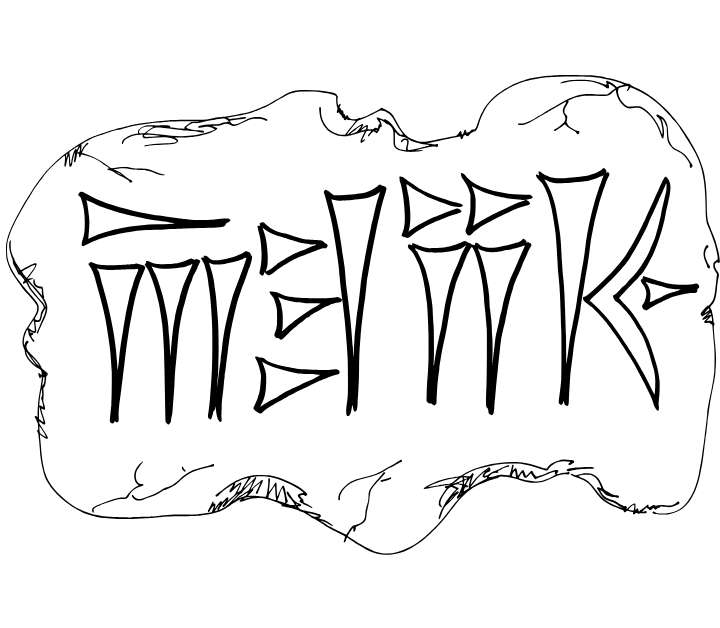
In Old Persian, ancestor of Middle Persian, *aryas became aryah, or 𐎠𐎼𐎡𐎹 in Old Persian cuneiform. That’s right, cuneiform: the wedge-shaped, logo-syllabic, clay-tablet-impressing, earliest-known writing system originating in the Middle East.
How do we know? The Old Persian aryah is preserved in stone inscriptions on monuments in the sometime capital of Susa built by Darius I, one of the King of Kings of ancient Iran’s Achaemenid Empire, in the 500–400s BCE. Darius I, known as Darius the Great, was buried in the same Naqsh-e Rostam, home to the first evidence of the name Iran.

Despite many lexical adventures by several Indiana Jones of historical linguistics, the deeper roots of the Proto-Indo-Iranian *aryas remain obscured by time.
With no discernible Proto-Indo-European root and potential origins as a loanword from a non-Indo-European language, such as the ancient Semitic language Ugaritic, proposals to crack *aryas‘s verbal nut of ar– include meanings of to move, plough, fit, allot, shape, and beget. A strong contender is to fit, semantically fashioning ar- into “compatriot,” a fellow Indo-Iranian—that is, “of the Iranians.”
From people to place: the evolution of the name Iran
As engraved in a structure known as Kaaba-ye Zartosht (Cube of Zarathustra) at Naqsh-e Rostam, the son of Ardashir I, Shapur I, pronounced himself as the “ruler of ērānšahr,” using as ērānšahr for his empire and meaning “land of the Aryans/Iranians.” Šahr, or 𐭱𐭲𐭥𐭩 in Pahlavi script, is “land, country.” It helps form the word satrap, a powerful governor in ancient Persia.


In referring to the empire, ērānšahr became shortened to ērān in the early course of Sassanian power. West of them, the Roman realm was called anērān: “not-Iran.” Those Romans called Iran by the Latin name of Persia; the Greeks Persis, hence Persepolis, “city of the Persians,” whose magnificent edifices Darius I built.
Both Persia and Persis derive from the Old Persian Pārsa, or 𐎱𐎠𐎼𐎿, surviving today, as we saw, in Pārs and Fārs, written پارس.
As sociolinguists Maryam and Habib Borjian have explained in their work:
‘Iran’ and ‘Persia’ are synonymous. The former has always been used by the Iranian-speaking peoples themselves, while the latter has served as the international name of the country in various languages, ever since it was introduced by the Greek some 25 centuries ago. In 1935, however, the national administration under Reza Shah Pahlavi made a successful effort to replace ‘Persia’ with ‘Iran,’ apparently to underline the nation’s ‘Aryan’ pedigree to the international community.
The Borjians go on to add some important, reinforcing context about the term Aryan worth quoting here:
The latter term used to signify all branches of the Indo-European language family (and even the ‘race’ of their speakers) but it was practically abandoned after World War II. In scholarly usage, ‘Aryan’ is occasionally used as a synonym of ‘Indo-Iranian’ in the linguistic sense.
Reza Shah Pahlavi, by the way, founded the Pahlavi dynasty, whose monarchy was toppled during the Iranian Revolution in 1979. His grandson is Reza Pahlavi, who is now positioning himself to take over the country in the wake of the US and Israeli attack.
***
I find it incredible that we know all this—the history of the name Iran, the rise and fall of empires the name withstood. Incredible that the inscriptions and reliefs and tablets survive. Incredible that people cracked the code of ancient, almost otherworldly scripts.
I find it incredible that, amid so much rock and rubble, so much can persevere. That, amid so much destruction, from the arrows fired by Darius the Great’s army to the missiles and drones launched by US warships, so much can endure.
But what perseveres? What endures?
“Look on my works, ye Mighty, and Despair!” Percy Bysshe Shelley’s traveller quotes from the ruined monument in his great poem “Ozymandias.”
The reign of Ozymandias, King of Kings ended. His flesh—mummified. His temples—faded, fragmented, eroded, dismantled from their original fearsome, pharaonic glory.
But “Round the decay” of Shelley’s “colossal Wreck” and in the sands stretching far and away, inscriptions survive. Memory survives. History survives.
And names, too. Like Iran, so little changed, really, from when Darius or Ardashir or Sapur or Reza Shah Pahlavi or Ayatollah Ali Khamanei or whoever next rules the too-oft besieged people who still bear that appellation from such an awesomely “antique land.”

Leave a Reply