
Of beards, fields, curtains, and sparkly rocks
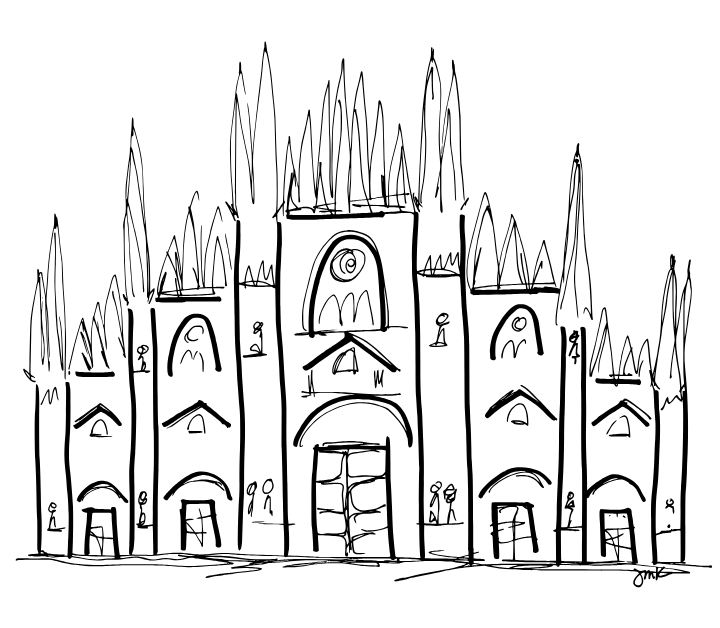
A theme for 2026 on Mashed Radish has definitely emerged—and it is the origin of place names in the news, including Venezuela, Minneapolis, Greenland, and Denmark.
Last post, I explained how the city Milan, joint host of the Winter Olympics with Cortina, gave us the word milliner for a women’s hatmaker.
This post, I give the toponym treatment to Milan itself, then head up into Cortina, nestled, as it is, in the Dolomites stretch of the Alps. Both cities fall within Lombardy, Milan being the capital of this region of northern Italy.
That’s a fitting place to start, Lombardy, coming off Super Bowl LX—in which a dominant Seahawks took home the Lombardi Trophy, named for famed coach, hat-wearer, and Italian son Vince Lombardi, from host city San Francisco, one of whose many landmarks is a serpentine stretch of Lombard Street, named after a historic thoroughfare in Philadelphia.
Never miss a mash! Feed your inner word nerd and subscribe to get Mashed Radish fresh in your inbox.
Lombardy etymology
Possibly from Germanic for “long beards”
- Italian name is Lombardia
- Named after the Lombards, a Germanic people who invaded Italy in the sixth century and ruled the area until 774
- Lombard is contracted from the Latin Langobardus, from the Germanic *Langabardaz
- The lang– element is based on the Germanic *langaz, meaning and related to long
- The –bard element has been thought to refer to beard, making Lombard “long beards”
- But –bard it is more likely rooted in a Germanic ethnic name
Milan etymology
From the Celtic for “middle of the field”
- Italian name is Milano
- Based on the Latin Medialano, the Roman name for the city
- Medialano is thought to be based on its Gaulish name, Medhelanon
- Gaulish is the Celtic language spoken by the Gauls, a tribe of which, the Insurbes, founded a settlement at Milan as early as 600 BCE
- The Celtic medhe– element means “middle, center”; middle is indeed related
- The Celtic –lanon element means “field, plain”; plain is indeed related
- So, Milan is literally “(settlement in the) middle of the flat area”
Cortina etymology
From the Latin for “curtain”
- Full name is Cortina d’Ampezzo
- Literally, “Curtain of the Ampezzo,” a basin in a valley of the Alps
- Originally an Etruscan settlement, later ruled by the Holy Roman Empire, Hapsburgs, Austrian Empire; only joined Italy in 1920
- Italian cortina, “curtain,” has historical sense of “piece of enclosed land”
- English curtain is closely related, from French cortine
- French cortine and Italian cortina go back to Late Latin cortīna, “curtain”
- Origin of Ampezzo is obscure, possibly from Latin roots referring to the terrain or native plants there
A peek behind the etymology of curtain
Earlier in Latin, cortīna meant “cauldron,” rooted in a form of cohors, “court, enclosure” and source of the very words court and cohort.
Later, however, its meaning shifted to “curtain,” apparently because cortīna was used in the Vulgate as a loan translation of the Greek αὐλαία (aulaía), “curtain.”
Aulaía is based on the Greek noun aulḗ, “court, chamber,” perhaps, as the Online Etymology Dictionary observes, “because the ‘door’ that led out to the courtyard of a Greek house was a hung cloth.”
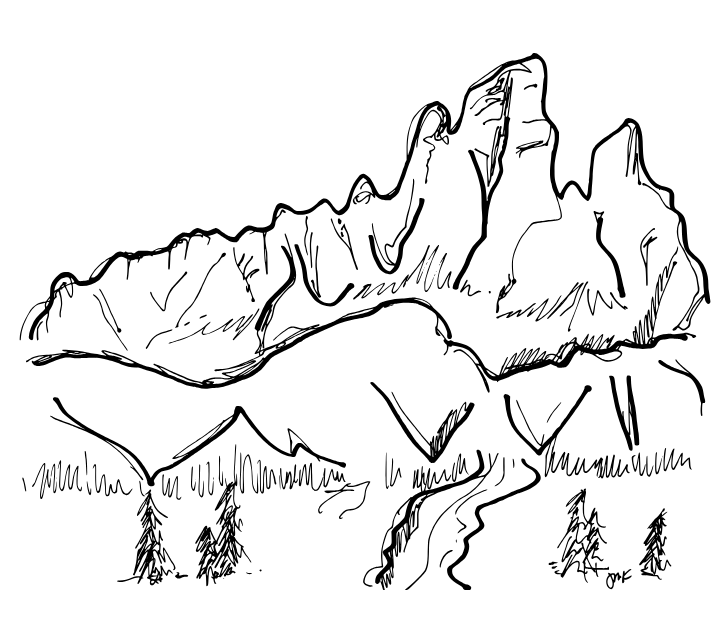
Alps etymology
Probably from an ancient, non-Indo-European word
- From Latin Alpēs, name of the mountains
- Probably related to Germanic words, like Middle High German albe, meaning “mountain pasture”
- Further etymology uncertain, but likely from a non-Indo-European source
- Historically was connected to the Latin albus, “white,” and Celtic alp, “protuberance”
- While Alps in the plural refers to the impressive European mountain range, an alp in the singular can indeed refer to any high, snow-capped mountain peak
Dolomites etymology
Named after French geologist Dieudonné Dolomieu
- Part of the Alps in northern Italy
- Named for the mineral dolomite, prominent in the limestone there
- Dolomite, in turn, is named for 18th-century French geologist Dieudonné Dolomieu, who discovered the mineral in the Alps in 1791
***
For the origins of the names of the major sports speeding and spinning down the Dolomites, see my coverage of Winter Olympics sport words Part I and Part II, refreshed from the archives.


 Mashed Radish
Leave a comment