
English’s core vocabulary for winter weather has largely been frozen—or as we used to say, “froren”—in place.
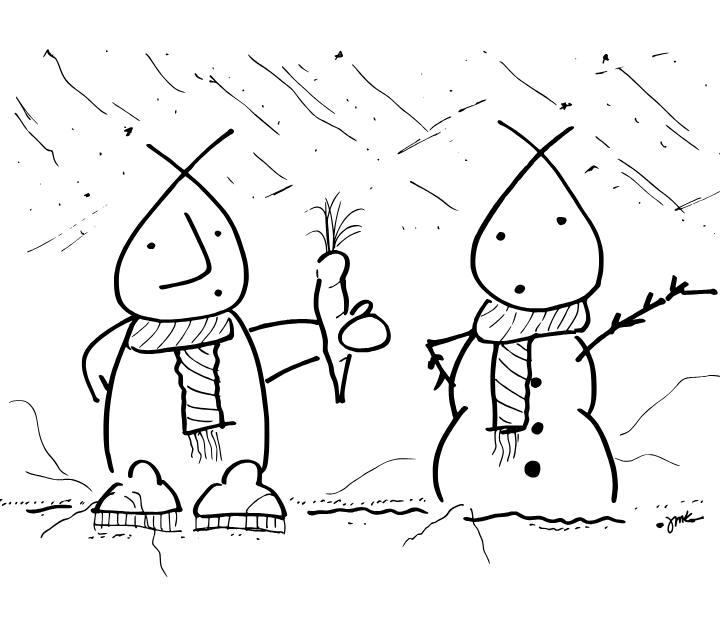
I don’t think the coldest I’ve ever been—even now as I and much of the US have been bundling up from an Arctic blast that trailed a massive snowstorm—was in the belly of subzero winters in Minneapolis or at the summit of a vertiginous volcano I once trekked in Chile.
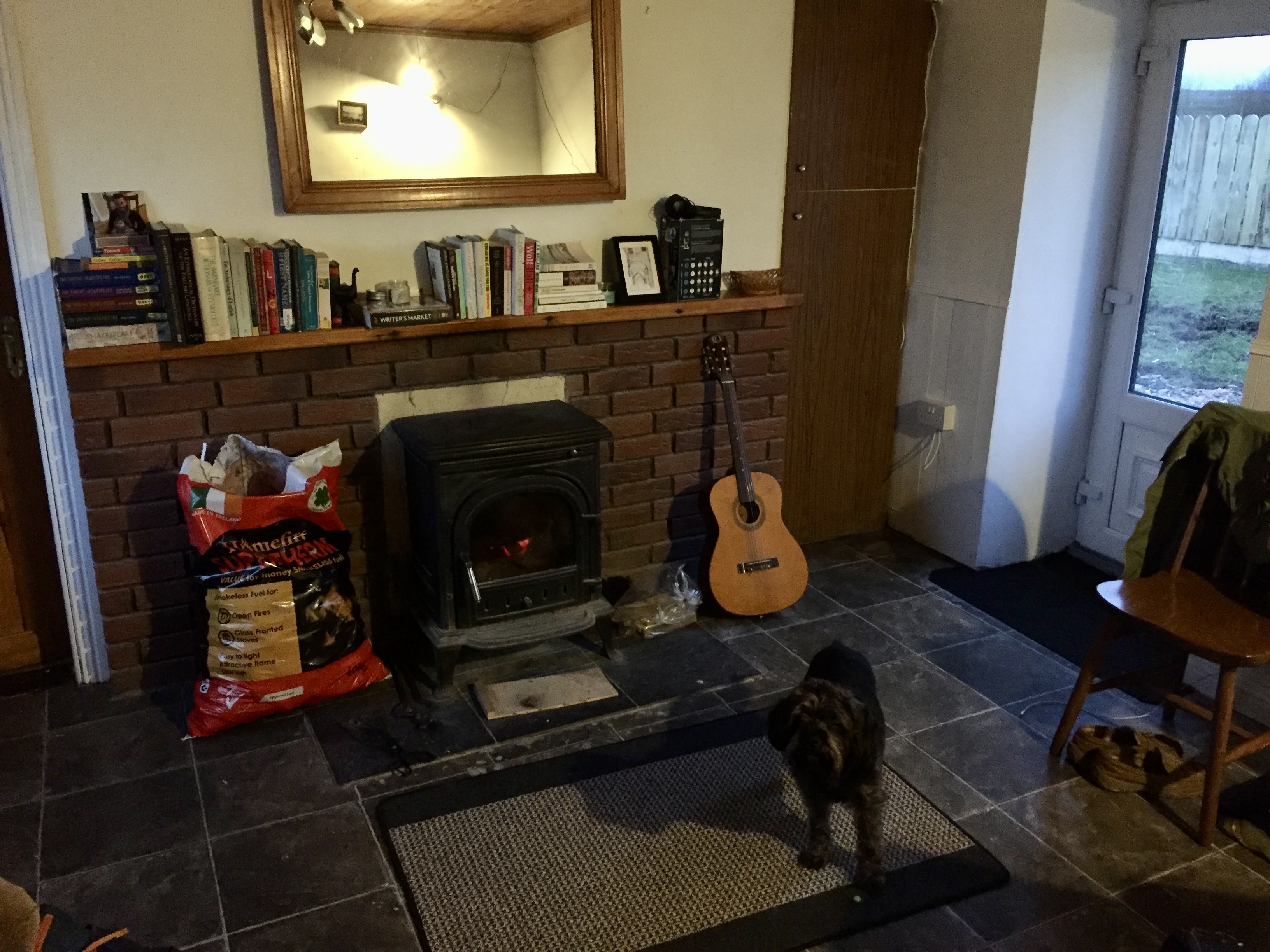
It was actually in Ireland, when I sojourned in a humble cottage tucked along a country road in County Sligo.
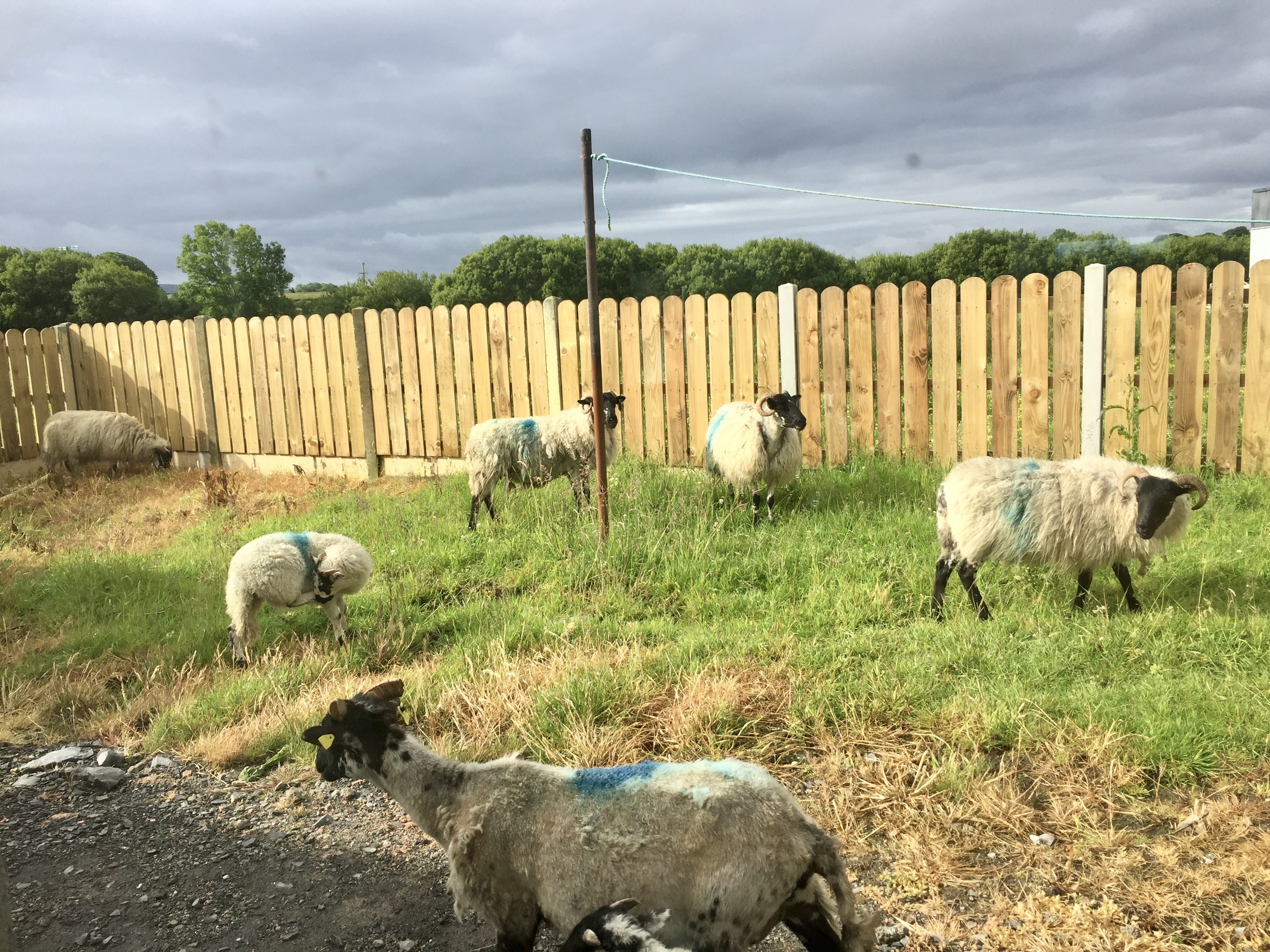
I had my dog Hugo, an internet connection, a bicycle, more booze than food (regrettably), my etymology tomes, the occasional company of whatever sheep roved into the yard during their grazings, and a bag of coal and some stacks of peat briquettes for the old stove.
The raw temperatures never dipped too low, but the damp—the damp, as the Irish called it—had a way of seeping into your very bones.
And that’s where we find the core vocabulary for the cold in English: deep in its bones.
Nearly unchanged from their Old English parents. With instantly recognizable cousins in Germanic languages today. Hoary forebears in Proto-Germanic—and yet grayer in hair and longer in tooth, Proto-Indo-European.
In this post, I pick up my snow shovel, as it were, to clear the etymological path for:
- winter
- cold
- snow
- ice
- icicle
- frost/freeze
- hail
- sleet
- slush
- blizzard
- arctic
The post is long, but each section is short—and the key info is bulleted. I think you’ll skate through it.
Never miss a mash! Feed your inner word nerd and subscribe to get Mashed Radish fresh in your inbox.
A note or *dwo– on protolanguages
It’s been a while since I extensively treated Proto-Germanic and Proto-Indo-European on Mashed Radish, so I think a few notes will aid the less acquainted reader.
Proto-Germanic is an unrecorded language believed to have been spoken along the shores of the Baltic sea and from which arose the Germanic languages.
It, in turn, descended from Proto-Indo-European, the proposed common ancestor of the Indo-European languages, ranging from Albanian to Irish to Persian to Russian to Welsh, thought to originate on the steppes of Eastern Europe and Central Asia.
Proto-Germanic and Proto-Indo-European, as their names imply, are known as protolanguages. These are hypothetical, undocumented parent languages from which actual languages derive.
Protolanguages weren’t written down, but when historical linguists make comparisons in the features of their daughter languages, they can reasonably reconstruct parts of its sound, structure, and lexicon.
You’ll notice a few things about the proto-words I cite in this post:
- They begin with asterisks. In historical linguistics, the asterisk is a used to mark a form as unattested, i.e., it has not actually been documented but it can be reasonably supposed to have taken that form.
- They end with a dash. The dash is used to indicate a stem form, i.e., the root onto which inflections (e.g., case endings) are added to change grammatical function. Indo-European languages are highly inflected.
Without further ado, let it snow!
Winter
- From Old English winter
- Inherited from Proto-Germanic *wintruz
- Possibly reconstructed in Proto-Indo-European *wed– (water, wet)
- Compare: German Winter, Dutch winter, Swedish vinter
The Proto-Germanic *wintruz does not share clear connections to other Proto-Indo-European languages, whose winter root is *ghei-.
That root, *ghei-, drifted into the Latin hibernate, the Greek chimera, and Himalayas, Sanskrit for “snow abode.”
Mashed Radish has built up some etymological snowpack over the years. I covered winter— complete with musings on William Shakespeare and Wallace Stevens—back in 2013 in a series on the names for the four seasons.
Cold
- From Old English cald, ceald
- Inherited from Proto-Germanic *kaldaz
- Rooted in Proto-Indo-European *gel- (cold, to freeze)
- Compare: German kalt, Dutch koud, Swedish kall
The noun cold caught its cold, if you will, from the adjective.
The verb stem of the Proto-Germanic *kaldaz is *kal-, “to be cold,” from which formed the frigid pair of cool and chill, among others.
Latin derivatives of the Proto-Indo-European *gel- have produced some lexical accumulation in English, including congeal, gel, gelatin, glacier, and jelly.
Snow
- From Old English snáw
- Inherited from Proto-Germanic *snaiwaz
- Rooted in Proto-Indo-European *sneigwh– (snow)
- Compare: German Schnee, Dutch sneeuw, Swedish snö
Snow is just a vowel shift away from the Old English cloud it fell from.
Niveous is a unique snowflake of a word. It means “snowy” and derives from the Latin niveus, descended from that Proto-Indo-European *sneigwh-.
Snowflake is recorded by 1734; snowstorm, 1771; snowman, 1827; snow angel, 1918; snow day, 1951. Snowshoe precedes them all: 1674.
Ice
- From Old English ís
- Inherited from Proto-Germanic *īs
- Reconstructed as Proto-Indo-European *eis– (ice, frost)
- Compare: German Eis, Dutch ijs, Swedish is
The original pronunciation of ice, as ís, rhymed with geese. The pronunciation—and spelling—of ice shifted during Middle English. Otherwise, the word ice has, as a word, been frozen shut.
Icicle
- Equivalent to ice + ickle
- Ickle meant “icicle”
- Modern spelling influenced by –icle, Latin-based diminutive (e.g., particle)
- Ickle is from Old English gicel
- From Proto-Germanic *jekilaz
- Reconstructed in Proto-Indo-European *yeg– (ice)
Icicle is literally “ice icicle”! Merriam-Webster’s word story on icicle is worth quoting:
Old English gicel, meaning icicle, became Middle English ikyl or ikel and later modern English ickle, which survives as a dialect word in Yorkshire, England. The word for ice in Old English is is, and in a manuscript of about the year 1000 we find Latin stiria, “icicle,” glossed, somewhat redundantly, as ises gicel, that is, “an icicle of ice.” Some 300 years later, in Middle English, this became the compound known today as icicle, which means precisely what it did 1000 years ago.
Meanwhile in Icelandic, the Proto-Germanic *jekilaz snowballed into jökull, where it means “glacier.”
The German counterpart is Eiszapfen, literally “ice tap or plug.” Similar is the Swedish istapp. The Dutch ispegel is like icicle—also apparently “ice icicle.”
Frost
- From Old English forst, frost
- Inherited from Proto-Germanic *frustaz
- Rooted in Proto-Indo-European *preus– (freeze, burn)
- Compare: German Frost, Dutch vorst, Swedish frost
Closely related to frost is freeze, from the Old English fréosan. The original past participle form of freeze was froren.
(I’m imagining Disney’s hit films, Froren and Froren 2).
Froren morphed into the adjective frore, meaning “frosty, frozen,” largely preserved now in poetry, as in Book 2 of Milton’s Paradise Lost:
Beyond this flood a frozen Continent
Lies dark and wilde, beat with perpetual storms
Of Whirlwind and dire Hail, which on firm land
Thaws not, but gathers heap, and ruin seems
Of ancient pile; all else deep snow and ice,
A gulf profound as that Serbonian Bog
Betwixt Damiata and mount Casius old,
Where Armies whole have sunk: the parching Air
Burns frore, and cold performs th’ effect of Fire.
Here, Milton describes a region of Hell so cold it is, paradoxically, fiery.
Exposure to extreme cold does have the sensation of burning, however. We see that contrast even in the Proto-Indo-European base of freeze and frost, *preus-, meaning both “freeze” and “burn.”
The notion of a burning desire—or in Latin, itching—yields the lewd-minded prurient. This adjective comes from the Latin prūrīre, “to itch, tickle, be sexually aroused.”
Related to prūrīre is pruīna, “frost, winter,” and prūna, “live coal,” ultimately from that Proto-Indo-European *preus-.
Neither are to be confused with Purina ®or prune.
Hail
- From Old English hagal, hagol
- Inherited from Proto-Germanic *haglaz
- Reconstructed in Proto-Indo-European *kaghlo– (pebble, hail)
- Compare: German Hagel, Dutch hagel, Swedish hagel
Sleet
- From Middle English slete
- Likely from unrecorded Old English *slét
- Possibly reconstructed in Proto-Germanic *slautijǭ
- Further origin obscure
Slush
- Originally meant “partially melted snow or ice”
- Recorded by at least 1642
- Possibly from a Scandinavian source, connected to Danish slus (sleet, mud) or Norwegian slusk (sloppy ground)
- Probably influenced by sludge and, older, slutch
- All are likely imitative
Blizzard
- Earliest senses, from 1829, were “violent blow”
- Davy Crockett famously used blizzard twice in the 1830s, once for a blast of a rifle and another for a blast of words
- The “severe snowstorm” sense dates back to at least 1859
- Early uses of meteorological blizzard into 1880s remark on it as a novel (Upper) Midwest American regionalism
- Further origin is obscure
Also in the Mashed Radish archival snowpack is blizzard, into whose origin we have limited visibility.
The great etymologist Anatoly Liberman, however, sees a way:
In British rural speech, there existed a sound imitative complex blizz expressing the idea of great quickness. When the suffix –ard was added to it, the new word began to denote all kinds of things having an immediate effect on its victim
Arctic
- Recorded in English by 1400 for the northern celestial sphere
- Has referred to the Arctic region since 1678
- Adjective for something remote and icy since 1500s; extremely cold, 1870s
- From French via Latin via Greek ἀρκτικός (arktikós), meaning, “of the Bear, northern”
- “The Bear” here refers to the long-mythed constellation Ursa Major
- Ursa Major is prominent in the northern part of the celestial sphere
- Antarctic is based on Greek for “opposite to the north,” hence the South Pole and associated region
The Greek ἀρκτικός is based on ἄρκτος, “bear,” which is related to ursa, the Latin for “bear.” Both trace back to the Proto-Indo-European *rtko-, as might be the Welsh name Arthur, thought to mean “bear man.”
The English bear is from a Proto-Germanic root meaning “the brown one.” The name of the color brown is indeed related. The “brown one” is thought to be a form of taboo replacement: ancient hunters believed it taboo to utter the names of prey.
Maybe there’s a lesson there for us. When it gets too cold, we don’t just need warm thoughts—but warm words, too.


 Mashed Radish
Leave a comment