
While relatively straightforward as etymologies, the origins of “Greenland” and “Denmark” do provide important historical insights into these two proud lands.
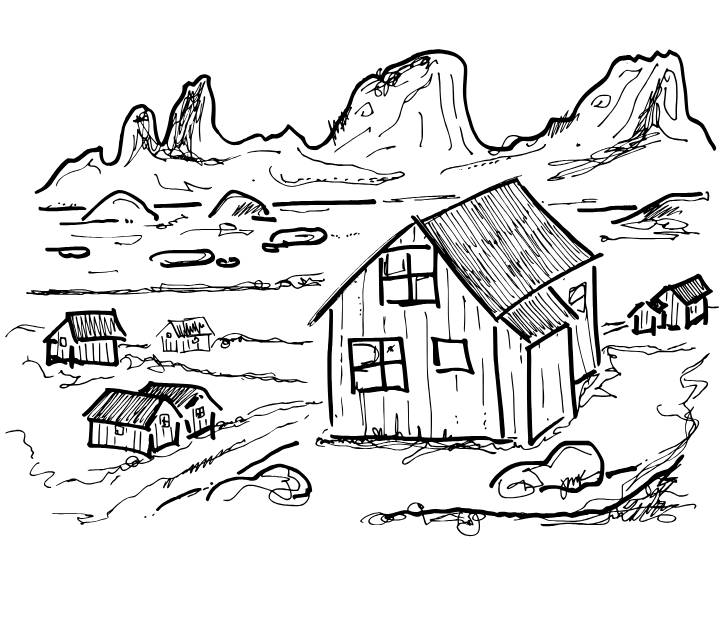
The news in 2026 is really stamping our etymological passports.
First Venezuela, then Minneapolis, now Greenland.
Well, again Greenland. I wrote about Greenland a year ago already when Trump started making noise about acquiring it.
The threat has proved insidious, for now the man has been flirting with, oh, you know, upending the world order by seizing it in one way or another.
And here I am, writing about word origins…
That and teaching. Yes, I’m a teacher again! I couldn’t be happier or prouder, especially at this time when education is under attack.
(I hope that, and my irresistible word facts, brighten your day in these darker times.)
Last fall, I heard the call back to the classroom—and heeded it.
My license renewed, I am currently a long-term substitute teaching grades 7–8 English at a Catholic school with a predominantly low-income and Hispanic population.
And since I have many students who didn’t grow up speaking English as a first language, all those cognates—those sweet, sweet cognates—come in handy.
Etymology is never in vain.
By the start of next school, I plan on being a high school English teacher, ideally helping underserved populations. Though I must say the junior high bug has bit me …
Soon, I hope to write up a more personal reflection on it, with the etymology of teach as a motif.
In the meantime, since the country name is newly, painfully, relevant, I am repackaging my writing on Greenland, which first appeared in a roundup.
And for good measure, I’m throwing in a section on the origins of Denmark, of which Kingdom Greenland is an autonomous territory.
Never miss a mash! Feed your inner word nerd and subscribe to get Mashed Radish fresh in your inbox.
Greenland etymology
Named “green” by Erik the Red to promote settlement
- Indeed a combination of green and land, based on the Old Icelandic Graenland
- Found in English by at least the 1600s
- According to the Saga of Erik the Red, Erik, exiled from Norway for murder, named the island Greenland around 985 to attract settlers there
- Greenlandic Inuit peoples, especially a group known as the Kalaallit, make up the vast majority of the Greenland population
- They call the country Kalaallit Nunaat, or “Land of the Greenlanders” in Greenlandic, an Inuit language
- Danish and Norwegian for Greenland is Grønland
- English green has cognates in other Germanic languages: German grün, Dutch groen, and others
As the Saga of Erik the Red tells it, Greenland was named as a sales pitch:
In the summer, Eirik went to live in the land which he had discovered, and which he called Greenland. “Because,” said he, “men will desire much the more to go there if the land has a good name.”
The same passage, in Icelandic:
Það sumar fór Eiríkur að byggja landið það er hann hafði fundið og hann kallaði Grænland því að hann kvað menn það mjög mundu fýsa þangað ef landið héti vel.
Of course, Erik didn’t discover Greenland. Indigenous populations long inhabited it—the world’s largest island that is, yes, mostly not green. Plus, a Norwegian settler of Iceland, Gunnbjörn Ulfsson, is credited with sighting it before Erik.
Denmark etymology
From Old Norse for “Danes territory”
Norse people ran small settlements on Greenland starting in 985 until about 1500, when they mysteriously disappeared.
But not for long, due to whaling and trading.
The Kingdom of Denmark-Norway colonized Greenland in the 1700s, with Denmark assuming control after the dissolution of that union.
Greenland’s colonial status ended in 1953, and it won home rule as a self-governing territory of Denmark in 1979.
The name Denmark ultimately traces back to two Proto-Germanic roots:
- Daniz
- marko
The Daniz referred to an ancient Northern Germanic tribe who became known as the Danes and settled areas which include modern-day Denmark.
That name, Daniz, might derive from a Germanic root related to the English den and meaning “flat area, low ground,” referring to the Danish tribe’s homeland.
The Romans called them Dani in Latin. The Vikings called them Danir in Old Norse. The Anglo-Saxons called them—and Norse invaders more broadly—the Dene.
Thanks to the influence of the Latin and Old Norse names, the English Dane eventually prevailed over Dene, although that form is still preserved in the spelling of Denmark.
The English Denmark directly comes down from the Old English Denemearc, literally “Dane territory.”
Mearc, source of the modern English mark, originally meant “boundary, limit” and is rooted in the Proto-Germanic *marko.
The sense of mark evolved from a boundary to an object marking a boundary to various things that leave various kinds of marks. French picked up mark as march, which passed into English as a term for the borderland of a country, as in the marches of Wales. The military march is probably not related.
The Old Norse equivalent to the Old English Denemearc is Danmǫrk. Along with “boundary” and “limit,” mǫrk also denoted a forest, which could delineate territories.
As for the Danish themselves, they call their country Danmark—and themselves danskeren. The singular is dansker, from dansk, an adjective equivalent to Danish.


 Mashed Radish
Leave a comment