
A schoolmaster combined Dakota and Greek words to propose an official name for the city in the 1850s.
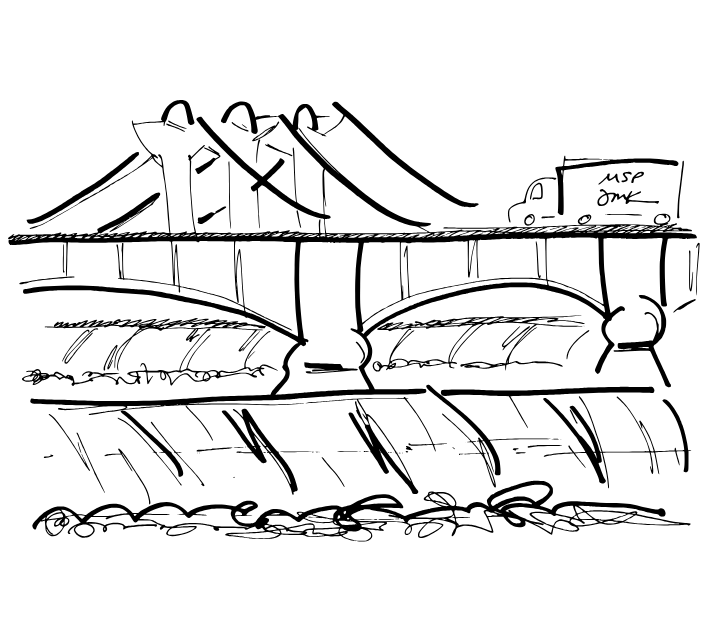
From Venezuela, the origin of whose name I explored in my last post, we travel to Minneapolis, a city being occupied—really, terrorized—by its own federal government.
Most starkly, a federal agent of the Immigration and Customs Enforcement, or ICE, murdered a woman, Renee Good, while she was legally observing immigrant-targeting operations.
I started Mashed Radish in Minneapolis. There, I lived not far from the Church of the Annunciation, ravaged by a mass shooting in August 2025.
If I had to move back to any place I’ve previously lived in, Minneapolis would be high on the list.
And all the higher now.
For I think its people, its protestors, are demonstrating the true meaning of democracy, the defense of which is now proving deadly in the US against the enemy in its very president.
It’s the “true meaning” of Minneapolis, in an etymological manner of speaking, that I make the subject of this post.
And in the origin of the name of a city benighted by the tear gas of federal law enforcement, we even encounter “smoke” and “police.”
Never miss a mash! Feed your inner word nerd and subscribe to get Mashed Radish fresh in your inbox.
Fast Mash
- Schoolmaster Charles Hoag proposed Minnehapolis in 1852 to offer an official name to the city
- He intended the h to be silent; it was later dropped
- Minneapolis ultimately blends the native Dakota Minnehaha (“waterfall”) and the Greek polis (“city”)
- The Dakota Minnehaha features mni (“water”), which forms the first part of the state name of Minnesota, literally “smoky water”
- The Greek polis referred to a “city-state” and more anciently, a “citadel” or other hilltop fortification
- Polis formed such words as metropolis and cosmopolitan; it is also the source of such words as police and political
- Polis also formed city names older and newer, from Constantinople in 330 to Indianapolis in 1821
The origin of the name Minneapolis
The name Minneapolis is credited to one, Charles Hoag.
The city’s first schoolmaster, Hoag proposed Minnehapolis in a letter to the editor of a local newspaper, the St. Anthony Express, in 1852 for an expanding town that still lacked an official name.
Intending the h to be silent, Hoag combined the English version of the native Dakota place name Minnehaha, meaning “waterfall,” and the Greek polis, meaning “city.”
The editor, George Bowman, thought Minneapolis an “excellent” and “euphonious” suggestion, as he put it. At some point, the silent h was dropped, yielding Minneapolis.
As recorded by Ernest Dudley Parsons in his 1913 The Story of Minneapolis, Hoag wrote Bowman:
… My purpose in writing this letter is to suggest a remedy for the anomalous condition we occupy of dwelling in the place selected by the constituted authorities of Hennepin County, as the county seat, which yet bears no name unless the miserable “All Saints” shall be considered so thrust upon us that the unanimous determination of the inhabitants cannot throw it off. It is a name that is applicable to no more than two persons in the vicinity of the falls and of doubtful application even to them.
Spicy! More on “All Saints” and “the falls” for that matter, in a minute.
Hoag continues:
The name I propose is Minneapolis—derived from Minnehaha, “laughing water,” the Greek affix “polis,” a city, meaning “laughing water city” or “city of the falls.” You perceive that I spell it with an “h” which is silent in the pronunciation.
This name has been favorably received by the inhabitants to whom it has been proposed, and unless a better can be suggested, it is hoped that this attempt to christen our place will not prove as abortive as those heretofore named. I am aware other names have been proposed such as Lowell, Brooklyn, Addiesville, etc., but until some one is decided upon we intend to call ourselves—Minnehapolis.
Hoag’s etymology is solid—except for the “laughing” part. So, to Minnehaha we now turn.
The Dakota Mníȟaȟa
Dakota is a language spoken by the Dakota people, indigenous to the Upper Mississippi River valley and surrounding Great Plains.
In Dakota, Minnehaha (Mniḣaḣa) combines mni, meaning “water,” and ḣaḣa, “cataract, fall.”
Mni is pronounced like, and is the source of, the first syllables of the state name of Minnesota, from the Dakota Mniṡota.
The word ṡota means “smoke.” Minnesota is literally “cloudy water”—or as the Dakota better translate their full Mniṡota Makoce, “the land where the water reflects the sky.”
Note: Dakota words have been transliterated into English in a variety of ways. In an effort at consistency, I’ve followed the spellings used by the Dakota Online Dictionary, a wonderful resource.
In Minneapolis, Minnehaha specifically refers to St. Anthony Falls, the only major natural waterfall on the Mississippi River and historically engineered to power milling in the villages growing up around it.
St. Anthony was the patron saint of Louis Hennepin, a Belgian Catholic priest who reached—and so named—the falls on a mission around 1680.
Hennepin himself is the namesake for many a place in Minnesota as well as in Illinois, Michigan, and New York, among elsewhere, due to the influence of his expeditions.
During the settlement of the area in the mid-1800s, St. Anthony also named a burgeoning city on the east bank of the Mississippi River down from St. Paul.
St. Paul, for its part, was christened by Lucien Galtier, a French Catholic priest and the first to serve as such in the state.
Residents of the future Minneapolis apparently nicknamed their town All Saints, as Hoag noted, to cheekily out-holy its hagiographic neighbors.
Minneapolis annexed most of St. Anthony in the 1870s.
The native Dakota name for Minneapolis is Bdeota Otuŋwe, literally, and fittingly, “Many Lakes City.”
Bde is “lake,” ota is “many,” and otuŋwe is “city, village, town.” The character ŋ in otuŋwe here nasalizes the preceding u.
Dakota is the source of many other names across the American plains as well as a structure that once dotted them: the iconic conical tent of the tepee.
Tepee is from the Dakota tipi, meaning “dwelling, house, building.”
The Greek polis
The Dakota word for “city” is otuŋwe, as we saw.
The Ancient Greek word for “city” was polis, or πόλις in its alphabet.
The Ancient Greek notion of the polis is complex, but we traditionally understand it as a “city-state.” Think Athens, Sparta, Thebes.
For polis, historical linguists propose a Proto-Indo-European root that meant “citadel,” or, more essentially, “fortified high ground.”
How apt, for polis helps form the word acropolis, a fortified hilltop part of a city-state—most famously, that of Athens.
To polis, acropolis (ἀκρόπολις) added the combining form of ἄκρος (akros), “highest, outermost.”
Acrobat, acrophobia, and even acronym (the initial letter being the “outermost”) also make use of acro– as a combining form.
Fun fact: Acronym is only first recorded in English in 1940, after the German Akronym, which is found by 1921.
Derivatives of polis including police and policy as well as politics and its kin.
Speaking of combining forms, polis itself has been productive, founding such words in Greek and its derivatives as:
- cosmopolis, “world city”; ultimately credited to a usage by the Cynic philosopher Diogenes that also yields cosmopolitan
- metropolis, “mother city”; referring to a capital city of a colony
- necropolis, “city of the dead”; originally denoting a large cemetery in a city, famously in Alexandria
The application of polis to name cities goes way back, too:
Polis forms the final syllable of Constantinople, “city of Constantine,” the name the emperor Constantine gave to Byzantium when he moved the Roman capital there in 330 CE.
Constantinople is now Istanbul. Polis also forms the final syllable of that name, too! Istanbul is a Turkish rendering of eis tḕn pólin, “into the city,” the Greek equivalent of “downtown.”
Tripoli, the capital of Libya, is literally “three cities,” from the Ancient Greek Trípolis. The city incorporated three settlements, and the Greeks had their turn at colonizing Ancient Libya.
The municipal onomastics of polis continued into modernity, such as Annapolis and Indianapolis.
Annapolis etymology
Annapolis is “Anne’s City”
Francis Nicholson, who served as a royal governor of Maryland as well as other British colonies, gave Annapolis its name in 1694 after, at the time, Princess Anne of Denmark. She later became Queen Anne of Great Britain.
Annapolis had previously been called Anne Arundel’s Towne, after Anne Arundell, wife of a baron who founded the Province of Maryland.
The Mary in Maryland was Henrietta Maria of France, queen to King Charles I, who granted the territory to Lord Baltimore.
Maryland prevailed over Lord Baltimore’s suggestion of Crescentia, Latin for “land of growth.”
Indianapolis etymology
Indianapolis is “Indiana City”
While serving as an Indiana state legislator, Jeremiah Sullivan, who went on to become a state supreme court justice, gets the credit for Indianapolis in 1821.
The city was nearly named Tecumseh, Suwarrow (a misrendering of the saguaro cactus), Concord, Delaware, Wayne, and Whetzel.
Indiana is effectively a Latin formation for “place of the Indians.” The state was formed out of the Indiana Territory, itself carved out of the Northwest Territory.
As early as 1765, Indiana had been used for a tract of land, as the Oxford English Dictionary notes, ceded by the Iroquois to a Philadelphia trading company.
This land later became part of Virginia.
And for good measure, in my state of Ohio, though Indianapolis is actually closer to Cincinnati…
Gallipolis etymology
Gallipolis is “City of the French”
Be sure to pronounce the name of this Southeast Ohio river town like the locals do: [ gal-ih-police ].
Settled in 1790 by some French people fleeing their revolution, Gallipolis features Galli-, which refers to Gaul or the Gauls, a Celtic people who inhabited what is now France.
***
Gaul is not related to gall, a word with old Germanic roots that only begins to characterize what Trump and his administration are perpetrating on Minneapolis.
That gall is “bile,” a bitter secretion of the liver. Bitter, indeed. We should all be at once sick to our stomachs and, in that emotion so long associated with bile, angry.
But we should be inspired, too, by the example of Minneapolitans to defend their rights, their community—and our constitution, our democracy.

 Mashed Radish
Leave a comment