
Nothing says Christmas Eve like … “shark”?
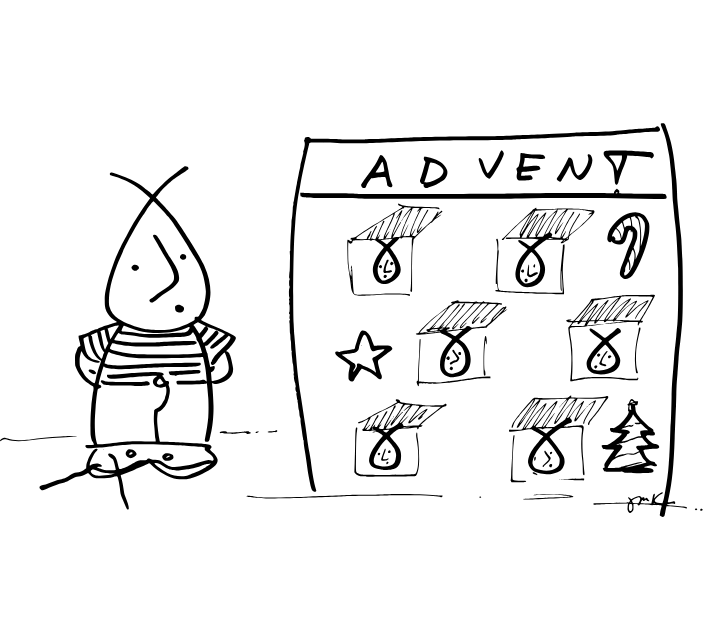
Christmas Eve marks the end of Advent. The first season of the Christian church year, Advent encompasses the four Sundays leading up to—and culminating in, of course—Christmas.
The word Advent derives from the Latin adventus, meaning “arrival” or “coming.” That is, the birth of Jesus—and, in the hopes of early Christians, his imminent Second Coming.
The Latin adventus is the past participle of advenīre, “to reach, arrive.” It combines ad- (“to”) and venīre (“come”). Its future participle, adventurus, “about to happen,” yields adventure.
Over the course of Advent, I have been offering etymological tidbits on the social media platform Bluesky in the form of an Advent calendar.
Or as I dubbed it, the Obscure Etymology Advent Calendar.
See, I think some of the greatest delights—as I wrote on Bluesky—in the business of etymology are words, particularly everyday words, whose origins we just don’t know.
So, I did an Advent calendar on this theme: words with origins that are obscure, uncertain, or otherwise unknown. That was the little treat, plain and simple, behind each door of a post on my calendar of a thread.
I am regifting them, all 25 of ‘em, in one big package here—just in time for Christmas. (It’s a Christmas miracle, I know you’re exclaiming.) You can also find the full thread here if you’re on Bluesky and not already following me there.
Of course, that’s not to say these words (which I culled from a much larger set of murky-rooted words) don’t have plenty of theories about their origins. That’s not also to say that there’s not plenty to say on their contextual background.
But sometimes, I think it’s a surprise enough to come across a common word and learn that, for all its familiarity, we, ultimately, just don’t know where it comes from.
Enjoy this reverse calendar by tucking each word back behind its door, if you will, closing it up again in obscurity.
Once you’ve polished off the last bonbon, keep reading for more on a brief history of advent calendars—and the word calendar itself.
The Obscure Etymology Advent Calendar
Secular Advent calendars often start on December 1, not strictly on the fourth Sunday before Christmas, which fell on November 30 this year. I thought an extra day—and word—would be both generous and observant. You’re welcome.
| Advent Day | Word | Origin |
| 25 (Dec. 24) | shark | Unknown |
| 24 (Dec. 23) | nugget | Unknown |
| 23 (Dec. 22) | boost | Unknown |
| 22 (Dec. 21) | hives | Unknown |
| 21 (Dec. 20) | peevish | We just don’t know |
| 20 (Dec. 19) | lorry | Unknown |
| 19 (Dec. 18) | moniker | Unknown |
| 18 (Dec. 17) | pink | Unknown |
| 17 (Dec. 16) | stubborn | Yep, we don’t know |
| 16 (Dec. 15) | saunter | Still don’t know |
| 15 (Dec. 14) | rowdy | Unknown |
| 14 (Dec. 13) | woo | Unknown |
| 13 (Dec. 12) | shack | Unknown |
| 12 (Dec. 11) | scoundrel | Unknown |
| 11 (Dec. 10) | quandary | It’s a quandary |
| 10 (Dec. 9) | girl | Don’t know! |
| 9 (Dec. 8) | askance | Unknown |
| 8 (Dec. 7) | nasty | Unknown |
| 7 (Dec. 6) | bald | Big unknown |
| 6 (Dec .5) | blight | Unknown |
| 5 (Dec. 4) | junk | ¯\_(ツ)_/¯ |
| 4 (Dec. 3) | pimple | Haven’t popped it |
| 3 (Dec. 2) | dollop | Unknown |
| 2 (Dec. 1) | squander | Unknown |
| 1 (Nov. 30) | dog | It’s a mystery! |
A fun-sized history of Advent calendars
Like the above words, the origin of Advent isn’t exactly clear, but early forms of its observance go back to the 300–500s. It originally involved fasting.
Other Advent traditions, including four-candled wreaths and calendars, took shape among German Lutherans in the 1800s, only spreading to the US in the 1900s.
Their English names are directly translated from German, and are attested in both tongues in the early 1900s:
- Advent wreath is from German Adventskranz (kranz, “wreath, ring”)
- Advent calendar is from the German Adventskalender
Tales are told that clever pastors or housewives crafted them to help children count down to Christmas Day—and parry the pestering impatience of “Is it Christmas yet? Is it Christmas yet?”
So, maybe these yuletide tallies originated to spare Herren and Frauen from calling out, “No!”
Never miss a mash! Feed your inner word nerd and subscribe to get Mashed Radish fresh in your inbox.
The etymology of calendar
Now, “calling out” is germane: it’s the origin of the word calendar. For the Ancient Romans, the first day of the month, proclaimed by priests when they observed the new moon, was known as the Kalendae.
Kalendae is related to the Latin calāre, “to call, proclaim, summon,” and has a literal sense of “that which is called out.”
Fun fact: Very few words in Latin—whose alphabet was modeled on that of Greek and Etruscan, itself based on Greek—were spelled with the letter K. K was originally used before the letter A, but C, used to represent both K and G sounds, ultimately made K redundant.
Kalendae, anglicized as Kalends or Calends, preserved it, likely due to the long history of the important day in this yet more ancient system of reckoning time around moons and agricultural cycles.
(The words moon and month are closely related, after all.)
The Kalends join the Ides, originally corresponding to full moons, and Nones, the ninth day before the Ides. Altogether, the days of the Roman month were reckoned back from them.
Perhaps it’s not so strange, then, for me to offer up a reverse Advent calendar!
The Kalends was also the day on which debts were due, giving it the nickname tristes Kalendae, or “gloomy Kalends.” (We feel you, Gaius. We feel you.)
And so Kalendae produced kalendārium, “account book, ledger,” whose K eventually ceded to C and supplied calendar—itself spelled with a K in its early days in English back going back to the late 1200s.
Speaking of “calling out,” I could keep doing so for more etymological tidbits than were lodged in the very matter, my Advent calendar, that launched me down this rabbit hole in the first place.
And by the time I finish, the advent candles will long have burnt out.
So let me, reader, perhaps now as impatient for this post to end as children awaiting Christmas morning, take a cue from the etymology of Kalends and proclaim:
I wish you a holiday season full of warmth and light—and not, like those origins in my Advent calendar, of obscurity, from the Latin for “dark” and “dim.”
Make sure to reach all the way to down the bottom of the stocking! The Mashed Radish archives have a parting present: the etymology of Christmas, which blends anointing oils and ceremonial dismissals.
 Mashed Radish
Leave a comment