
What begins as a Latin demonstrative pronoun becomes an expression of Frenchness.
For all that I write about French on Mashed Radish, my French is—comment dit-on—not very good.
Pas très bon?
I was fortunate to be back in Paris for the first time in some time earlier this month.
This time was the best time—because it was with my wife, and it was her first time in this impossibly beautiful city.
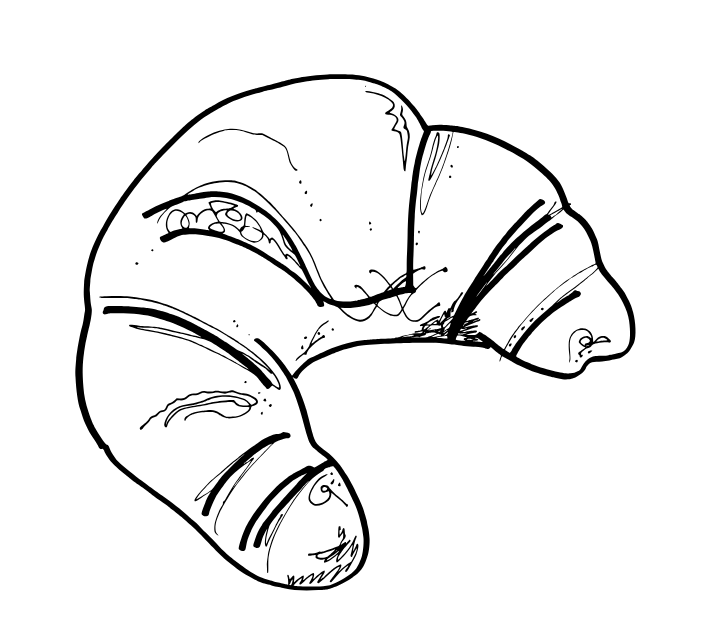
I loved getting to see Paris work its magic on her. And of course, all the Cézanne and croissants aux aumandes to my heart’s content.
She “loved” getting to see just how far my Francophone assays went until I surrendered, waving my white, monolingual flag, raised in clumsy articulation: Je suis désolé. Parlez-vous anglais?
Almost invariably, as a busy waiter patiently humored me, I would be met with one syllable I most certainly did know: oui.
When I’m in a place like Paris, I’m in multiple dimensions. One is that world before me. The other is how that world refers to itself—its wordscape, if you will.
If I’m salivating over a patisserie display, I’m at once eyeing macarons, madeleines, and mille-feuille—and inquiring about each of their etymological ingredients.
If I’m ambling down a boulevard or roving a rue, I’m marveling at what storied sights they divulge—and wondering where such words as boulevard and rue come from.

And when traveling, when sojourning in a different tongue, it’s not often the biggest or most unusual words that pique my interest.
It’s the taken-for-granted ones. The ones that make up the everyday stuff of the world. Like oui, that simple, indispensable syllable that we’ve rendered into a veritable cliché of Frenchness.
So much so that—and I love this fact—the word for France or French in Māori, the language of the native peoples of New Zealand, is Wīwī, from oui oui.
Never miss a mash! Feed your inner word nerd and subscribe to get Mashed Radish fresh in your inbox.
The etymology of oui
Recorded in French in the 1300s, oui is shortened from the Old French oïl, found in the 1000s.
The Old French oïl combines o and il, which developed in northern French dialect from the Latin hōc, “this (one),” and ille, “that (one).”
You will likely recognize hōc in such Latin expressions borrowed into English as ad hoc (“to this”) or post hoc (“after this”).
A mini-lesson on grammar? Yes, please!
Grammatically speaking, hōc (this) and ille (that) are demonstrative pronouns. They can also serve as demonstrative adjectives.
These pronouns point out—or demonstrate, as Latin would call it—the particular person or thing they are referring to:
This is a flying buttress. That is a mansard roof. I would like this croissant and that baguette, s’il vous plait.
In Latin, hōc is the third-person singular neuter form of this demonstrative pronoun. Its masculine counterpart is hīc; feminine, haec.
Ille is masculine, with illa feminine and illud neuter.
The masculine pronouns became the default. Because men.
In Latin, the phrase hoc ille functioned as an affirmative response to a question, the verb omitted: “This (is what) he did” or “This (is what) he said.”
Q: Did he do this?
A: He did this.
Q: Did he say this?
A: He said this.
Or, over time, yes. Yes, he did this. Yes, he said that.
Hōc ille. Oïl. Oui.
Unless you were in southern parts of France, where hōc became oc.
How saying yes divided a language
The evolution of the Latin hōc in the north and south of historic France marks an important linguistic division: langue d’oïl vs. langue d’oc.
That is, the language of oïl and the language of oc.
Northern parts of France spoke langue d’oïl, the form of medieval French that used oïl for “yes”—among other characteristics, of course. The southern parts spoke langue d’oc, which used oc.
Langue d’oïl became the basis for modern, standard French, in no small part because it was used in its powerful capital, Paris.
Langue d’oc—also known as Occitan, so named, yes, for that oc—became the basis of modern Provençal.
Famously employed by the medieval troubadours, Provençal is associated with the historic province (hence the name) of Provence in France’s Mediterranean southeast.
But why should you listen to me? My French is bad!
Listen to journalist-authors Jean-Benoît Nadeau and Julie Barlow, who offer a great (and pretty spot-on) summary in their popular, 2006 history of the language, The Story of French:
By the tenth century France was a patchwork of duchies, marches, counties and baronies (the estates of different orders of nobles) where a galaxy of vernaculars was spoken that mixed Latin, Frankish and other Germanic languages. By the fourteenth century, Romance dialects belonged to two broad categories. Those in which “yes” was pronounced oc—mostly south of the Loire River—were called langues d’oc (oc languages). Those in which speakers said oïl for “yes”—in the north—were called langues d’oïl, a term which came to be used interchangeably with Françoys. Oïl and oc are both derivatives of the Latin hoc (this, that), which at the time was used to say yes. In the south they simply chopped off the h. In the north, for some reason, hoc was reduced to a simple o, and qualifiers were added—o-je, o-nos, o-vos for “yes for me,” “yes for us” and “yes for you.” This was complicated, so speakers eventually settled for the neutral o-il, “yes for that.” The term was used in the dialects of Picardy, Normandy, Champagne and Orléans. Other important langues d’oïl were Angevin, Poitiers and Burgundy, which were considerably farther south of Paris. Scholars debate who created the designations langue d’oïl and langue d’oc. The poet Dante Alighieri, in his De vulgari eloquentia of 1304, was one of the first to introduce the term langue d’oc, opposing it to the langue d’oïl and langue de si (Romance from Italy). A fifth important langue d’oïl was Walloon, the dialect of the future Belgium.
As for si, that word for “yes” in French’s close Romance cousins of Italian (sÌ) and Spanish (sí)? It’s reduced from the Latin sīc, “thus,” “so,” or, in assent, “yes.”
English’s yes has its own story to tell, but I should save that for another day, non? Mais oui.
Aftermash
Well, I teased them, didn’t I?
Macaron
Ultimately from the same word that gives us macaroni, the Italian maccherone. The other cookie, macaroon, is itself from macaron, made from most of the same ingredients.
The origin of the Italian maccherone is obscure. Possibly from a Greek word for “barley-broth,” with further origins in words for “blessed” or “funeral chant,” maybe because the food was associated with solemn occasions.
Madeleine
Based on the given name, the French form of Magdalene, ultimately from Greek for “woman of Magdala,” an ancient Jewish city on the Sea of Galilee, from a Semitic root meaning “tower.”
Mille-feuille
Literally, “thousand leaves.” English cognates include million and foliage.
Boulevard
The French rendering of an older Germanic word equivalent to our bulwark, a fortification that is literally a work of boles, or tree trunks. Paris built its boulevards on top of old bulwarks.
Rue
From the Latin ruga, “fold, wrinkle, crease,” extended to a “path, street” furrowed into those medieval villages. The scientific adjective rugose is also so derived.
And lest I rue any exclusion of avenue, that’s French, too. It’s from its verb for “to reach, arrive” and related to such words as adventure.
There’s plenty of more French to be found on Mashed Radish. Nary an entry doesn’t reference the influential language in some way. With this talk of boulevards and bulwarks, though, I recommend “Storming the etymological bastille.”

 Mashed Radish
Leave a comment