A definitive—and delightful—handbook to the hard-to-define aphorism.
I’ve always wanted to be a “quote guy.”
The kind of person who can dispense a sagacious saying, a poetic passage, a meet maxim, an apt aphorism as the occasion demands. Sure, I have a literary line or two, but I’d say my storehouse is overstocked with platitudes.
I have a friend who can deliver tracts of verse when the situation inspires him. I have always admired this.
Another friend, back in high school, helped me memorize the final lines of novels I read for AP Literature ahead of the big exam.
“Old father, old artificer, stand me now and ever in good stead.” So ends James Joyce’s A Portrait of the Artist as a Young Man. Recalling it now, I mostly remembered that line correctly, though I never did deploy it in any of the essays for that test. Instead, I recall referencing Virgil’s invocation of Erato in Book 7 of the Aeneid. Don’t ask. If you did, I couldn’t tell you why. Nor could my graders.
When I read all of Shakespeare in 2016, I made a point to memorize Macbeth’s “Tomorrow, and tomorrow, and tomorrow” speech. I wanted to leave that project equipped with some ready recitation of the bard. Alas and alack, I committed all those lines not to the long term.
I accept now that I’m not a quote guy. My brain, for all the trivia it holds, doesn’t work that way.
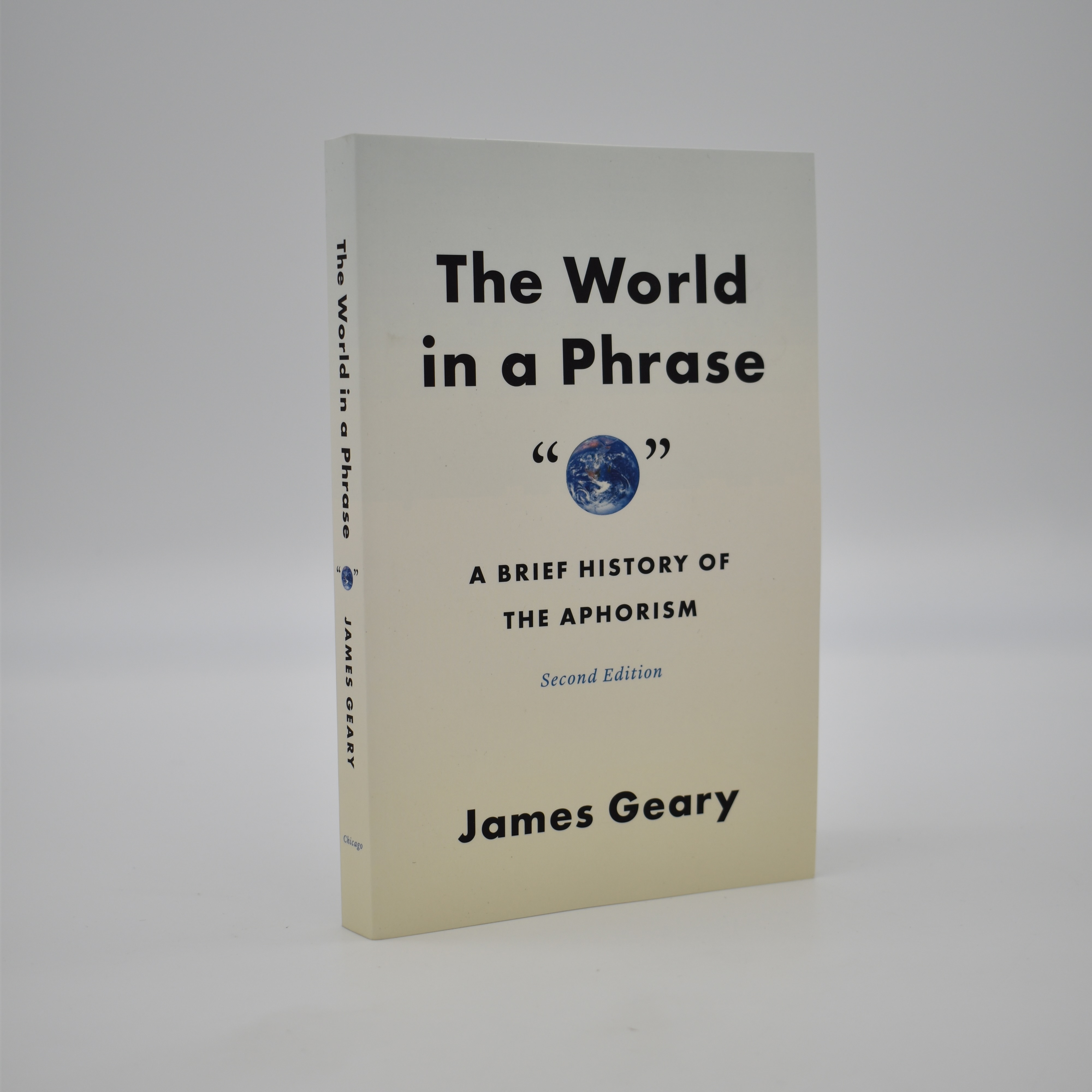
But I don’t need to have the apt aphorism available. Because I have James Geary and his delightful and insightful new book, The World in a Phrase: A Brief History of the Aphorism.
Expanded in a second edition 20 years after its original publication, The World in a Phrase is out on November 12 from the University of Chicago Press.
Never miss a mash! Feed your inner word nerd and subscribe to get Mashed Radish fresh in your inbox.
Geary, author and lecturer, styles himself an “aphorism addict.” Evidence bears this out, James, but we are all wiser for your habit. We meet this wisdom but a page into the preface of his updated vade mecum to this beguiling genre.
“The aphorism,” Geary writes, “is, in some ways, perfectly suited to the digital age: The oldest form of literature finds its ideal vehicle in the most modern short modes of communication.” The World in a Phrase indeed connects “current expressions of the aphorism with its ancient roots,” as Geary goes on.
Beginning with the balance-seeking precepts of ancient Chinese sage Lao-tzu and ending with the mixed-media messages of South African artist Lawrence Lemaoana, Geary’s tour from antiquity to modernity stops along the way in broadly chronological sections encompassing 64 aphorists—and scores more of their sayings.
He spans the Buddha (“Be lamps unto yourselves”) to Ambrose Bierce (“Misfortune, n. The kind of fortune that never misses”), Diogenes (“To own nothing is the beginning of happiness”) to David Byrne (“Adults think with their mouths open”), George Eliot (“There is no private life which has not been determined by a wider public life”) to Jenny Holzer (“Protect me from what I want”).
Aphorisms can make us stop in our tracks. “The difference between a rut and grave is the depth,” as Chicago Episcopalian bishop Gerald Burrill said, always has Geary stop in his to get fresh perspective.
So I should stop in my tracks here: what is an aphorism?
“Ironically for the world’s shortest form of literature,” Geary writes, “a compact definition of the aphorism is impossible.”
Instead, Geary provides five laws the aphorism must follow:
- It must be brief
- It must be definitive
- It must be personal
- It must have a twist
- It must be philosophical
Ironically, “definition” is at the root of aphorism, which comes from the Greek aphorismós, “definition,” ultimately combining apó (“from”) and hóros (“boundary”). Period is related, among other words.
An “aphorism is something that marks off or sets apart,” Geary explains. Geary had already hooked me, but when he served up this word origin, etymology addict that I am, he had my full attention.
Geary follows his own five laws in his brisk and punchy writing, which itself often sparkles with aphoristic wit equal to those he quotes. (“Aphorisms are literature’s hand luggage,” he observes. “Aphorisms are like particle accelerators for the mind.”)
He provides historical context and engaging explication for each era and aphorist. (“Aphorisms evolved during a time when books were exceedingly rare and literacy was limited to a scholarly elite. They thrived because they were accessible to everyone; their brevity, wit, and imagery all made them fun to remember and impossible to forget.”)
In some of my favorite parts of his book, he weaves in his own stories, including how his love affair with aphorisms literally changed his life—and in surprising ways. (“If not for an aphorism by W.H. Auden, I might have never met my wife.”)
And he draws deeper conclusions about what aphorisms qua aphorisms can reveal about our humanity. (“Aphorisms are fine, incisive sayings that in dark times and in light help us see the world more smartly.”)

I found myself reading The World in a Phrase in two ways: linearly and referentially. I enjoyed learning how the aphorism has evolved as a form, from the nirvana noodlers of Zen koans to interwoven intertextuality in Swahili kanga.
But I also enjoyed aphorism-hopping, skipping around on featured figures personally intriguing to me (the Gospel of Thomas treatment of Jesus was especially notable, and the inclusion of a favorite poet, Wallace Stevens, was a treat) as well as flipping around to alight randomly on examples, like the new-to-me Georg Christoph Lichtenberg and his luminous lines like “The fly that does not want to be swatted is safest if it sits on the fly-swat.”
And I found that Geary’s latest chapter, “We Kneel Before Heroes, Not Invaders: The Aphorism Today,” makes a persuasive case for the aphorism’s relevance now, not only in short-form social media content but also in politically pointed contemporary art. (Look up the work of artist Xu Bing. Beautiful. Original. Challenging.)
One such contemporary aphorist, South Korean poet Lee Seong-Bok, came up in an email exchange with the Geary:
Aphorisms are always popping into my head in relation to things that happen to me, things I’m thinking about, or just in relation to general stuff going on in the world. Nothing as dramatic recently as the anecdotes described in the book, but researching and writing the new book has brought me into contact with some great contemporary practitioners of the form. One is South Korean poet Lee Seong-bok, with whom I’ve become email friends. His aphorisms are about writing; this is one of my favs: “Think of what balconies would be like without railings. Only the railing keeps us from certain death. Writing is to get rid of this railing.”
I hadn’t heard of Lee before The World in a Phrase, and the book introduced me to many others and their phraseological worldviews. This highlights another great virtue of Geary’s second edition: novelty and variety alongside the tried-and-true titans, like Alexander Pope and Mark Twain.
What about our great “tomorrow”-er, William Shakespeare?
I asked Geary about him over email, too:
I do think Shakespeare is an aphorist! There are a lot of writers who were deliberate aphorists; i.e., they expressly wrote in the form. But the aphorisms of many great aphorists occur in other forms—essays, novels and, in Shakespeare’s case, poems and plays. I also compiled an anthology of aphorists, Geary’s Guide to the World’s Great Aphorists, and Shakespeare is in there. The plays and poems are rife with astounding aphorisms and, as you note, the final couplet in a sonnet is the perfect vehicle through which to deliver aphoristic insight.
Aphorisms like to be anthologized—and this, too, is part of their long, grand, and still growing tradition. Geary successfully continues this tradition in his new book. And what a service! Because I’m not a “quote guy.” I’ve got The World in a Phrase.
The World in a Phrase is published by the University of Chicago Press and available from a range of booksellers. The publisher sent me a copy for review.
 Mashed Radish
Leave a comment