I wrote about a wide variety of slang and trending terms for an impressive new section on Merriam-Webster.
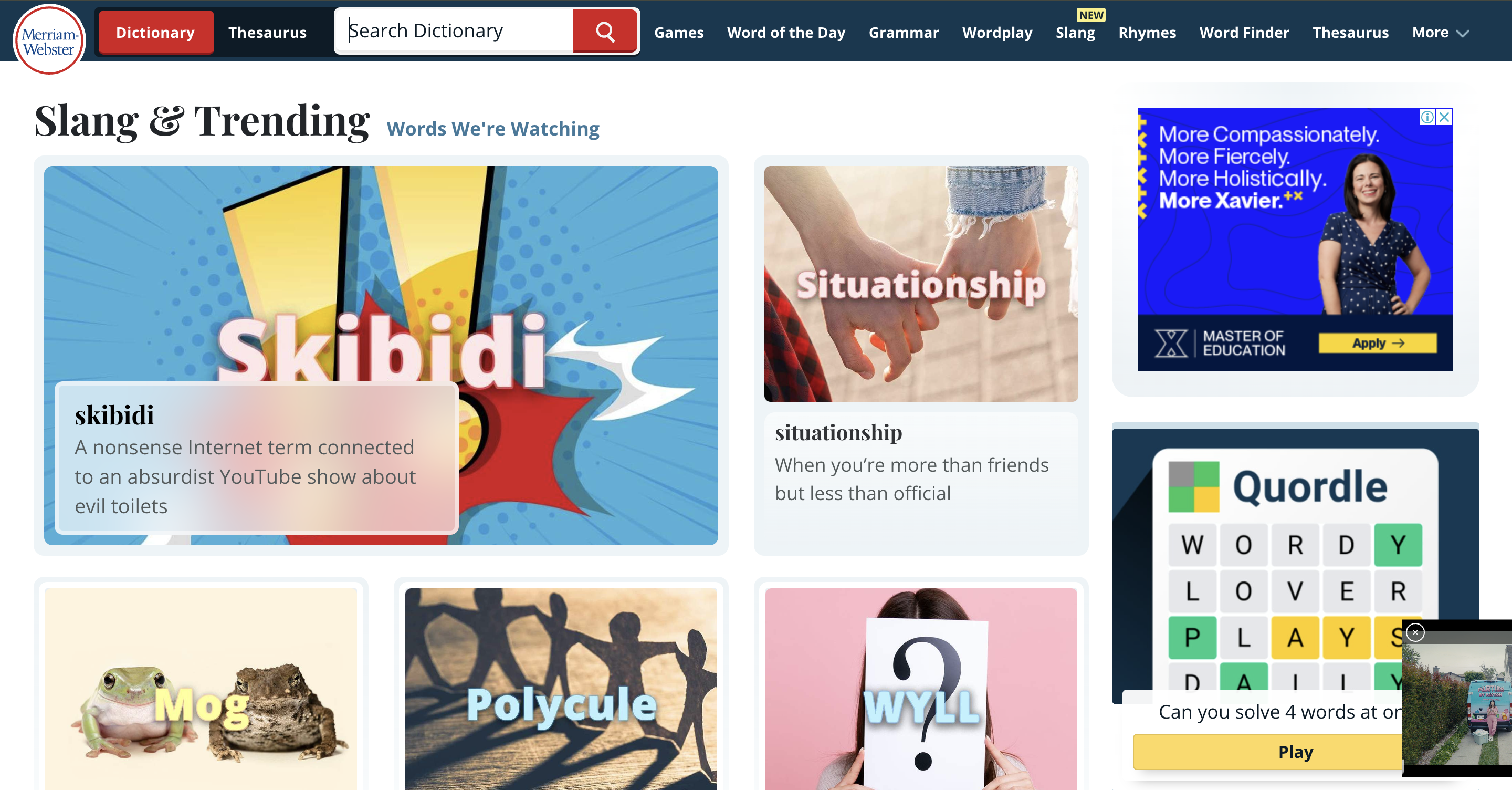
Sigma. Skibidi. Doge. Tradwife. Delulu. Brain rot. Looksmaxxing. Mog. Enshittification. Canon event. Manosphere. Even new senses of preppy and the buzzy agentic.
Lost on what these mean? Maybe you’ve come across them but still aren’t quite sure? Just generally—or perversely—curious to learn more about their context?
Well, Merriam-Webster has you covered. The dictionary just launched an amazing new slang and trending language vertical—and I am happy to share that I got to compose ‘em, save most acronyms.
👉👉 Check out the new section here! 👈👈
The new section combines the full rigor and thoroughness of lexicographical research, from origins and usage notes and citations, with accessible, what-you-need-to-know definitions.
Just want a quick snapshot of what they mean? Gotchu. Want more depth and context? Boom.
Give them a read. Explore the pages. Bookmark the section. Share.
A note on slang lexicography
Of course, many of the added terms aren’t new new. The activity of capturing slang and trending language is, by its nature, reactive.
That’s how this kind of language works. It spreads, as linguists might put it, from indexing membership in a subcultural in-group to the mainstream. Along the way, it undergoes a lot of change—often with the original users having long abandoned it even as many of us are just first learning about it.
But this work has also taken pains to be responsive, documenting these terms where they are at now, which are often in various forms of ironic reappropriation or semantic drift, while giving due credit to their (frequently minoritized) originators.
Never miss a mash! Feed your inner word nerd and subscribe to get Mashed Radish fresh in your inbox.
Some patterns in contemporary slang
Now, zooming out, I want to share some initial reflections on patterns I have observed in the set of terms I defined.
Younger male internet lingo
Young women drive a lot of language change. That remains very much the case. But there is an increasingly prominent vocabulary spreading from young male communities online, which we can more broadly call the manosphere.
This language, and the expansion of the manosphere, is complex—and concerning. Some terms originated in online movements connected to misogyny but were diluted over time, especially through ironic use that mocked the associated men and their extreme ideologies. Others began in male-centered groups and content that present various self-improvement tips and advice but that actually—and insidiously—promote models of toxic masculinity.
See looksmaxxing, mewing, mog, sigma, grindset.
The video game vector
Video game streaming—and its influencers—are an increasingly notable source and vector of slang and trending language.
See Fanum tax.
Kids are still being kids
So much of slang remains a way young people engage in wordplay and mess around with adults to have fun and develop senses of belonging.
See skibidi, sigma, bomboclat.
The eternal axis of cool vs. cringe
So much of slang is also a revolving door of ways to express what is considered good, authentic, and cool—and what’s not. And as ever, slang loves to express positive concepts by flipping pejoratives.
See delulu, ratchet, bet, no cap.
Style as identity
Social media may be accelerating vocabulary that captures (the performance and presentation of) identity, especially among young women and in terms of ever more specific lifestyle and fashion ‘aesthetics.’
See tradwife, cottagecore, preppy.
A narrative imperative
I am intrigued by what I see in popular language as a kind of “matrix of narratological metaphor” (I’ll workshop that). That is, we are expressing personal and social experiences by likening them to the elements of narrative. Or, more simply, “Life is story,” to invoke Lakoff and Johnson’s Metaphors We Live By.
The underlying concept here is far from new. Consider a theatrical precedent poetically encapsulated by Shakespeare’s “All the world’s a stage” speech and theoretically developed in various narrative theories in sociology and psychology.
But I am struck by this trend now, at this moment, at this time. Is it a self-aware reflection of our media consumption? Is it a growing parasocial identification with the media we consume? Is it a kind of broad and pervasive meta-narrative paradigm we are developing as creators of our own brands online? Perhaps it’s a combination of these forces. Perhaps it’s just that—a fun trend.
See canon event, main character energy.
And again, see my work on the exciting slang vertical over at the one and only Merriam-Webster online.
 Mashed Radish
Leave a comment