
There is a lot of noise about mystery drones buzzing overhead. It turns out there is a lot of noise buzzing behind the word “drone,” too.
The recent “drone panic”—a spate of sightings of drones, especially in New Jersey—has had many looking skyward at unidentified, unexplained, or just plain unfamiliar flying objects. (Sometimes the lights are stars!) The phenomenon has me, of course, looking word-ward: how did the word drone take flight?
Despite some efforts at more colorful explanations, drone, a remote-controlled pilotless aircraft, dates back to the 1930s as a US Navy code name originating as a clever homage to a plane the Royal Navy used for air force target practice: 1935’s DH.82B, nicknamed the Queen Bee.* (Ben Zimmer had the story back in 2013.) The name extended to the smaller, helicopter-like devices—the ones that are supposed to deliver our groceries one day—by the early 2000s.
Never miss a mash! Feed your inner word nerd and subscribe to get Mashed Radish fresh in your inbox.
The origin of drone, the bee
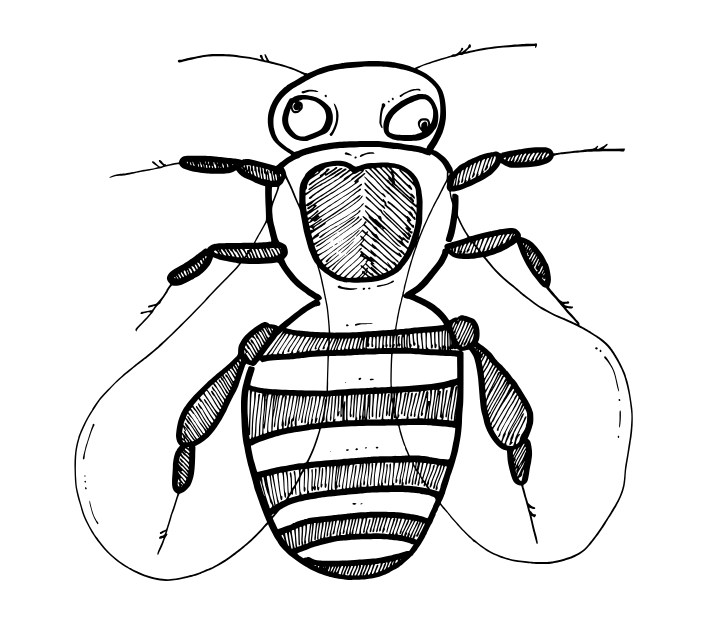
The original drone in English was a “male bee.” Male bees have one job in the hive: to mate with a new queen. They don’t sting. They don’t collect nectar or pollen. They don’t do any work. In fact, they rely on female worker bees even to eat. Drones mate. Then they die.
(There is a lesson here. There are several lessons here.)
From observations about the role of male bees arose the sense of drone as a “lazy person, freeloader.” The Oxford English Dictionary (OED) first cites this extended drone in the early 1500s in “Against the Scots,” an invective verse by the influential Tudor poet, John Skelton, commemorating an English rout of Scottish forces at the Battle of Flodden in 1513: “The rude rank Scots, like drunken dranes, / At English bows have fetched their banes.” A drone may not have a stinger, but Skelton certainly did!
Drone further evolved (by the late 1800s) as term for a person engaged in mindless, meaningless work.
Skelton, as you probably noted, uses drane—and that’s the form we should probably expect drone to take today. Drone develops from the Old English dran (and occasionally dræn). The OED attests it in the Antwerp-London Glossaries—an eleventh-century encyclopedic work considered the earliest school text in English—glossing the Latin fucus, meaning “drone,” along with some other senses associated with red or dark brown colors, including the cosmetic “rouge.” (A variety of the Italian honeybee can apparently skew to a leathery hue.)
This gloss of dran appears alongside beomoder, “bee mother”—a delightful Old English way of referring to what we now call the queen bee. Fun fact: queen bee, recorded in the early 1600s, is preceded in evidence by king bee, found in the 1560s. Queen bees were once thought to be male.
(There is a lesson here. There are several lessons here.)
By Middle English, a form of dran with an o emerged—which, due to various complexities of historical sound changes, presents something of a puzzle—resulting in the drone, not an expected drane, we use today.
The Old English dran is related to a number of historical Germanic forms that also produced its German cousin today: Drohne. Their deeper root is a Germanic base, hypothetically *drēn-, that probably imitates the low continuous humming sound a buzzing bee and other flying insects make.
Drone may have a yet larger etymological hive. The OED points out some similar words in other Indo-European languages (especially Balto-Slavic): Lithuanian tranas (“drone”), Russian truten′ (“drone”), and Ancient Greek ἀνθρήνη (anthréne, “wasp, hornet”), among others.
Speaking of boisterous airborne bugs, English once more generically referred to them as dor, although especially attributively, as in dor-bee, dor-beetle, and dor-fly. (The Dutch word for a drone bee, dar, is obviously related.) From Old English dora, dor even extended to people, somewhat akin to a metaphorical gadfly. Given their similarity in sense—and sound, with r sounds well known to slip around in the pronunciation of words—it would be surprising for there to be no relationship between the Old English dran and dora.
The origin of drone, the sound
“A low continuous humming sound”—don’t we have a word for that? Ah yes, drone. This sense of drone, both as a noun and verb, is attested by the early 1500s. Evidence for the noun comes slightly earlier than the verb. The noun originally referred to an instrument that produces a prominent drone and is associated with a most Scottish sound: the bagpipe. The history of drone just can’t get enough of Scotland.
(There is a lesson here. There are several lessons here.)
The origin of sonic drone doesn’t make a bee-line from the apian drone, but it almost certainly also originates in imitation of the sound. There are likely cousins in the Germanic languages. German has dröhnen, Swedish dröna, Danish drøne, Icelandic drynja—though all largely meaning “to boom, roar.” For its part, English once had a rare droun: “Hee drouned as a dragon, dredefull of noyes,” as intoned in Alisaunder, a Middle English romance about Alexander the Great. (I don’t think anyone needs a modern update for that Middle English passage. Try reading it aloud—I, for one, dip into a wee bit of a Scottish brogue.)
Aftermash
Bees, bagpipes, buzz, and boom—all this noise about drone suggests some common ulterior etymology, no?
Some historical linguists posit a speculative base *dher-, “to drone, murmur, buzz,” believed to yield drone as well the Greek θρῆνος (thrênos), “dirge, lament” and forming the first part of threnody (“song of lament”; the second part is from the same Greek root that gives us ode). Then there is the Sanskrit dhránati (“it sounds”), Old Irish drēcht (“song”), and that Germanic suite of “roar” words.
Perhaps there is that ancient account for our drone words grounded in some wider sound symbolism. But I think it is far likelier for the drone sightings over the Northeast to meet with satisfactory explanation. Sometimes words just appear, like unidentified etymological objects in our language.
And there is a lesson in that. There are several lessons in that.
*After-Aftermash
For its part, I think the nickname Queen Bee is one of referential riffing. Developed by the British de Havilland Aircraft Company, the plane was based on an insectan-monikered make known as the Tiger Moth, with a series of models designated as DH.82, DH.82A, DH.82B, DH.82C, and others. The Queen Bee is classed as the DH.82B (though some say that designation is mistaken). That B may have prompted a “Queen Bee” pun—which could have been added onto a possible allusive namesake. The Queen Bee was not quite the first remote-controlled aircraft, however. That distinction goes to a 1931 plane made by the Royal Aircraft Establishment and dubbed the Fairey Queen, which apparently inspired the de Havilland’s subsequent, more successful effort.



 Mashed Radish
Leave a comment