
A Red Sea port and green ground cover lie behind the name of a headline color.
We’ve been in the thick of “Word of the Year” season, when dictionaries issue their announcements—efforts I for several years led at Dictionary.com—for the word they think best captures the past year in life and language.
Etymologically, I’ve already weighed in on a few winning words. Collins Dictionary chose brat. My former Dictionary.com selected demure. Abroad, aura won the Langenscheidt German Youth Word of the Year.
I’ll be weighing in on more Words of the Year soon. Here, however, my attention first turns not quite to words—but to colors.
Pantone, which provides a standardized system of colors, recently revealed its look-ahead Color of the Year for 2025 as “Mocha Mousse,” an “evocative soft brown” it associates with tranquility and indulgence.

For observers, the choice was less evocative than provocative, with many people humorously associating its cocoa with kaka—which they felt, in its way, also summed up 2024.
I, for one, definitely think that the hue is definitely on trend, as much as Charlie XCX’s brat lime green dominated the summer and Wicked’s emerald green the fall. Plus, for me the name Mocha Mousse is—to use a rare word to complete my theme—invocative of some fascinating word origins. So, color me etymological.
The etymology of mocha
Today, a mocha is a latte flavored with chocolate. Mochas are delicious. And I never order them—because I can’t slow myself down enough to drink them like a respectable person should. They also make for a fascinating history lesson.
Mocha is named after Mocha, a port in Yemen on the Red Sea. The port was a commercial hub in the 1600–1700s, especially as a market for coffee, from which the bean and beverage spread abroad along the Ottoman Empire’s trade routes.
Mocha coffee had a reputation for being particularly fine and, apparently, as having strong chocolate flavors. The coffee arrived at port from inland Yemen, which is widely considered the first to cultivate coffee, probably from native plants acquired from across the Red Sea in Ethiopia, and brewing it into a drink I consume voluminously today—even using a coffee maker ultimately named for it, Moccamaster.
Solid documentation (emphasis on documentation) for coffee’s cultivation dates back to the 1400s. It surely has a much older past, replete a fun—though apocryphal—origin story.
Need to top off your “coffee” etymologies? Here are six more. Cream and sugar are off to the side. (I take mine black.)
A shot of Arabic
In Arabic, Mocha is written as المُخا, romanized as al-Mukhā. Al- is the Arabic definite article (“the”), frequently prefixing proper nouns like place-names. Arabic involves a beautifully intricate—and contextualized—script, written right to left. Out of context, the al- portion of المُخا is ال . The Mukhā portion—pronounced like moocha, with a ch as in the Scottish loch and an open, lengthened a at the end—is مُخا.
As for the deeper roots of the place-name al-Mukhā? That would require some separate sleuthing—and far more Semitic skills than I possess.
Evidence for mocha in English dates back to 1773. The Oxford English Dictionary (OED) cites it in a letter in the Encyclopedia Britannica referring to the Yemeni export. Evidence for its concoctions with chocolate occurs in an 1892 cake recipe.
Italians may have first mixed coffee and chocolate in the 1600s, although the modern-day drink appears to be a twentieth-century phenomenon. The OED cites café mocha in 1977 in The Washington Post.
Mocha, referring to the drink, has since been borrowed (back) into Arabic as موكا. Unlike the fricative phonology of its original place-name, موكا uses the same hard k sound in mocha—although its medial vowel is closer to our short u.
Never miss a mash! Feed your inner word nerd and subscribe to get Mashed Radish fresh in your inbox.
The etymology of mousse
Speaking of chocolate, most of the mousse I have encountered—in my mouth, not hair—has been flavored with it. Come to think of it, I’ve actually probably had more salmon mousse than chocolate. And I am sure I’ve gotten hair mousse in my mouth in one way or another over the years.
As you may have guessed based on how it is spelled and pronounced, further combined with knowledge of Western culinary and cosmetic cultural history, mousse is French.
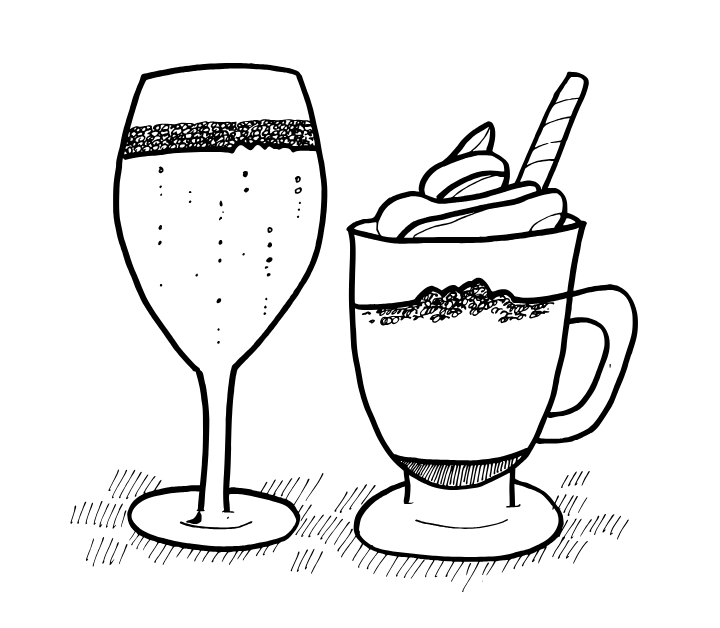
Now, the earliest use of mousse in English—and I did not know this until now—is for that “head” of bubbles that forms atop a glass of a different beverage: sparkling wine. (Perhaps we could extend that mousse to the froth of steamed milk cresting a chocolate mocha?)
This sense is recorded, according to the OED, in the 1860s, followed in the 1880s by its more prevalent meaning: a dish made with whipped cream and beaten egg whites, typically as flavored with chocolate, fish, or fruit. Mousse—as used for styling hair—appears in English by the 1980s, preceded by skincare applications in the 1970s.
And whence is the French mousse whisked? Well, it helps to know what it means, first of all, in French: “moss.” The way the plant propagates in clumpy coats apparently inspired its extensions to “foam; froth; whipped cream.”
Mousse likely grew on French via Frankish *mosa, the extinct West Germanic language my discussion of marshal acquainted us with last week. The English moss is, indeed, related—and in fact, words for “moss” have carpeted the Germanic languages as well as Latin (musca) and Russian (mox). That x in mox? Cyrillic alphabet; represents the same loch sound in al-Mukhā.
Early on in English, as with other Germanic languages, moss also meant “bog.” Its Old English form was mos.
A honey chaser
Older forms (that is, spellings) of mousse and other Romance languages may have been influenced by the Latin mulsa, a name for a different sweet treat: honey wine, mead. Latin dictionaries typically cite mulsa as a past participle form of the verb mulcēre, “to stroke, pet; soothe; delight,” the sense being the wine has been “sweetened” with honey. Etymologists connect mulsa, however, to mel, “honey.”
And when you take a good look at it, Pantone’s Mocha Mousse does have a drop of honey color in it, doesn’t it?


 Mashed Radish
Leave a comment