
One is from “Mars.” The other is from “horses.”
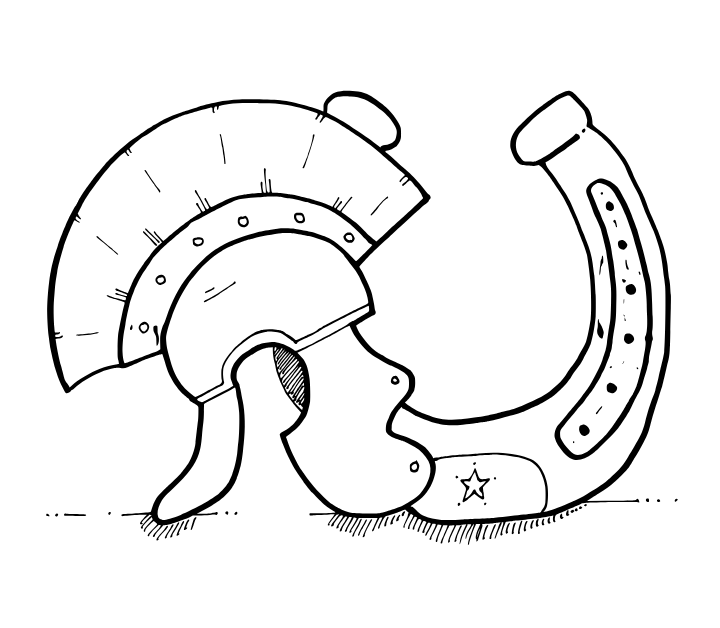
The word martial, meaning “relating to war,” most commonly precedes two words. The first is arts. The second is law.
Martial law refers to the government of a country by the military, involving the suspension of ordinary civil law to maintain order during war or unrest.
In dramatic events in South Korea this week, President Yoon Suk Yeol briefly imposed, out of frustration with his opposition, martial law (Korean 계엄, gyeeom) until the legislature overruled his edict.
Marshaling the facts on martial law
Historical uses of martial law—especially in distinction to common law—more generally concerned procedures authorities could take to depose rebels or invaders. Early on, martial law was also used to signify “military law,” or the law governing armed forces.
As recorded by the Oxford English Dictionary (OED), the earliest known evidence for martial law comes in a 1533 polemic, The Debellation of Salem and Bizance, by the influential English humanist, statesman, and utopia-coiner Thomas More:
… Yf the lawe were so that the iudges myght procede and put felons to answere without endyghtementes, as in treason is vsed in thys realme by the lawe marshall vppon warre rered …
Here’s the passage in present-day spelling:
… if the law were so that the judges might proceed and put felons to answer without indictments, as in treason is used in this realm, by the law martial, upon war reared …
So, first off, what’s a debellation?
A debellation is a somewhat obscure—and now obsolete—word meaning “conquest” or “subjugation.” The root is the Latin bellum, forming such words as antebellum, bellicose, belligerent, and rebellion.
Now, what is More even talking about?
In his Debellation, More, a Catholic, was writing in response to Christopher St. Germain, his Protestant rival and frequent disputant. Here, the two heatedly debated the power of ecclesiastical courts to arraign suspects without indictment and for their judges to decide the cases without juries—unlike in common law. While believing common law was in general superior, More defended the ecclesiastical procedures, comparing them to a sovereign’s power to use martial law—or lawe marshall, as he put it—to punish treason during war.
I call back to lawe marshall because there are two aspects of the phrase I want to call out:
- Spelling martial like marshal. This is no accident. As we’ll see later, marshal and martial not only became homophones (words pronounced the same but with different meanings) but also came to overlap in their contexts: military matters.
- Placing martial after law. An adjective that follows the noun it modifies is known as a postpositive. English generally places modifiers before the noun they describe. Not so in Romance languages, like French, where modifiers typically come after. As we’ve seen time and time again on this blog, French, via the Norman Conquest, had a prodigious effect on English, especially on the vocabulary associated with status and power—including government and law. Today, we see the particular impact of French adjective placement in some number of surviving set expressions, the classic example being attorney general. Law martial—a phrase that, interestingly, seems to have originated in English, not as a loan translation of French or Latin—would appear to meet the expectations of legal context in More’s day.
For more on the argument that the phrase martial law was formed in English, see the last paragraph starting on page 31 in the excerpt—which I linked above to credit my explanation of More’s use of martial law—by John Collins Martial Law and English Laws, c.1500–c.1700.
Never miss a mash! Feed your inner word nerd and subscribe to get Mashed Radish fresh in your inbox.
The etymology of martial
Meaning “relating to war,” martial marched in English as early as the late 1300s, recorded in Geoffrey Chaucer’s Troilus and Criseyde. Via French, martial ultimately derives from the Latin mārtiālis, “of Mars,” the Roman god of war, connected to Mārtius.
Mārtius is another adjective form for Mars, many of whose festivals were observed in March, which month is named for him then and now—as is the planet, whose distinctive red hue apparently evoked the bloodshed of battle.
A Mars sidebar
Second in command only to Jupiter, Mars was already identified with his Greek counterpart, Ares, in historical times, although he may have yet more anciently been a native Italic god of agriculture. The emperor Augustus—known, ironically, for marshaling in the period of Pax Romana, or “Roman Peace”—notably expanded the status of Mars in Roman religion.
The name Mars is contracted from Mavors. In the southern Italic language of Oscan, once spoken south of Rome, we find his name as Mamers. North of the Eternal City, where Etruscan formerly reigned, we find it as Maris.
In the Carmen Arvale, an ancient Roman hymn invoking divine protection for crops, Mars is even addressed in the reduplicated forms of Marmar and Marmor. The hymn survives in an inscription, which writing is a critical form of evidence in antiquity—including for those older forms of Mars and his possible origins as an agricultural deity.
The symbol for male, ♂, is connected to Mars. Find out how!
The etymology of marshal
Today, a marshal can refer to various, high-ranking officers in the military, law enforcement, fire protection, and some public events.
Way back, though, a marshal tended horses—a fact which is etymologically hiding in the very word itself.
English has been grooming marshal since, really, Middle English. The OED cites it in the form of merescald in some late Old English land deeds as “a very late borrowing.”
That borrowing is from the French mareschal, itself from—no, not Latin—but Frankish. Frankish was once a West Germanic language (as is English) spoken by the Franks, who occupied the area that is now their namesake, France.
The Frankish word for mareschal is based on a common Germanic compound equivalent to a word in an early form of German, Old High German: marahscalc. It combines:
- Marah, “horse,” related to mare
- Scalc, “servant”
So, a marshal is literally a “horse servant.”
Today, a mare is a female horse. It comes from the Old English mearh, cognate to that Old High German marah and originally referring to any horse. Related to mearh is the Old English mīre, specifically a female horse (and feminine derivative of mearh).
The Old English counterpart to scalc was scealc. This scealc evolved into shalk, a sometime literary term for “servant” that has since ridden off into the lexical sunset.
Palatalization cleanser
In Old English, the sc in scealc, was pronounced like sh. The very ancient Germanic roots of scealc would have been pronounced with a hard sk, but that sound underwent a common process known as palatalization—a kind of articulatory softening. This shift from sk to sh variously occurred across the Germanic languages.
Palatalization affects many other sounds, too, including the pronunciation of the -ti– in martial as a sh.
The prominence of horses in medieval culture, and especially in war, helped promote marshal, in English and on the European continent before it, from humble farrier to high-ranking military officer.
And so, through their similarity in sound and sense, written forms of martial and marshal have overlapped quite a bit historically—as evidenced in Thomas More’s lawe marshall.
For its part, the verb marshal—“to arrange, assemble, usher”—is attested by the late 1400s.
Aftermash
As I noted long ago in the introduction, the noun now most commonly collocated (habitually occurring or used together) with the adjective martial is arts.
Martial arts—specifically referring to sports, like judo or karate, originating in East Asian as disciplines of self-defense or attack—is recorded in the early 1900s. Instances of the phrase martial arts as such, used more generally to refer to warcraft or skills associated with the military or fighting, are found well and amply far earlier.
The precise term martial arts is a loan translation, also called a calque, of the Japanese bujutsu. The first part, bu, refers to “military, war.” The second, jutsu, means “art, skill, technique,” also found in jujitsu. Ju means “gentle,” and forms the first part of judo, “the gentle way.”
The Japanese word bujutsu is typically rendered in kanji—the Japanese system that uses characters adapted from Chinese, which profoundly influenced Japanese vocabulary and writing. And the kanji form of bujutsu is 武術, which corresponds to the Chinese wǔshù (武術), from which it, and the English wushu, derives.
For more on collocations, settle into my post on couch, which, etymologically speaking, means “collocated.”


 Mashed Radish
Leave a comment