
The word “longshoreman” unloaded a vowel along the course of its history.
They form an invisible world. Sewage systems piped below ground. Traffic signals timed across the roads. Cell phone towers mounting hills, spanning earth. Arrays of satellites bouncing innumerable messages from orbit. Highways of shipments launching and landing, landing and launching, up and down the shoreline.
This infrastructure , this logistics, makes our world work, and yet for most of us, most of the time, it’s out of sight. Out of mind. Until it’s not. Until, for what reason, it’s disrupted.
So, too, is its vocabulary, which forms an invisible lexicon. Its words can be familiar and yet, removed from so many of our daily experiences, strange. Their meanings instinctive, but precise senses ultimately elusive, evading our own definitions if pressed.
Like longshoreman. The term is newly prominent after unionized dockworkers—members of the International Longshoremen’s Association (ILA), the largest maritime workers union in the North America—went on strike across East and Gulf Coast ports this week over wages and automation.
Let’s unpack the etymology of longshoreman, this taken-for-granted term.
Never miss a mash! Feed your inner word nerd and subscribe to get Mashed Radish fresh in your inbox.
What is a longshoreman?
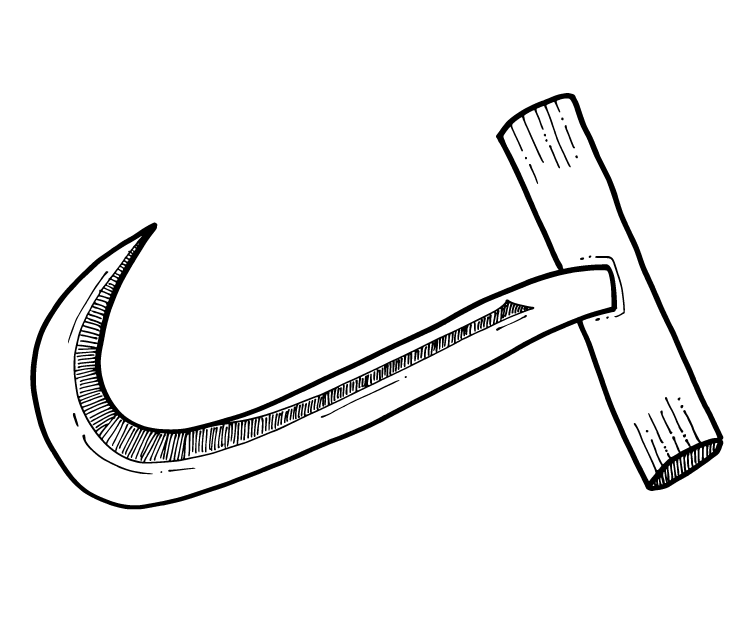
A longshoreman is someone who loads and unload ships at port. Today, they frequently operate, maintain, and repair the heavy equipment that helps handle the cargo. Welding skills are a must.
As not only men do these jobs, longshoremen are now commonly referred to using gender-neutral—and perhaps more direct—terms such as dockworkers, dock laborers, port workers, and others. The title longshoreman still has currency, however.

Man. That’s clear. Words for a person—and yes, historically a man—doing a particular job or activity have frequently ended in –man: boatman, clergyman, craftsman, fireman, huntsman, infantryman, postman, and so many more.
Shore. Got it. The core responsibility of longshoremen has been moving cargo on and off boats, which dock along the shore, where water meets land.
But long? For this, I have always…intuited longshoreman…but could never put my finger, er, tongue on it exactly. Is it because shores are long?
What is the origin of longshoreman?
In a way, I actually organically derived longshoreman in my preceding—and oh-so illustrative—explanation of shore when I used the construction along the shore, a prepositional phrase we commonly use in English when positioning something in relation to a shore.
Now, the crux of the etymology of longshoreman:
Longshoreman combines longshore and man. Longshore is an adjective that means “found along the shore.” It’s a variant of alongshore, from the phrase along (the) shore. A longshoreman, put simply, is a person employed to do work along the shore.
The more familiar word alongside was formed in the same way.
The initial a in alongshore fell away in a process called aphesis. This can happen to words that begin with unstressed sounds. I’ve mentioned it before. ‘Bout a handful of times. ‘Member?
The International Longshoremen’s Association, as well as its West Coast counterpart, the International Longshore and Warehouse Union (ILWU), relate similar, proud stories about the historical beginnings of longshoreman in the US. As the ILWU tells it:
In the old days of clipper ships, sailings were frequently unscheduled and labor was often recruited at the last minute by shoreside criers calling: “Men along the shore!”—giving rise to the term “longshoremen.” The work was brutal, conditions unsafe, employment irregular, and the pay too low to support a family.
This origin isn’t exactly accurate, as we’ve seen, but its sense—that available, work-seeking men along the shore, where water meets land and dockyards meet settlements, were hired ad hoc to help with shipments, much as portrayed in the movie On the Waterfront—is true. And I’m sure members of the ILA today no doubt agree about the conditions and pay.
When does longshoreman originate?
The Oxford English Dictionary (OED) first records longshoreman in 1792 in reference to an unnamed enslaved person. The term is more common in North American usage, with docker prevailing in British English.
The OED cites a more general use of longshoreman in a 1793 work, Medical Observations and Inquiries, by doctor and Declaration of Independence signer Benjamin Rush in an account of influenza that spread through Philadelphia in 1790–91. Note how Rush characterizes longshoreman as commercial jargon:
It was remarkable that persons who worked in the open air, such as sailors, and ‘long-shore-men, (to use a mercantile epithet) had it much worse than tradesmen who worked within doors.
Speaking of the Declaration of Independence, longshore dates back to at least 1776. The OED cites it in the journal of British sailor John Gore on Christmas Day that year, describing a kind of white bird in the Southern Ocean, as part of the voyages of James Cook.
Early uses of longshore in reference to people, especially in the 1800s, skew derogatory. Think of sordid associations with seafaring types or maritime men that survive today in expressions like swear like a sailor or curse like a stevedore.
Alongshore is found earlier, as a nautical term, in the 1680s.
Aftermash
The origin of stevedore
Along, shore, man: Each of these is lexical cargo containing some interesting and complex etymologies in their own right, but I will stow these away for another time.
And as soon as you start unpacking nautical terminology, you embark on an odyssey on the semantic high seas. But we can’t ship off without at least one more, overwritten pun—and giving a little more attention to stevedore.
Curious about more nautical words? Learn what anchor has to do with tug-of-war, why plumb means “lead,” and how fathom, knot, and league became units of measurement.
Historically, stevedore has been used interchangeably with longshoreman, but it typically specifies a worker who supervises or contracts longshoremen. Like longshoreman, it also appears to be North American. The OED records it in the form stowadore in a Massachusetts newspaper in 1788, with its next citation being from Noah Webster’s landmark 1828 American dictionary: “Stevedore, one whose occupation is to stow goods, packages, &c. in a ship’s hold.”
The word stevedore is apparently based on the Spanish estivador, “a cargo loader,” from the verb estivar, “to stow cargo.” The root is Latin’s stīpāre, “to cram, pack.” The somewhat obscure verb steeve—“to pack cargo,” especially wool or cotton, in a ship’s hall—is related.
The word cargo itself comes directly from the Spanish cargo, now primarily meaning (and related to) “charge” and historically “load, burden.”
How does a Spanish verb become a North American English job title? At the time we see evidence for stevedore in the late 18th century, the Spanish empire controlled or claimed a great deal of territory in North America, not to mention South.
Conquest, commerce, contact, exchange, the loading and unloading of goods and ideas between people—these are so often the pathways, so often lying just out of sight, that generate our vocabulary, known to us and yet still unfamiliar.



 Mashed Radish
Leave a comment