
Feudal Japan. Proprietary plastic. Counterfeit money. Latin verbs counterfeiting as English nouns. This roundup of words in the news features etymologies as assorted as a Tupperware set.

Happenings this week have served up a veritable smorgasbord of interesting words—with interesting histories. That calls for an etymological news roundup.
Some of them are indeed about history. One of them is literally interesting! I’ll share some of their lexical secrets. And don’t worry: there’s plenty of Tupperware for leftovers.
Enough with the puns—to the etymologies!
Never miss a mash! Feed your inner word nerd and subscribe to get Mashed Radish fresh in your inbox.
Shogun
Big title about a big title
The FX TV drama Shōgun won record-breakingly big at the 2024 Emmys, including the award for Outstanding Drama Series. The show is set during the dawn of the Edo or Tokugawa period in Japan, when the Tokugawa shogunate rose to power.
Shogun has been recorded in English since the early 1600s. It was borrowed into English directly from the Japanese shōgun, effectively equivalent to English’s “commander-in-chief.”
Shōguns were hereditary military commanders who ruled Japan until power was returned to emperors and feudalism was abolished in 1868 in a revolution called the Meiji Restoration.
The Japanese word shōgun ultimately derives from Chinese, from a root now taking the form jiāngjūn, “a general.” The Chinese jiāngjūn is composed of characters that literally mean “to lead the army.”
Shōgun is actually short for sei-i taishōgun, a fuller title that can be literally translated as “barbarian-conquering great general.”
Written in Japanese kanji, shōgun is 将軍. Its romanized version is shōgun, which the FX show—whose vast majority of dialogue is in Japanese—formally uses in its title. Sei-i taishōgun in kanji is 征夷大将軍.
Do you know what language skosh comes from? Find out!
Tupperware
Tupperware party, etymology-style
Tupperware is filing for bankruptcy, but its name still has a lot of currency. For so many of us, tupperware is the go-to, household word for plastic food storage containers.
Lexically, tupperware can be characterized in an assortment of ways:
- Proprietary eponym (a word based on or derived from a person’s name)
- Registered trademark
- Proper noun
- Compound noun
- An uncountable noun, typically
- Fighting against genericization, despite registration
Tupperware® is still technically a registered trademark, however, held by a subsidiary of Tupperware Brands.
Tupperware combines the last name from its inventor, Earl Silas Tupper, and ware, which is passed down from the Old English waru, meaning, pretty much then as now, “ware, merchandise.”
The word ware is often combined with the type of material it is made from. Silverware and glassware are familiar examples. Hardware and software follow this pattern.
Tupper started inventing his namesake while working at a plastics factory in the 1930s. As profiled in the September 8, 1947 edition of Time magazine, Tupper set up Tupperware Corp. in 1942, although he had earlier companies featuring his surname.
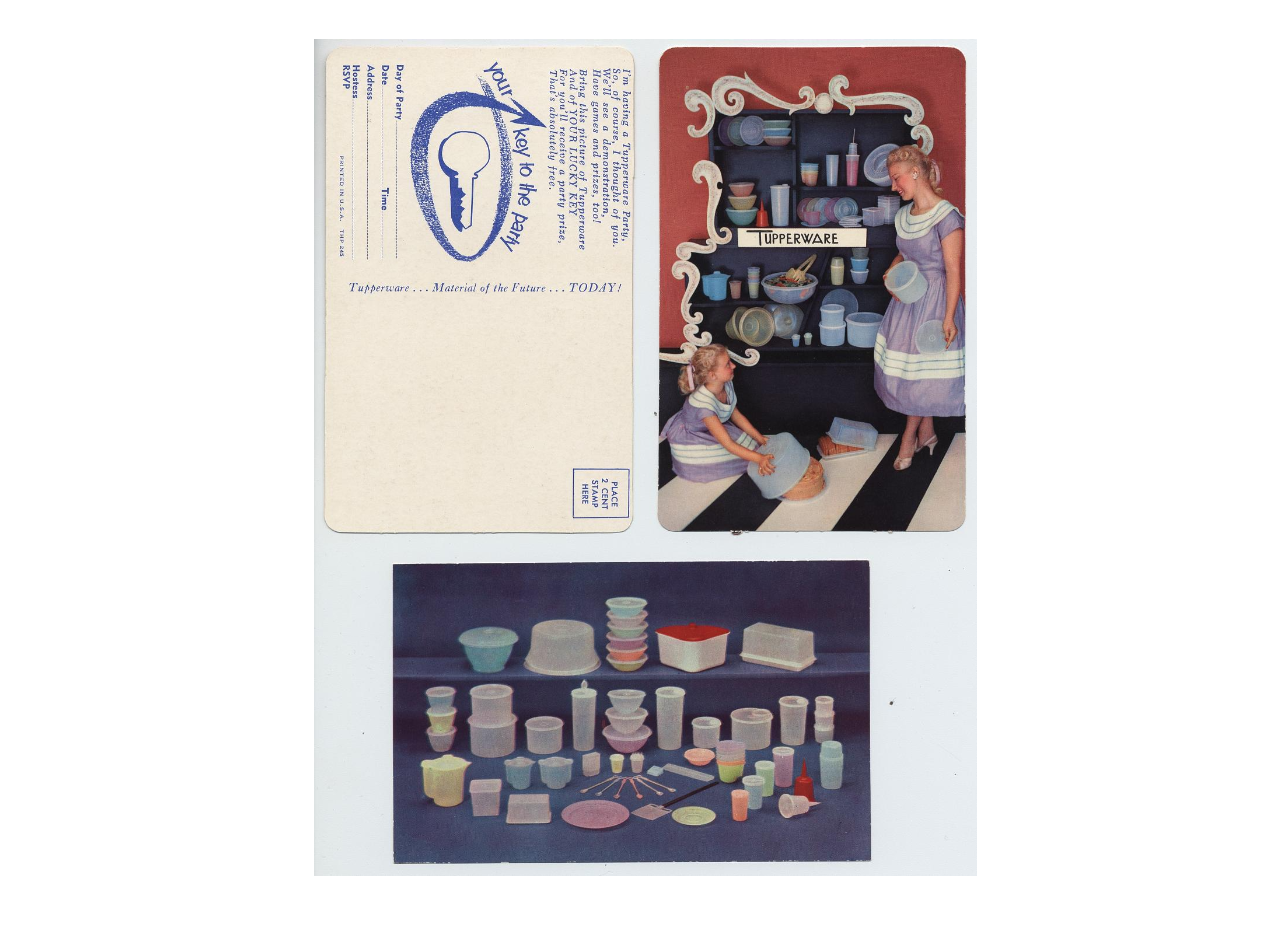
His now-iconic products—and museum pieces—didn’t debut until 1946. First filed in 1955, Tupperware was registered as a trademark in 1956.
As for the surname Tupper? Last names are complex and the ancestry of the Tupper family is unclear without deeper research—although going down this rabbit hole I got lost in the utterly fascinating Earl S. Tupper papers archived at the Smithsonian.
More effort is needed to, well, burp that seal. Plus, I don’t want to leave us with an etymological bowl without a verified lid to match.
OK, fine. I desperately want to find a connection from Tupper to Töpfer, a German occupational surname meaning “potter” for that sweet narrative line from ceramicware to plasticware.
Dive deep into the history of the durable word ware and the many, diverse compounds it’s formed in this archived post I did for Oxford Dictionaries.
Secret Service
It begins with counterfeit money
After a second assassination attempt on Donald Trump, the US Secret Service is under serious scrutiny.
Merriam-Webster finds record of secret service as early as 1706, used in its older sense of a “governmental service of a secret nature.” Historically, such services involved espionage, including notably in earlier secret services in US history.
The Secret Service, today a division of the Department of Homeland Security, is best known today for providing protection for the president and other top national leaders, past and present. Less well known is that it also conducts investigations against various financial crimes—just as it did when it originated.
As the Secret Service itself explains:
The United States Secret Service, one of the nation’s oldest federal investigative law enforcement agencies, was founded in 1865 as a branch of the U.S. Treasury Department. It was originally created to combat the counterfeiting of U.S. currency—a serious problem at the time. In fact, following the Civil War, it was estimated that one-third to one-half of the currency in circulation was counterfeit.
In 1901, following the assassination of President William McKinley in Buffalo, New York, the Secret Service was first tasked with its second mission: the protection of the president. Today, the Secret Service’s mission is two-fold: protection of the president, vice president and others; and investigations into crimes against the financial infrastructure of the United States.
In brief, secret derives from the Latin sēcrētus, “separate, isolated, secret,” among other meanings. It’s the past participle of the sēcernere, “to separate, distinguish, set aside.” Secretion is also derived from this verb; discern is related.
Service is ultimately from the Latin noun servus, “slave.” Conservation, observation, preserve, serve, and servant are all related.
Interest rate
A Latin verb hiding in plain sight
The Federal Reserve is set to cut interest rates for the first time in over four years. Technically, they are lowering what is called the effective federal funds rate, or EFFR for short—which sounds like the utterance I make not only when trying to wrap my head around these terms monetarily, but also etymologically.
The Oxford English Dictionary first cites interest rate in 1846.
According to the Oxford English Dictionary, the word interest has a two-part history, although each part ultimately derives from one, common root.
The first part is interess. Interess is a now-obsolete noun for a “legal claim or concern” as well as “loss, damage, profit, interest on money.” It dates back to the 1300s in English and comes from the French interesse, which had the same range of senses.
The French interesse is from the Latin verb interesse, literally “to be between.” Inter is “between,” esse “to be.” This verb was extended to mean “to differ, make a difference, be of concern or importance.” This verb was also used as a noun, yielding interess.
Now, the third-person present singular indicative form of interesse is interest. (Slow down there, grammar: think he/she/it runs for that mouthful of a name for that verb form.)
In Latin, interest means “it is of importance, it is of concern.” This also came to be used as a noun in Latin, French, and then English, applied to legal and financial matters—and in the areas of business and banking, interest eventually came to signify more specifically money owed or paid at a certain rate for borrowing money.
In the broad sense of “concern,” a word also applied to business in English, interest is evidenced since the 1400s. Its narrow monetary sense, the 1500s.
Rate is also Latin via French. The past participle of the verb rērī, “to think deem,” is ratus, “reckoned, calculated, fixed, settled.” It was used in expressions referring to “fixed amounts,” hence rate. Ratio and reason are related.
Interesting!



 Mashed Radish
Leave a comment