
What starts with geoengineering jargon ends with Ancient Greek musical instruments.
Along with over 67 million other Americans, I tuned into the first and likely only debate between Kamala Harris and Donald Trump this week.
Now, when I watch such a debate, I, incorrigible word nerd that I am, come equipped with a notebook and pen to capture any notable words the candidates used.
And oh, many notable words were used in this debate. Perhaps they had you exclaiming some…notable…words of your own.
They did to me: Frack! Not as in What in the frack?! I used the stronger word there. More on this frack in the Aftermash below.
I mean frack as in fracking, the highly controversial technique of extracting oil or gas by forcing a form of highly pressurized water into rock and breaking it up. Moderators asked Harris about her stated position on fracking, which has changed.
Now, on its surface, fracking may not seem like the most notable word, consequential as it is a practice. But its etymology, when we excavate it deeply enough, yields some surprises.
And in the case of the ultimate origin of the word fracking, its etymology, like the actual practice, also releases some gas—just in a very different form from where we started.
How we got the word fracking
The Oxford English Dictionary first records fracking in 1953, when it appeared as a novel term in a heading in the Oil & Gas Journal: “‘Fracking’—A New Exploratory Tool.’”
Through a series of shortenings and recombinations, fracking derives from the compound noun hydraulic fracturing. The first known evidence for hydraulic fracturing also comes from that same industry publication, Oil & Gas Journal, a few years earlier, in 1948:
The hydraulic fracturing process, ‘Hydrafrac’, shows distinct promise of increasing production rates from wells producing from any type of formation.
The actual process of fracking began, experimentally, just a year before in 1947 in Kansas. As I explained it earlier, hydraulic fracturing involves breaking up rock—fracturing—to extract oil or gas from it by forcing a form of highly pressurized water—hydraulic.
Notice this citation is already introducing this technical term, hydraulic fracturing, in terms of the industry’s own jargon: hydrafrac.
Hydrafrac clips each of the first parts of hydraulic and fracturing and joins them back together. This is a common word formation process in English, and was notably used in the technology and sciences of the mid-19th century.
For example, the word modem, which dates back to the 1950s, combines a clipped mo- of modulator and dem- of demodulator, so named because the device modulates and demodulates electrical signals between phones and computers. (Don’t ask me how this works.)
By at least the 1980s, we see hydrafrac—which as a verb and verbal noun was sometimes even spelled as hydrafraccing, with two c’s to indicate a hard sound— being regularly rendered in the form of hydrofrack.
This form, hydrofrack, better fits hydrafrac into expected conventions of English. Hydro- is modeled on that same, widely used prefix, meaning “water.” (More on that shortly.)
Spelling frac with a final -k makes pronunciation—and even meaning and origin—far more obvious and easier than hydrafracing, where in English we usually treat that c soft, like an s. Compare panic or frolic, which are spelled with a k in panicking and frolicking to indicate pronunciation.
The origin of fracture and hydraulic
So, frack is ultimately shortened from fracture.
Fracture—evidenced in English since the 1400s and specifically referring to, as it still widely does today, the breaking of a bone—comes into English from French and Latin before it.
Latin had fractūra, from fractus, literally “having been broken,” past participle of frangere, “to break, smash, shatter.” Fraction and fragile are two common words, among many others, also derived from frangere. And English’s own break is, essentially, the Germanic cousin to Latin’s frangere.
Now, hydraulic. You probably know that it concerns “water,” familiar as you likely are with hydrate, hydroelectric, hydrogen, and the flood of other words that derive from the Greek word for water ὕδωρ, hudōr, and its prolific combining form, hydro-. English’s water, too, is in its own distant way the Germanic counterpart to Greek’s hudōr.
But what about this -aulic part? It looks like mere lexical equipment, nuts and bolts tightened onto worse to hold them together. Functional, but taken for granted. And yet this is where, with some digging, we can find the surprises of etymology.
Via French and Latin, hydraulic ultimately comes from the Greek ὑδραυλικός (hudraulikós), an adjective that brings together, yes, the Greek for “water” (ὕδωρ, hudōr) with αὐλός (aulós), meaning “flute, tube, pipe.”
Flute. As in the wind instrument.
Etymological “pipe” lines
The -aulic part of hydraulic isn’t some suffix-y lexical equipment. It’s musical equipment.
The Ancient Greek instrument the aulos is now understood to have been less like a flute and more like an oboe, a reed instrument.
So, etymologically speaking, hydraulic is literally a “water pipe.” But in the ancient world, this “water pipe” wasn’t originally used to carry water. It was used to make music.
The Greek adjective hudraulikós was originally used in the term ὑδραυλικὸν ὄργανον, or hudraulikon organon—a hydraulic organ, or water organ.
Organ. As in the pipe organ. Like the kind you may associate with church.

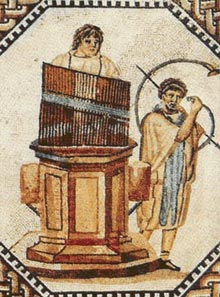
The water organ, also known as a hydraulis, was invented in the 3rd century BCE by Ctesibus of Alexandria, a Greek inventor and scientist who lived in that city of Egypt—and major center of the ancient Mediterranean world, once home to the famed lighthouse and library. Ctesibus, whose forte was fluids, also invented a water clock.
Put simply, the hydraulis uses water to maintain the pressure of air pushed the organ’s pipes to make music. (Also don’t ask me how to explain this.)
And that very hydraulis is considered the first known pipe organ.
The origin of a word can reveal a fascinating pipeline. Fracking is a word encountered as piped from the TV about water piped underground ultimately derived from roots about musical pipes. Put that in your water pipe and smoke it. (Couldn’t resist.)
Aftermash
Frack is a euphemism for the f-word. It’s a special kind, in fact, known as a minced oath, which substitutes a more polite word as a recognizable replacement for a profanity.
Doggone, fudge, heck, shoot—and for historical forms of blasphemy, words like golly, jeepers, and zounds—are other examples.
This sweary substitute, frack, originates in the sci-fi television series Battlestar Galactica. As lexicographer Jesse Sheidlower notes in his colorful compendium The F Word:
Spelled frack in the Original Series [1978], frak in the Reimagined Series [2003-2009], apparently because the producers wanted it literally to be a four-letter word.


 Mashed Radish
Leave a comment