
The origin of the word “coach” takes us on a (horse-drawn) journey. Learn more about the far-flung etymology of this word.
Whether you made a point to tune into—or out of—the 2024 Democratic National Convention, where Vice President Kamala Harris became the first woman of color in US history to receive a party’s nomination for president, you still likely learned a lot more about the Democratic ticket this week.
That includes Minnesota Governor, vice presidential nominee, and small-town native Tim Walz, who Democrats hail as “coach” for his time as a high school football coach while teaching school social studies.
For my part, incorrigible word nerd that I am, as I encounter appellations of “coach” or placards so addressing Walz, I can’t help but see a word—like that song by John Mellencamp so often a campaign anthem—born in a small town.
For the word coach has indeed come quite a long way. Allow me to be your etymology coach on the history and origin of the word coach.
From Hungary to hangars
Today, a coach is an instructor or trainer, especially in athletics (tennis coach) but also more generally (career coach).
A coach is also a comfortable bus used for longer distances, a railroad car—or that section of the airplane where we, the hoi polloi, vie for room for our bags, elbows, and feet, hopefully with a little space for our dignity left over.
It’s not a coincidence, these senses of coach. For, as different as they seem, they are fellow passengers on the same etymological journey.
Words, too, come from small towns.
Coach begins in Kocs, the name of a small town in Hungary—pronounced pretty similarly to coach—about 50 miles west of Budapest. That’s about an hour on a coach bus or an hour forty-five by rail coach.
In the late Middle Ages, Kocs became well-known for the high-quality horse-drawn carts and carriages it made. So well-known, in fact, that Kocs carts—or kocsi szekér, with kocsi being the adjective form of the place name Kocs and szekér meaning “cart, wagon”—spread both as vehicle and vocabulary for it. Fun fact: a place name is also called a toponym.
Evidence for kocsi naming such horse-drawn carts dates as far back as 1469, according to the Oxford English Dictionary (OED).
By the 1550s, coach had arrived into English—also originally naming a “horse-drawn carriage,” but especially one for riding in style. It passed through the French coche along the way. German has Kutsche and Spanish coche, as some examples of the lexical route of kocsi around Europe.
As transportation technology evolved, coach hitched a ride as a word for other passenger-bearing conveyances, used of first-class railway cars by the 1820s and plush motor buses by the 1900s.
By the 1950s, we have coach naming more economical commercial aircrafts, soon extended to that class of seating—and now often feeling like it’s lost all class.
From carriages to crammers
Coach took a metaphorical turn in the 1830s. Students at Oxford and Cambridge universities in England at that time applied coach to the private tutors they hired to help them study, to cram, for exams. These tutors, so the metaphor goes, acted like vehicles that would successfully convey or carry pupils to their academic destinations.
This figurative coach soon spread to name athletic trainers, then trainers or instructors in various other areas of life.
The verb use of coach, “to train or instruct,”develops at the same time in English university slang, first meaning “to give additional or private instruction.” Much earlier, coach was used as a verb in its original vehicular contexts, especially “to transport someone in a horse-drawn carriage.”
From the word to Woodruff
Calling someone a coach as a title or form of address before their name—like, say, “Coach Walz”—dates back to at least to the 1890s, according to the OED.
The OED cites a headline in the December 2, 1895 edition of the New York Times: “Coach Woodruff Tells of Pennsylvania’s Team.” Coach Woodruff—or George Washington Woodruff, then a law school student at the University of Pennsylvania—led his Quakers over Cornell for an undefeated season.
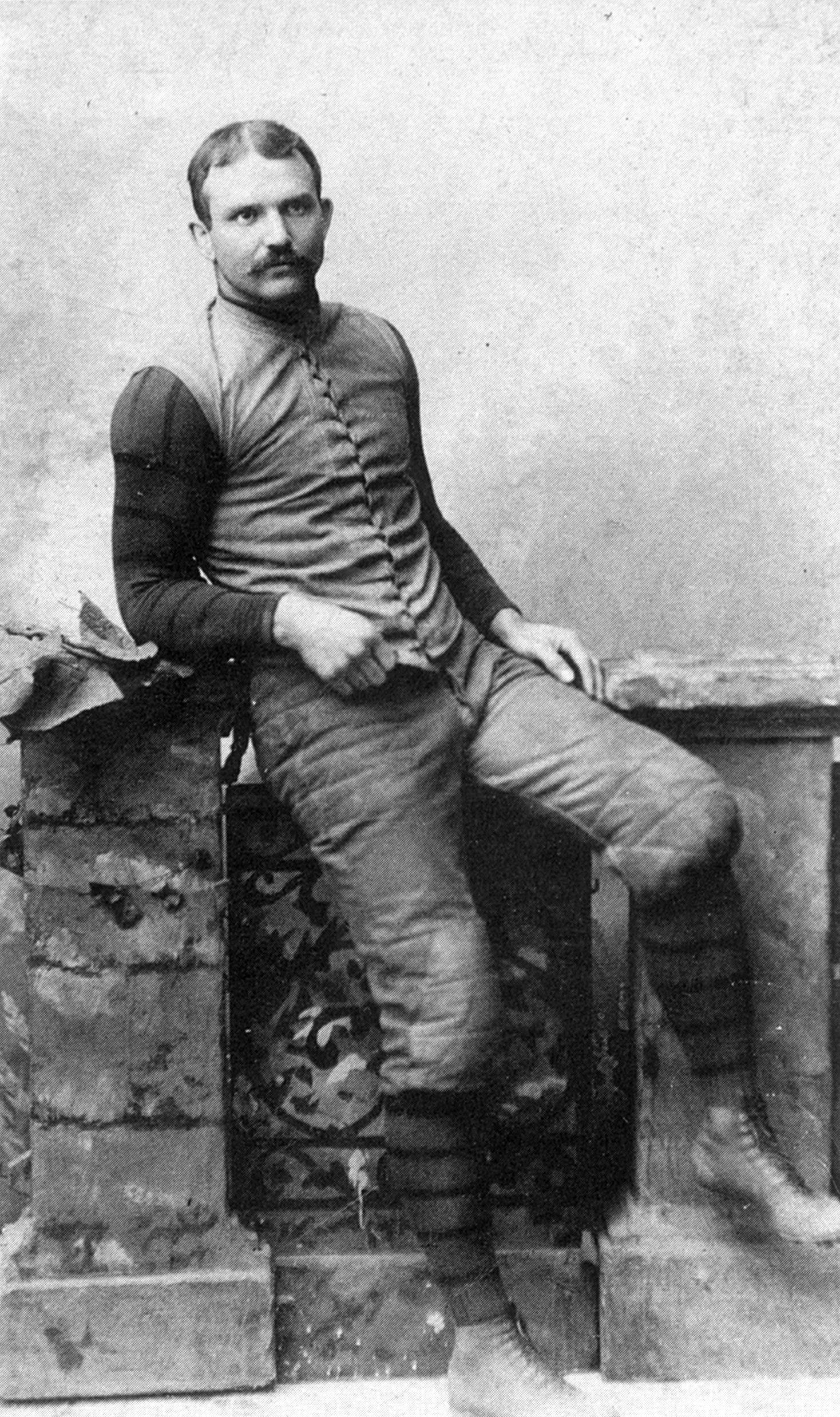
Explaining his success after the game, Woodruff said: “I do not consider it so important to have players as to have a system in playing, no matter how simple, on which to work.”
Woodruff goes on to describe the innovativeness of what we would now call a gameplan, the journalist reporting how—like a good coach, despite how he lowered expectations of success on starpower—he “spoke highly of the way in which the men carried out the work planned for them.”
Also in that post-game interview, Woodruff—who hailed from a small town in northeastern Pennsylvania—was clear to give credit to his captain, Carl S. Williams. And the Times explained that Williams may not have been able to return to the field next season, as he might be too busy with medical school. Williams did not, indeed, play following year.
Woodruff did return, where he coached the Penn squad until 1901, before going on to a career in Republican politics, rising all the way up to acting Secretary of the Interior under Teddy Roosevelt.
For his part, Williams, himself from a small town in northeastern Ohio, earned his medical degree from Penn—and went on to coach the Quakers starting the very year after his old mentor stepped down. Williams was also an ophthalmologist and served in the military.
In the American story, we, all of us, share in celebrating how people from small towns can go to do such big things.
In the story of English, words, too, in their own way, like coach, can come from small towns, traveling afar to the unlikeliest of destinations.
Want some further, relevant word rabbit-holing? Check out weird, waltz, and history for more.


 Mashed Radish
Leave a comment